Monday, 26 January 2015

Covers Without a Cause: SF Cover Illustrations

To complement the surreal selection of 70s SF album covers from earlier this month, I decided to post on SF book covers... with a twist. The titles I’ve chosen are ones where the subject depicted on the front of the book has little, if any, resemblance to the story of the novel. It’s a problem that’s plagued pulp fiction generally but particularly SF; the mass production of cheap books from the 1940s onwards demanded a high turnover of titles, with publishers’ in-house artists usually working to a brief following the established formula of spaceships and aliens. However, the passage of time has given some of these books a certain charm, or at least enough entertainment value to raise a smile.

The three covers featured here are a somewhat piecemeal selection, and the tip of the iceberg in terms of the SF genre but a good starting point that will perhaps spawn a sequel post. Here goes...


1. Dagon and Other Macabre Tales by H.P. Lovecraft. Highly influential in the SF, fantasy and horror genres, the stories of Lovecraft offer plenty of terrifying visual fodder, or so you might think. The cover design for this Mass Market Paperback edition (1985) of his collected short stories shows an odd, brown scaly creature (not, to my memory, resembling anything in the stories) sitting on top of an unconvincing pile of disembodied heads. Maybe the artist assumed the title was a typo, since the creature’s appearance is definitely more dragon than Dagon.


2. The Hospital Ship by Martin Bax. The first (and only?) novel by the writer and consultant paediatrician, Bax’s experience as a doctor informs this tale of post-apocalyptic societal collapse. The hospital ship of the title sails around picking up casualties of recent wars, a futile undertaking that does little to mitigate the impending global disaster. Clearly, it’s a gloomy theme, and one that could use some help exciting a reader’s attention. So it’s the old sex sells cliché that kicks in for the Pan Books edition (Picador imprint, 1977). Even allowing for the tenuous link to the practice of ‘love therapy’ in the novel, the cover (and the covergirl) are pretty wide of the mark. And if you bought the book for the cover alone, you were bound to be disappointed with the contents.


3. The Caltraps of Time by David I. Masson. The writer and former Curator of the Brotherton Collection (University of Leeds) was the subject of a former post, in which you can read more about his life and this, his only published collection of short stories. Suffice to say, these tales of curious features of language and temporality are not well served by the book cover in this New English Library edition (1976). It is, of course, a classic case of ‘safe SF design’ (when in doubt, draw a spaceship). I’m sure it saved many a tortured conversation about how to visually represent time, phonology or linguistics but it doesn’t do justice to the original and inventive themes in the stories.

Wednesday, 14 January 2015

Science Fiction-Music Interconnections: 1970s Spaced-out Album Covers

A Journey through Space and Time in 10 Cosmic Album Covers of the 1970s.

A personal, but by no means exhaustive, selection – in chronological order:


From Germany, Tangerine Dream - Alpha Centauri (71)

From Germany, Tangerine Dream - Zeit (72)


From the UK, Pink Floyd - Dark Side of the Moon (73)


From Germany, Can - Soon over Babaluma (74)


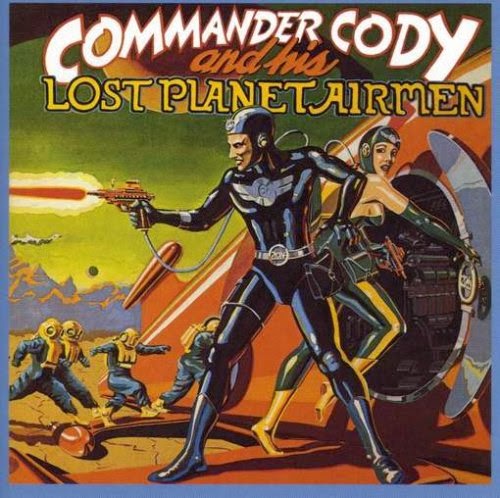
From the US, Commander Cody and His Lost Planet Airmen (75)


From Japan, Far East Family Band - Parallel World (76)
 

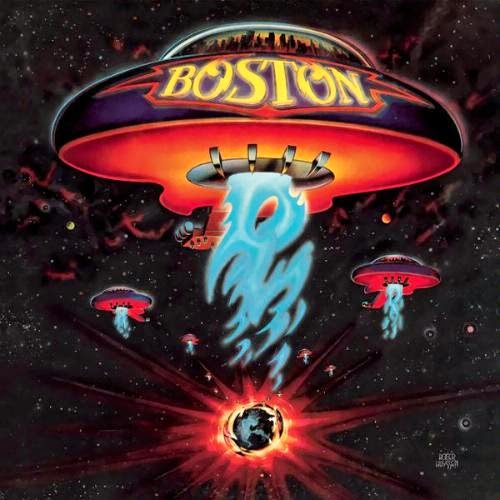
From the US, Boston [first album] (76)
 

From Canada, Rush - 2112 (76)
 

From the UK, E.L.O. - Out of the Blue (77)
 

From France, Jean-Luc Ponty - Cosmic Messenger (78)

Monday, 29 December 2014

Do Communists Dream of Electric Shepherds?

In spite of much sci-fi being inspired by leftist politics, the influence is not obviously mutual. The utopian visions of the future so common among 19th century socialists have been rolled back by successive generations of dour ‘scientific’ pragmatists who have accommodated the dreams for the future to the demands of the moment. Today, with the far left generally unable to influence the tenor of political life and a technologically driven ecological disaster beckoning, it is perhaps unsurprising that faith in the future and of human beings’ capacity to use technology for the benefit of all is at a low point.

Rallying against this state of affairs, and following on from the accelerationist manifesto, lefty ‘media platform’ Novara Media has begun to take seriously the question of what the future might look like. So far, the group’s weekly video slot, IMOBastani, has proffered two dystopian visions of how capital might reproduce itself in the future (clue: it’d be bad) and one socialistic alternative predicated on the use of automation to largely eliminate the need for alienated labour. This has inspired a self-consciously sci-fi response, reflecting on the post-capitalist universe depicted in Star Trek. As far as I can see, no critique of the Novara perspective from a curmudgeonly ultra-left yet loveably tweedy medievalist perspective has emerged in the month or so since these pieces were published, so here’s one from 1889. In sci-fi, socialism, as in life: nothing changes and nothing stays the same.

Thursday, 11 December 2014

The Twilight Zone and Rod Serling

“You’re travelling through another dimension – a dimension not only of sight and sound but of mind. A journey into a wondrous land whose boundaries are that of imagination. Your next stop: the Twilight Zone!”

Late 1950s/early 1960s American television broadcasting remains associated with the celebration of traditional values and the provision of wholesome family entertainment – nothing too daring or threatening which might offend commercial or Establishment interests. Rod Serling, a successful script-writer for radio and television plays, had become frustrated by over-bearing network control and the demands of sponsors, and was in search of his own project. As creator of The Twilight Zone, which initially ran from 1959 to 1964, he achieved that ambition. Within the constraints of the time – and in appearance, he conformed to the clean-cut image of his era – Serling crafted a truly pioneering series of half-hour stand-alone episodes, ranging freely across science fiction and fantasy themes. Many episodes were written or adapted by Serling himself, but he was also able to utilise the talents of authors Charles Beaumont and Richard Matheson, who constituted an informal writing team, later supplemented by George Clayton Johnson. They were able to draw on a wealth of as yet unfilmed science fiction material – notably short stories – for the scripts; among the well-established authors to make a one-off contribution was Ray Bradbury (‘I sing the body electric’). The show also featured many young actors in the formative stages of their careers who went on to greater fame, including Dennis Hopper, Donald Pleasance, Robert Redford and Burt Reynolds, in addition to both Leonard Nimoy and William Shatner, pre-Star Trek.


By Serling’s own admission, the quality of episodes was variable – some betray the limitations of a demanding shooting schedule, the expectations of a mainstream audience and technical restrictions which are apparent in the effects and often in the sets, but at its best it transcended those constraints. There was considerable ingenuity and originality in episodes such as ‘Five characters in search of an exit’, whose protagonists know neither where, nor who, they are. Not only did this episode echo Luigi Pirandello’s 1921 play, Six characters in search of an author, it also prefigured the plot of the 1997 film Cube. Investigations on the nature of reality were a frequent topic, memorably tackled in ‘A World of Difference’, whose central character finds he is living in a script – or else the script has become his life. ‘Person or persons unknown’ has parallels with Philip K. Dick’s later novel, Flow my tears, the policeman said, in its depiction of an alternate reality where the central character awakes in familiar surroundings, only to find that no-one recognises him. The Twilight Zone reflects Serling’s personal belief in science fiction as a vehicle to explore contemporary issues, with recurring representations of Cold War anxieties and meditations on the widespread fear of imminent nuclear attack and the aftermath of disaster, in episodes such as ‘Time enough at last’ and ‘The shelter’. As an avowed liberal, Serling used other episodes to promote civil rights and attack the lingering anti-Communist paranoia in the wake of Senator McCarthy’s ‘witch-hunt’ and the hearings of the House Committee on Un-American Activities, which led directly to the blacklisting and exile from Hollywood of actors, directors and writers, for their supposed support for the Soviet Union and Communism.

The series’ distinctive title music was initially provided by Bernard Herrmann, a composer who had scored Orson Welles’s acclaimed Citizen Kane as well as being a regular collaborator with director Alfred Hitchcock (North by Northwest, Psycho, Vertigo). Herrmann was already familiar with science fiction themes (The Day the Earth Stood Still, Journey to the Center of the Earth), and later provided soundtracks for several of Ray Harryhausen’s films (including Jason and the Argonauts, The Three Worlds of Gulliver, and The Seventh Voyage of Sinbad). In his article, ‘Music in the Twilight Zone’, James Wierzbicki states that Herrmann’s atmospheric music “played a significant role in literally selling The Twilight Zone to sponsors”; certainly having a composer of such stature would have helped to establish the show’s credentials at the outset. From the second series French avant-garde composer Marius Constant took over theme music duties, and his eerie title became the one most strongly associated with the programme. Much of the show’s incidental music consisted of previously recorded ‘stock cues’ drawn from the CBS library, a far more economical process than commissioning original music throughout; once an initial fee was paid to the composer, subsequent use was royalty-free. Lud Gluskin was in charge of music for all CBS television shows at that period and as such, Wierzbicki notes, “had a substantial influence on music and the role it played in The Twilight Zone”, whilst producer Buck Houghton was responsible for the precise placement of sounds within each episode.


 After the cancellation of The Twilight Zone in 1964, Serling drifted into Hollywood hack-work, producing scripts and screenplays to order, unable to fully recapture his own vision. His name was later associated with Night Gallery, a less successful attempt at a science fiction television series, but with much-reduced creative input from him. By this time, he had become thoroughly frustrated with the limitations of the format, and its ever-present commercial constraints. The major networks still retained significant control over American television in the early 1970s, and the artistic freedom and independence which Serling and others craved remained many years distant. An articulate and highly intelligent man, always prepared to challenge conventions and to innovate, Serling made a conscious decision to “shy away from the year 2500”, being more interested in “what happens Thursday, not in the next century”, aligning him with subsequent visionary writers of the ‘near future’, such as J.G. Ballard and William Gibson. Rod Serling died in 1975, aged only 50, but his legacy lives on – forever synonymous with his name, The Twilight Zone has become ingrained in popular culture, the title itself used as an almost universal shorthand signifying the uncanny or the unknown. He would surely have wanted it this way.

Monday, 24 November 2014

New Project to Digitise 10,000 Sci-Fi Zines from University of Iowa Libraries

Back in 2012, the University of Iowa Libraries announced its acquisition of the James L. 'Rusty' Hevelin Collection of pulps, fanzines, and science fiction books. Hevelin died at the end of 2011 but he was well known, particularly in US science fiction circles, as an avid SF fan, collector and dealer. His founding of Iowa state's Icon and DemiCon SF conventions made the Univeristy's purchase of the collection a fitting one.

The items in the collection attest to Hevelin's years as a fan, during the evolution of SF fandom, and the announcement in October of plans to digitise 10,000 fanzines was motivated by a growing interest in the history of this movement. Fanzines to be digised include titles such as the The Phantagraph published in the 1930s-1940s in New York and the Leeds-produced Futurian War Digest (covered in previous posts Futures Past: SF History in Leeds, P.2 and P.4, an issue of which can also be seen in the SF montage that forms a background to the blog). These were DIY materials produced for a growing SF community and often distributed by hand. They also provided a chance for aspiring SF writers to publish their stories, some of whom, Ray Bradbury, Robert Heinlein, and Arthur C. Clarke to name a few, would go on to become icons of the genre. The University's Curator of Science Fiction and Popular Culture Collections, Peter Balestrieri, explained, 'some of the earliest works by these writers can be found in Rusty’s collection of fanzines, along with important writing from all of the major fans who created this new form of popular culture'.

There are plans to record the progress of the project to digitise the fanzines at the Hevelin Collection Tumblr, where updates will be posted.

Sunday, 16 November 2014

An Appendix to Structures of Soviet Science Fiction: Visitor to a Museum

Following the previous feature, which touched on the influence of Andrei Tarkovsky’s 1979 film Stalker and its parallels with the ‘zone of exclusion’ created by the Chernobyl nuclear disaster, the 28th Leeds International Film Festival has screened two Soviet films which can be considered in the same light. Both were written and directed by Konstantin Lopuchansky, who worked as an assistant on Stalker, and both deal with post-apocalyptic environments. Lopuchansky’s screenplay for the first of these, Letters from a Dead Man (1986), was written in collaboration with Soviet authors Vladimir Rybakov and Boris Strugatsky. The film depicts the aftermath of nuclear meltdown, a golden-tinted world of ‘perpetual twilight’ where a scholar, holed up in a makeshift shelter, copes with the devastation around him by writing and reciting letters to his son, who is presumed dead.


Posters for Letters from a Dead Man and Visitor to a Museum,
from 'The Apocalypse Quartet of Konstantin Lopushansky' at www.fright.com

 
The second, Visitor to a Museum (1989), has even been interpreted as a sequel of sorts to Stalker. Its main character travels through a vividly portrayed nightmarish wasteland (literally – it appears to be one vast rubbish dump) on a journey to visit the Museum of the title, which lies submerged under rising flood waters and can only be reached at low tide. In this blighted landscape, an underclass of mutated humans, known as Degenerates, are confined to reservations, where they persist in primitive forms of worship – their sole prayer is “let us out of here”. The central protagonist is disturbed by their plight and fascinated by their religious customs, later seemingly being adopted by them as a Messiah before continuing on his mission as a form of spiritual quest. The latter part of the film is particularly hallucinatory and harrowing; the ‘hero’ reaches the Museum, only to find that it is nothing more than a bleak island of ruins amidst the toxic sea. These evocations of a decayed civilisation, environmental ruin and social collapse are vividly portrayed throughout – a truly dystopian vision created at the very end of the era of Soviet Communism. 

Sunday, 26 October 2014

Structures of Soviet Science Fiction (II)

While the art-work of Ilya Kabakov (discussed in Part I) documents the decline of the Soviet Space Age, further evidence of this ongoing process is abundant in modern-day Russia. A visit to the Space Museum in Moscow in the early years of the twenty-first century confirmed the distance between the heroic feats of Gagarin and his fellow cosmic pioneers, mythologised in Soviet propaganda, and the true state of affairs in the post-Communist era. The dingy gallery of space junk had its own charm, with its obsolete hardware and the space-suited dogs Belka and Strelka who fell to earth, alive, complete with their clear spherical helmets. Signs of neglect were evident in this main gallery; though perhaps the dim illumination of the gloomy chamber was for conservation purposes, rather than cost-cutting, the Museum offered little in the way of either customer service or exhibition interpretation. It all seemed very distant from the smiling Cosmonauts gazing skyward, in anticipation of conquering the heavens.

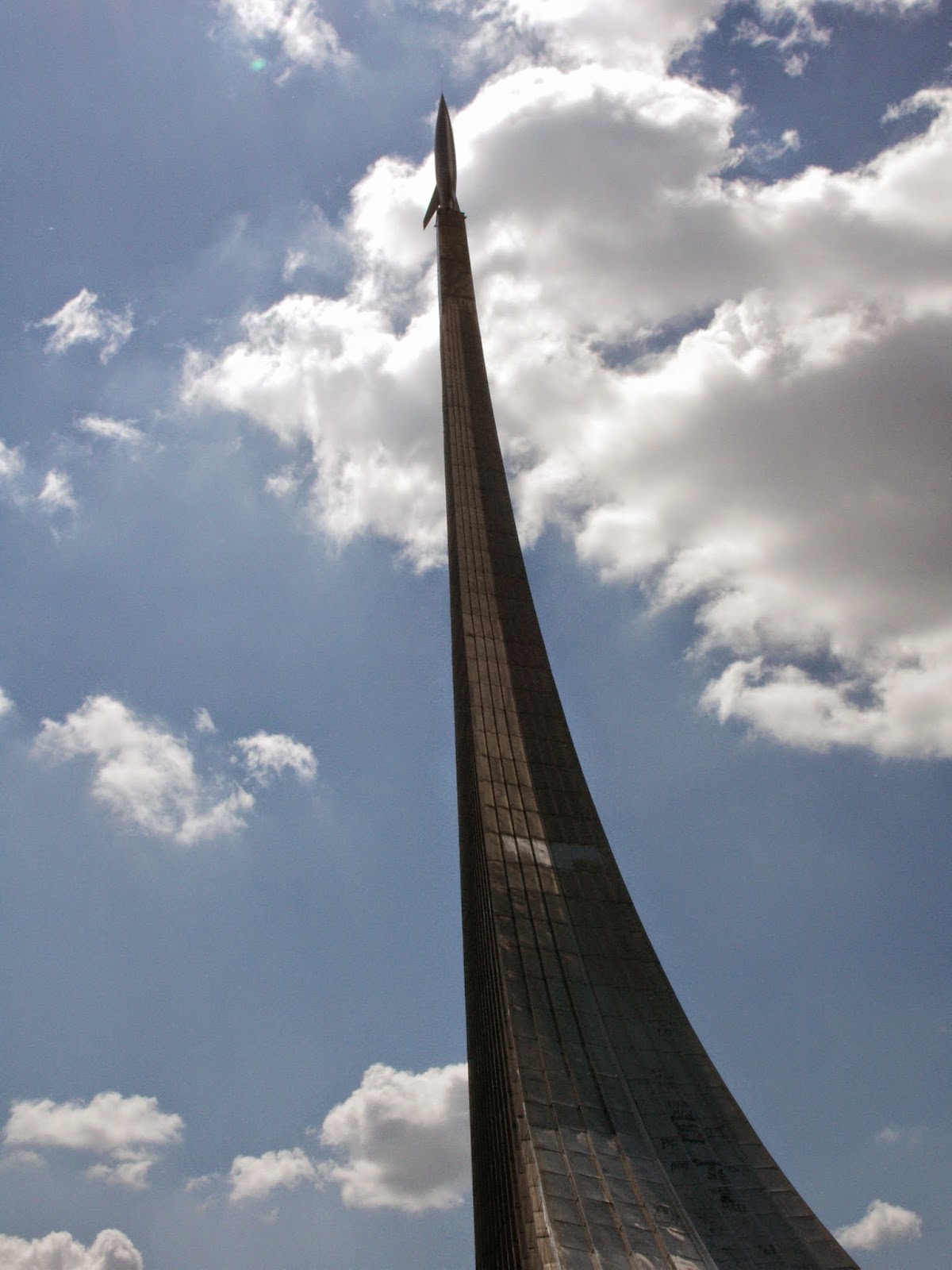
On the paved space above the Museum-bunker stands the imposing metallic Space Monument, thrusting toward the stars; it is surrounded by the Pavilions of the VDNKh – the former All-Union Exhibition of Economic Achievements – a showcase of planned-economy productivity. In the vast interior spaces where once the achievements of the mighty State in all spheres of science and industry were proudly displayed, the void is now filled by market stalls selling competitively-priced consumer goods; as in the Museum, rockets, satellites and even space capsules are mere theme-park sideshows. Thus the vanished Soviet utopian dream, a gleaming, technologically-advanced future, has left behind a faded splendour. The derelict worlds of futuristic entropy portrayed in Andrei Tarkovsky’s 1970s films Solaris and especially Stalker (both based on sf novels by eastern European authors), documents from the years of stagnation before Communism’s terminal collapse, begin to look painfully prophetic. The whole Exhibition complex, evidently still a popular attraction, appeared run-down to western eyes, in a state of decay and dilapidation, slowly becoming overgrown; the subsequent refurbishment of the Space Museum was, in truth, long overdue.


Above: Belka & Strelka in the Space Museum
Right: The Space Monument


Artists Jane and Louise Wilson, sisters from Newcastle-upon-Tyne, are among those to have investigated the relics of the Soviet Space Age, notably with their installation piece, Star City (2000), filmed at the formerly secret Cosmonaut training base outside Moscow, Zvyozdny Gorodok (translated literally as ‘Starry Town’). Once a source of Soviet pride, the facility has only survived into the twenty-first century by embracing space tourism and western capital. The Wilson sisters have also engaged with another, grimmer aspect of the Soviet legacy in their 2012 film The Toxic Camera. Taking as its subject the nuclear reactor explosion at Chernobyl in 1986, and the subsequent deadly toxic fall-out, it utilises contemporary footage taken at the scene by Soviet film-maker Vladimir Shevchenko, who later died due to the radiation he was exposed to there. In the Wilsons’ photographic series, Atomgrad, haunting images of the city of Pripyat, abandoned in the wake of the disaster, evoke the wider damage of state-sponsored environmental pollution and the dystopian high-rise collective housing estates which dominate the urban landscape, from the suburbs of the capital to the towns of the provinces.

The central concept of the novel Roadside Picnic by brothers Arkady and Boris Strugatsky, Soviet science fiction writers, which was filmed as Stalker, is ‘The Zone’; in book and film this is a sealed-off area once visited by extra-terrestrial life, where earth’s physical laws no longer apply and strange things occur. Later the term was also applied to another zone of exclusion – the irradiated region around Chernobyl, marking the limits of human habitation after the disaster. The parallels between the fictional post-apocalyptic ‘Zone’ and the all-too-real one between Belarus and Ukraine are reflected in the growth of ‘anti-tourism’, with increased visitors to the area in recent years. This has also given rise to its further use as a set for a virtual gaming environment, with scenes based on photography taken in the actual physical location. 


Hotel Cosmos

The superficial brilliance of contemporary Moscow, represented as a resurgent, shiny megalopolis of gangsters, oligarchs and pop stars in the blockbuster films Night and Day Watch (2004 and 2006, both based loosely on Sergei Lukyanenko’s novel The Night Watch) suggests another (science-) fictional world, embodied by their use of the strikingly futuristic Hotel Cosmos, itself overlooking the Exhibition grounds and Space Museum, as a pivotal location. Where those films echoed a popular image of the capital’s prosperity, rapid development and regeneration – capturing a narrative that President Putin’s regime is also keen to present to the West – much of post-Communist Russia is broken-down, worn-out, and facing an uncertain future. The past continues to cast a long shadow, even if the revolutionary rhetoric of a technologically-enabled utopia, embedded in the Soviet Union from its inception with its egalitarian society, space-flight complexes and optimistic dreams of conquering the cosmos, now belongs to a vanished world, and its monuments to the glorious future have long since become rusting remnants of that distant era.