Showing posts with label 1990s. Show all posts

Friday, 1 September 2023

William Gibson in the 1990s: Virtual Realities

William Gibson established himself as one of the foremost contemporary SF writers with 1984’s Neuromancer. The first instalment of the ‘Sprawl’ trilogy was followed by Count Zero (1986) and Mona Lisa Overdrive (1988). Set in a futuristic dystopia where all-powerful multinational corporations have largely replaced national governments, Gibson’s characters survive as ‘outsiders’ within the lawless post-industrial cities of the Sprawl. His aesthetic is an updated noir “combination of lowlife and high tech”. Together with the short stories collected in Burning Chrome (1986), Neuromancer and its successors were the precursor of the short-lived cyberpunk movement. Most significantly, Gibson’s 1980s works serve as an early exploration of the scope of the Internet as global information source, and the potential for autonomous Artificial Intelligence (AI).


In the following decade, the ‘Bridge’ trilogy began with Virtual Light (1993) in a near-future federated Northern and Southern California, c. 2005. Moving primarily between Los Angeles, a reconstructed San Francisco and Tokyo, the subsequent Idoru (1996) and All Tomorrow's Parties (1999) continue Gibson’s investigations of cyber- and pop-culture. The interwoven themes are today mainstream preoccupations: meditations on the development of AI, the “consensual hallucination” of cyberspace, the data-flows and ‘nodal points’ of information on the Web, digital identity, the fusion of big tech, celebrity, consumerism and mass media. The societal impact of new technologies and virtual realities reverberates throughout the Bridge trilogy, as the new phenomenon of the Internet reached a wider public.

The eponymous ‘idoru’ or idol, Rei Toei, is a computer-generated holographic, whose marriage to a rock star is at the heart of the second novel. Discussing the body as personality construct, author Dani Cavallaro attributes the creation of the idoru to a branch of nanotechnology which renders “the very distinction between the animate and the inanimate somewhat obsolete”. While a post-human construction, Rei Toei “carries traces of personal history”, presumably programmed. Colin Laney, the character who sifts the Internet to identify the significant ‘nodal points’ of incipient change, is described as “an intuitive fisher of patterns of information” – a gift he owes to the ingestion of experimental drugs as an orphaned child. The interaction of the real and the virtual is arguably the defining strand of science fiction tradition that Gibson explores as distinctively as Philip K. Dick before him.


All Tomorrow's Parties brings many of the earlier threads and characters together – Laney is now resident in a cardboard box in a Tokyo subway station, permanently plugged into the Web – and returns the series back to the Bridge. The trilogy’s emblematic setting of the Golden Gate Bridge, now a semi-autonomous zone or outsider community, serves as a counterpoint to the corporate world and provides a (temporary) refuge beyond the reach of an all-pervasive digital surveillance network. The arrival of the Lucky Dragon convenience store franchise signifies not only commodification of the Bridge – now a tourist attraction – but a disruption of its independent status. The Bridge’s virtual analogue is the Walled City (based on the physical location in Kowloon, Hak Nam or the City of Darkness, which was fully demolished in 1994), a self-regulated space within the web’s data-flows created by disaffected programmers and hackers. This attempt to “create a private realm for themselves where they would enjoy complete autonomy” has evolved outside the control of the multi-nationals; the ‘ownership’ of the Internet is a recurring concern of Gibson’s.

1995 saw the cinematic release of Johnny Mnemonic, an adaptation of his 1981 short story. Starring Keanu Reeves as the title character, a data courier who transports information stored in his head, Gibson was involved in the production but was dissatisfied with the final version – reflected in its mixed reviews. He complained of changes made late in post-production which “destroys the integrity” of the movie, together with the replacement of the original score. Many of the sets dated rapidly, and the film as a whole failed to capture the distinctive vision found in his fiction.


Gibson also contributed to the decade’s hugely successful sci-fi TV series, The X-Files, which was largely filmed in his adopted hometown of Vancouver. He collaborated with friend and fellow author Tom Maddox on the script for ‘Kill Switch’, broadcast in 1998 during the show’s fifth season. Many of the themes familiar from Gibson’s fiction are condensed into the episode, combining a rogue autonomous AI with virtual reality scenes – and still categorised as ‘cyberpunk’. Gibson confessed that his daughter (then 15) had introduced him to the series, and she also insisted they be present for the episode’s filming. Also in 1998, Gibson wrote an introduction to The Art of the X-Files, cementing his affinity with the show, which he described as “a disturbing and viscerally satisfying expression of where we've come from, where we are today, and all those places we simultaneously yearn and dread to go.” He again collaborated with Maddox on a second episode, ‘First Person Shooter’, which aired in February 2000 and explored a deadly presence in a role-playing VR game. 


After the impact of the Sprawl trilogy, Gibson was in demand during the 1990s as a cultural commentator and observer of technological developments. In his interviews and non-fiction, he cast a critical eye over emerging trends from an addiction to eBay to the evolution of the World Wide Web, speculating on where the changes might lead society. Famously, in ‘Disneyland with the Death Penalty’ (an article which now has its own Wikipedia page), his record of a visit to Singapore for Wired magazine, he found disturbing signs of totalitarianism beneath the prosperous, sterile façade of the city-state. The publication was promptly banned there, adding weight to his argument. Gibson also continued to insert musical references into his work, including Nick Cave, Steely Dan and the Velvet Underground in the Bridge trilogy, whilst being cited as an influence by Billy Idol, Sonic Youth and U2 among others.


He described the significance of the Internet in a 1994 interview:

“The advent, evolution and growth of the Internet is, I think, one of the most fascinating and unprecedented human achievements of the century. I sometimes suspect that we’re seeing something in the Internet as significant as the birth of cities. It’s something that profound and with that sort of infinite possibilities. It’s really something new, it’s a new kind of civilization.”

Gibson discussed the potential consequences of the Internet in myriad interviews, even as its scope expanded over the course of the decade, anticipating that it would become “completely ubiquitous”. While he believed that “we’ll see some amazing social changes” as it evolves, he recognised within AI and the virtual worlds, “something almost pathological growing out of this technology.” Such observations translate seamlessly to his fiction, and while the narrative viewpoint is generally detached, fears that technological developments may not be entirely beneficial are articulated throughout the Bridge trilogy.

bridge_trilogy_image by_dahliainosensu

Within its physical and virtual worlds, Gibson’s cast of disenfranchised and rootless characters seek a place in an increasingly de-humanised and polarised society. Counter-cultural remnants carve out a fragile existence in the shadow of omnipresent techno-corporations – what one of the protagonists hopes to document as “interstitial communities”. These urban ‘interzones’, spaces for the marginalised or “places built in the gaps” are found recurrently in Gibson’s work. The settings of Tokyo’s cardboard-box cities and the amorphous jumble of the Golden Gate Bridge are a reflection of the author’s belief “that there are viable degrees of freedom inherent if not realised in interstitial areas.”


Characterised elsewhere as a continuation of the “combination of high-tech gadgets, low-tech environments” found in the Sprawl novels, Gibson himself has described the Bridge trilogy as being “my take on the 1990s,” in a decade where technology was shaping an uncertain future. Recalling waiting for “the Soviet Union to collapse” before completing Virtual Light, in a 1993 interview he acknowledged the setting as “just ‘now’ with the volume cranked up.”

All Tomorrow's Parties in particular introduces the concept of 3D printing (later developed in 2014’s The Peripheral), while nanotechnology permeates the trilogy as a whole, in the reconstructed buildings of San Francisco and Tokyo. As a contemporary SF theme, both 3D printing and nanotechnology are even more exhaustively explored in Neal Stephenson’s The Diamond Age: Or, A Young Lady’s Illustrated Primer (1995), his follow-up to the influential Snow Crash. Also notable for its depiction of the ‘neo-Victorians’ which anticipates the Steampunk aesthetic, Stephenson’s novel depicts a future where the Matter Compiler (a more advanced 3D printer) is commonplace and nanotechnology ubiquitous – inside bodies, interactive books and the physical environment the characters inhabit. Gibson has acknowledged in Stephenson’s fiction “a natural overlap” with his own. The work of both authors in the 1990s is a guide to the digital landscape which was to come, as much a warning as a celebration of the potential for technology to re-shape the world.


Saturday, 4 September 2021

Science Fiction-Music Interconnections: Listening in the 1990s

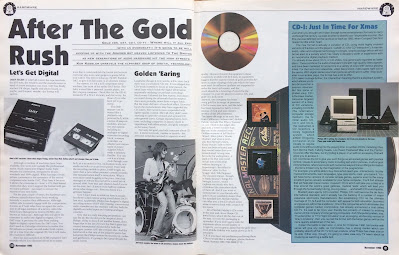
Hi-Fi: Heading to the Digital Age

How was the music of the 1990s experienced as home entertainment? On traditional stereo ‘systems’ via the analogue formats of vinyl and cassette, with the future looming in the shape of compact discs, and the brave new world of Digital Audio Tape about to revolutionise the music industry… 


On the Move

Anyone storing their entire music collection on a phone or iPod should spare a thought for the 90s mobile listening experience. Developed over the previous decade, surprisingly bulky Minidisc and Walkman players allowed you to enjoy your favourite discs and tapes (one at a time) if you were on the move – until the batteries ran out… 


Cassette Culture: Home Taping is Killing Music

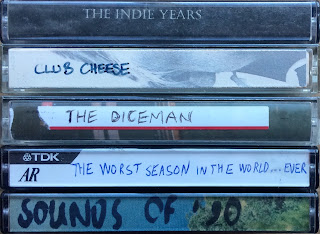
The cassette remained thriving throughout the first half of the decade (in my experience at least), both in commercial form and for exchanging music via the ubiquitous mix-tape – there was even a market for the cassette single… 


Among the more notable discoveries was the ‘outer space’ design of Memorex’s Sound Invasion tape – this particular example found at Music Zone, Salford Shopping City in 1993/94…
 

A number of ‘lo-fi’ musicians made an art form of the humble cassette, while magazines were still happily advertising blank tapes for sale, compatible with glossy home stereo and portable players…


In the Future

Meanwhile, German researchers had been working since 1987 on developing digital audio files, a project which eventually resulted in the MP3. It was patented in the US in 1996 and, rather than a cutting-edge electronic label, the independent Seattle-based Sub Pop (the first home of Nirvana and ‘grunge’) is credited as the first to release music in the MP3 format. The file-sharing network Napster was launched in 1999, and the transformation of the record industry was underway. Music in the twenty-first century was to be consumed in different ways than any previous listening experience…
 

Saturday, 27 February 2021

Science Fiction-Music Interconnections: The Indie 90s

Whilst researching the various SF-related 90s topics which have informed recent posts, I began to explore the connections with one of my formative influences of the decade: Indie Rock. As a fan of all things ‘indie’ around the first half of the 90s (when I was a late-teenager and student), I had various memories and favourites from the genre’s heyday in that pre-Internet age. The affiliation is less immediate than with the ambient and rave scenes of the era, but various connections can be found. 

The associated English artists Spacemen 3, Sonic Boom/Spectrum, and Spiritualized (the best-known/most commercially successful of the trio) all explored otherworldly imagery and themes, often pharmacologically inspired. The Spiritualized albums Lazer Guided Melodies (1992) and especially Ladies and Gentlemen We Are Now Floating in Space (1997) epitomise these qualities. Among their contemporaries categorised as ‘shoegazers’, the band Slowdive ventured into similar territory with their second album, 1993’s Souvlaki, including collaborations with Brian Eno and the ambient-inspired ‘Souvlaki Space Station’. 

Sonic Boom, Spectrum (1990)Spiritualized, Lazer Guided Melodies (1992)


Stereolab, Space Age Bachelor Pad Music (1993)


Stereolab, with French vocalist Laetitia Sadier, offered a combination of easy-listening sensibilities and avant-pop epitomised in the 1993 EP Space Age Batchelor Pad Music – a nod to the hi-fi test records and ‘space age pop’ of an earlier era. The following year’s Mars Audiac Quintet expanded on the formula, with ‘The Stars Our Destination’ a reference to Alfred Bester’s 1956 novel (itself seen as a precursor of Cyberpunk). Meanwhile ‘International Colouring Contest’ was a tribute to outsider musician Lucia Pamela, whose 1969 album Into Outer Space reports a trip to the moon. 


Ash, 'Girl from Mars' (1995)Northern Irish band Ash kicked off a series of successful singles with 1995’s ‘Girl from Mars’, and a later compilation, Intergalactic Sonic 7″s, reinforced their sci-fi influences. Less likely artists also touched on sf themes; the title and artwork of Suede’s B-sides collection, Sci-Fi Lullabies (lifted from an earlier lyric). A song by Swedish outfit the Cardigans, ‘Daddy’s car’, imagines a carefree European road trip turned cosmic: “From Luxembourg to Rome, From Berlin to the moon / From Paris to Lausanne, From Athens to the sun / Our car became a spacecraft, flashing through the world – Crashed down in Amsterdam.” 


Suede, Sci-Fi Lullabies (1997)


The ongoing rise of MTV in North America saw an expansion of indie content, notably 120 Minutes. Videos by artists drew on sci-fi themes, even where they were apparently unrelated to the song. The Smashing Pumpkins contributed 'Rocket' and later ‘Tonight, tonight’, directly influenced by Georges Méliès’ 1902 pioneering silent film A Trip to the Moon. Also in 1995, Norfolk band Catherine Wheel collaborated with Tanya Donelly (one of the decade’s most influential indie figures with Throwing Muses, the Breeders, Belly and as a solo artist) on ‘Judy Staring at the Sun’, with its kitsch sf imagery. Bernardo Bertolucci’s 1996 film Stealing Beauty (decidedly non-sf) had a soundtrack including the Cocteau Twins, Mazzy Star, Portishead, and Liz Phair, whose ‘Rocket Boy’ was accompanied by another incongruous video.


The growth of US alternative/college rock music through the 1980s saw a spate of bands emerge in the Boston/Massachusetts area. Galaxie 500 produced a psychedelia-influenced sound with space-rock references. I continued to associate them with sci-fi even after discovering they were actually named after a car! Singer and lead guitarist Dean Wareham continued to explore this ‘dream pop’ territory with his next band, Luna, formed in 1991. The better-known Pixies also sprang from the Boston area, led by Black Francis and gaining acclaim by the late 80s for their combining an abrasive style with melody, and the quiet/loud dynamics which would influence Nirvana among others. Their early 90s albums Bossanova and Trompe le Monde saw Francis delve into sf-inspired lyrics, which developed further in his solo career as Frank Black. His 1997 album The Cult of Ray paid homage to writer Ray Bradbury (who Black also interviewed).


Finally, a song that stands alone: Pop Will Eat Itself’s ‘X, Y and Zee’, 1991’s slice of ‘intergalactic punk rock hip hop’. Singer Clint Mansell later became a film composer, with credits including the soundtrack to Moon, directed by Duncan Jones in 2009.


Art & Design Credits:

Ash, ‘Girl from Mars’ (1995): Design – Carnage; Other [Girl from Mars] – Sarah From Islington; Photography – Roger Sargent
Luna, Lunapark (1992): Art Direction – Laurie Henzel; Studio Photography – Macioce
Pixies, Bossanova (1990): Art Direction, Design – Vaughan Oliver / v23; Artwork [Globe] – Pirate Design; Photography – Simon Larbastier; Design Assistance – Chris Bigg
Sonic Boom, Spectrum (1990): Artwork [Commercial Art] – Sonic, T + CP London; Lacquer Cut By – Porky; Photography [Sonic] – Steve Double; Photography– Andy Earl
Spiritualized, Lazer Guided Melodies (1992): Original Artwork – Mr Ugly; Logo Design – Albert Tupelo; Design – Andrew Sutton for Blue Source; Model Maker – Gavin Lindsay; Photography – Pete Gardner
Stereolab, Space Age Bachelor Pad Music (1993): Design – Magic Glue
Stereolab, Mars Audiac Quintet (1994): Layout – Trouble; Photography – Peter Morris 
Suede, Sci-Fi Lullabies (1997): Image ‘Hidden’ by John Kippin; Art Direction – Peter Saville; Design – Howard Wakefield

Saturday, 8 August 2020

Three SF Novels of the Early Nineties: Snow Crash, Virtual Light and Vurt

The early nineties were a fertile time for futurists, eyeing the new millennium at a time of rapid technological advances and refining the ideas of ‘cyberpunk’ into a more nuanced vision. William Gibson was already established as one of SF’s leading visionaries by the time 1993’s Virtual Light began his second major trilogy. The breakthrough novels of Jeff Noon (Vurt, 1993) and Neal Stephenson (Snow Crash, 1992), saw them join the decade’s most influential writers. 


These books share a central theme of an escape from dystopian futures into alternate worlds, and display an interest in altered states, shared hallucinations and virtual realities. In Vurt and Noon’s related novels, the titular magical realm – a shared hallucination or fantastic place – is reached via ingesting feathers. Snow Crash posits a form of virtual reality as a fully-formed location (the ‘Metaverse’), populated by avatars, as an alternative to daily life. Virtual Light begins the ‘Bridge’ trilogy, grounded in a recognisable California shaped by corporate technology, with a view through virtual reality glasses.

Neuromancer and Gibson’s other early work (the ‘Sprawl’ trilogy) charts the vast uncharted territory of data-information he designates as ‘cyberspace’. The ‘Bridge’ trilogy (Virtual Light, Idoru, All Tomorrow’s Parties; 1993-99) is set in a more identifiable near future than Neuromancer and the cyberpunk novels and stories which built Gibson’s reputation. The author himself described these novels as “my take on the 1990s” but commented that “lots of people assumed I was still writing about the capital-F future.”

Combining elements of post-apocalyptic and dystopian imagery with a characteristic eye on the effects of technology, Virtual Light follows marginalised characters through a fractured California. San Francisco’s Golden Gate Bridge, no longer used for vehicles but colonised by the disenfranchised, is the book’s emblematic location. The novel grew from Gibson’s short story, ‘Skinner’s Room’, commissioned by the San Francisco Museum of Modern Art for a 1990 exhibition, Visionary San Francisco. Architects Ming Fung and Craig Hodgetts created an installation envisaging the transformation of the Bridge in response to the story.


Untitled (The Bridge, a shanty-town on the remnants of the San Francisco-Oakland Bay Bridge) by Ming Fung and Craig Hodgetts in Visionary San Francisco


The disintegration of the social structure, the privatisation of public bodies (and spaces) of Virtual Light are taken one stage further in Snow Crash, also set in California. The central characters, as in Gibson’s work, are trying to find a niche in this unforgiving society, working in security, as couriers, or operating as hackers. Here, the state has almost entirely ceded control to corporations which own portions of land as autonomous commercial republics, or ‘Franchise-Organised Quasi-National Entities’. Private citizens, or those who can afford it, live in the anodyne gated communities of ‘Burbclaves’, guarded by their own security forces.

Where Gibson’s plot revolves around a stolen pair of Virtual Reality goggles (the Virtual Light of the title) but remains in a familiar landscape, Stephenson’s Metaverse is “a computer-generated universe”. Information and power are concentrated in the Metaverse, where the digital/neuro-linguistic virus of the title is unleashed with consequences for the ‘real world’. Visitors to this virtual world are represented by their avatars, while still constrained by spending power and status. In recent months the Metaverse has become particularly topical, a process accelerated by the need for ‘virtual’ spaces in a world locked down by Covid-19. Big tech and media conglomerates see popular multi-player games such as Fortnite and Roblox as potential platforms, where concerts and films can be hosted (and paid for in digital currency), building on earlier virtual reality concepts like Second Life. Many articles on the goal of creating a Metaverse explicitly reference Stephenson and Snow Crash. 

A rendering of Snow Crash's Metaverse


Informed by developments in virtual worlds and rave culture’s hedonistic escapism, Noon conjures an imagined, transitory utopia from the lawless, rain-swept streets of a near-future Manchester. Vurt’s action follows Scribble, Beetle and the gang of ‘Stash Riders’ riding their van in search of the differently-coloured feathers which unlock the key to other worlds. The dream-scape of the ‘Vurt’, like the Metaverse, has its casualties, brings real dangers, and poses philosophical questions reminiscent of Philip K. Dick alongside its escapist thrills. Less preoccupied with technology than pharmacology, Vurt draws on post-rave subcultures in its depictions of the various human and mutant variations which fall under the intoxicating spell of the feathers, enigmatic portals to alternate worlds. Noon’s creation has also lent itself to virtual role-playing games.

Vurt: the role-playing game


Noon has ‘retro-engineered’ a sequence of novels in the Vurt series and spoken of his affinity with the electronic music scene, especially the techniques of re-mixing in what he calls ‘dub fiction’. The depictions of a rave/techno drug-based subculture supplement the theme of escape; nightclub characters Inky MC and Dingo Tush (the man-dog, “presented by Das Uberdog Enterprises”) illuminate a phantasmagorical Manchester. Snow Crash too draws on elements of dance and indie music which were already blending and metamorphosing in pop culture at the time. The vivid depictions of Vitaly Chernobyl & the Meltdowns’ experimental ‘nuclear fuzz-grunge’ gig under the freeway, and the stylings of ‘Nipponese rap star’ Sushi K, show Stephenson’s wry humour. 

Where Gibson’s earlier ‘Sprawl’ trilogy was peppered with pop-cultural references from William Burroughs to Steely Dan, Virtual Light is more restrained, content to include the iconoclastic band Chrome Koran. However Idoru (1996), the next novel in the series, focusses on the computer-simulation pop star Rei Toei, an Artificial Intelligence idoru or ‘idol’; Gibson continues to weave music-based themes into his work, not least in All Tomorrow’s Parties (1999), which completed the ‘Bridge’ trilogy. 


All three books share a preoccupation with misfits and outsiders navigating a grim urban landscape, struggling to find a place in an increasingly alienating society, often only to be found in alternate or virtual realms, drug-induced or computer-generated. Nearly thirty years on, we appear to be increasingly living in the world/s they anticipated.


Saturday, 28 September 2019

Science Fiction-Music Interconnections: The Raving 90s

The rise of rave culture from the late 1980s to the early 1990s was a worldwide phenomenon which had a particular impact in the UK. Like many other youth subcultures, the emphasis on drugs and loud music, other worlds and altered states, brought notoriety to the rave scene. Rave was rife with science fiction imagery, from promotional flyers to the stylings of the music’s practitioners. Operating at the intersection of chill-out/eco/new age/techno and dance subcultures, rave reached the zenith of its popularity at the huge Castlemorton Common Festival of 1992, in Worcestershire’s Malvern Hills. This event, to borrow the terminology of the 60s, represented a ‘gathering of the tribes’ and saw rave as a unifying force among disparate groups; it was also the precursor to state intervention.


The connections with 60s/70s ‘alternative’ lifestyles (even the term ‘rave’) were inescapable, apparent in the tendencies toward escapism and hedonism and the trajectory from the underground to the mainstream. Antonio Melechi was among the commentators to note that “Not until the expansion of rave culture... has the counterculture so explicitly harked back to the sixties.” It was a ‘grass roots’ movement, building on the UK’s tradition of nationwide free festivals established in the wake of the huge gatherings at Woodstock and the Isle of Wight which marked the commercialisation of 60s rock. An anonymous pamphlet published at the end of the 1970s summarised the free festival ethos:

“Free festivals are practical demonstrations of what society could be like all the time; miniature Utopias of joy and communal awareness rising for a few days from grey morass of mundane, inhibited, paranoid and repressive everyday existence.”


George McKay, writing in Senseless Acts of Beauty: Cultures of Resistance since the Sixties, recognised the tendency toward transformation; “One of the spaces of the dance scene side of rave – the club – is presented as libertarian utopian space, packed with transformative possibility.” As in the 60s, through the festivals, the subculture came to span both rural and urban environments, encompassing illicit rave parties in warehouses and the countryside, embracing both a ‘back to nature’ impulse and the modern technology of the music itself. Though rave styled itself as a movement without ‘stars’, stressing anonymity as central to the communality of the experience, artists such as Altern8, Orbital and the Prodigy became popular, together with the Orb and Steve Hillage on the ambient fringe, while Hawkwind, veterans of the counterculture and free festival circuit, incorporated dance elements and demonstrated the affinities with an earlier generation.

Undeniably central to rave’s appeal was Ecstasy, functioning like LSD decades earlier as both a catalyst and symbol of the movement, defining and enhancing the musical experience. This parallel was identified by Nicholas Saunders, one of the individuals to span both eras. Saunders was behind the 1970 publication of Alternative London, described as “a key text of the counterculture packed with information about subjects from health foods to communes to drugs.” As a rave enthusiast and the author of E is for Ecstasy (1993), Saunders described the affinities between the two eras, both culturally and in their respective choices of recreational chemicals: “I felt symptoms familiar from taking LSD in the sixties... A kind of uplifting religious experience of unity that I have only felt once before”.

With growing popularity came increasing attention from the press and public authorities; at this point, parallels with the free and easy 60s and 70s began to evaporate. While some debate took place around the medical effects of Ecstasy, the high-profile deaths of Leah Betts and Clare Layton fuelled media sensationalism and moral panic. The veteran investigative reporter Roger Cook used his Cook Report, broadcast nationally, for an episode entitled ‘Ecstasy Kills’ in 1992, which served as a prolonged broadside against the evils of drugs. The popular press followed suit. Criminalisation was in the offing, with the Castlemorton event, a week-long free festival, serving as the basis for the legislation which was enacted in the 1994 Criminal Justice Act. There was strong public opposition, with critics describing the provisions of the Act as “explicitly aimed at suppressing the activities of certain strands of alternative culture”, but it was duly passed. The widespread sceptical sentiments were echoed by author Jon Savage, who stated that the legislation was “about politicians making laws on the basis of judging people’s lifestyles, and that’s no way to make laws.” The Prodigy registered their disapproval with the themes and artwork of their 1994 album Music for the Jilted Generation.

Music for the Jilted Generation. Inner sleeve artwork by Les Edwards.
Previous governments had imposed certain restrictions on large-scale gatherings, notably The Isle of Wight County Council Act 1971, which contains provisions aimed at the control of overnight assemblies in the open, and gives the local authority powers to set conditions and to veto unsuitable sites. Whilst regulating, the authorities of that era remained open to the utopian possibilities of such free festivals, recognised by the government commission established in the wake of the Isle of Wight chaos of 1970. The Stevenson Committee’s 1973 Report to the Department of Environment states: “These young people have been expressing a need to get away from their immediate environment and the inhibitions and limitations of everyday life – particularly in our towns – to a situation in which they can experiment socially, come face to face with new ideals and concepts of life and decide for themselves what they wish to accept or reject.” The liberal attitude extended to ministerial level, with the Secretary of State for the Environment at the time, Geoffrey Rippon, commenting “The last thing the Government wants to do is to intervene in people’s reasonable pleasures”, in sharp contrast to the draconian provisions of the Criminal Justice Act, a bill passed in Parliament twenty years later aimed at doing exactly that.

Police Review, June 1992, in the wake of the Castlemorton Festival

While rave as a mass movement never recovered from the effects of the 1994 legislation, it reverted to an underground sub-culture, evolved into different forms, and enjoyed a surprisingly durable afterlife. For an experience predicated on transitory chemical pleasures and instant thrills, rave culture has left an extensive legacy of archive, ephemera and memorabilia – blogs, compilations, flyers, literature, some of it even collectable. As one of the last widespread pre-Internet phenomena, nostalgic ravers and inquisitive researchers can read reminiscences, browse galleries of retro-flyers and glimpse ecstatic states in their vivid other-worldly imagery, without popping a pill and setting out for warehouse or field.


Saturday, 27 April 2019

Science Fiction-Music Interconnections: The Ambient 90s

Electronic music, developed from the synthesiser experiments of the earlier twentieth century and refined by German band Kraftwerk in the 1970s, was at the peak of its popularity on the cusp of the 1990s, both in the pop mainstream and underground variants. Combined with the prevalence of mind-altering chemicals, different strands of 90s electronic music drew heavily on science fiction themes. In the UK, the ‘ambient’ instrumental soundscapes of Brian Eno and others were modified for club-goers ‘coming down’ from chemical highs as the basis of ‘ambient house’. The Orb, a partnership of Alex Paterson and Jimmy Cauty, a member of the Justified Ancients of Mu-Mu (or JAMs), were influential in refining the genre. Cauty eventually re-worked their collaboration Space into a solo recording, released in 1990; with nods to 1970s ambient pioneers Tangerine Dream and Pink Floyd, it was envisaged as “a voyage through the solar system from Mercury outwards”, with each piece named after a planet.

Space, 1990


The Orb evolved into Paterson and a shifting cast of associates; their 1991 debut album Adventures Beyond the Ultraworld set the template for sci-fi-influenced themes and imagery. The album’s centrepiece, the side-long ‘A huge ever-growing pulsating brain that rules from the centre of the Ultraworld’ was directly inspired by an episode of Blake’s Seven, ‘Ultraworld’, written by Trevor Hoyle. Their live performances were accompanied by “a constant stream of psychedelic images… projected onto the screens about the stage” (another echo of Pink Floyd), typically featuring aliens, astronauts and futuristic cityscapes. Their next album, U.F. Orb, continued the sci-fi links with samples from NASA transmissions, science fiction references and ambient explorations of space travel, notably on the 40-minute 1992 single, ‘Blue Room’. The track is believed to reference a secret location at Wright-Patterson Air Force Base, Ohio, containing UFO evidence. An edited version was aired on Top of the Pops. 


The Orb’s affinity with the progressive rock of an earlier era was illustrated by their connection to guitarist Steve Hillage, member of 1970s cosmic rockers Khan and Gong. He played on several sessions, was credited as a co-writer on ‘Blue Room’ and his 1979 solo proto-ambient album Rainbow Dome Musick was sometimes aired before Orb performances. Hillage, who was originally part of the influential Canterbury Scene and later worked with Hawkwind’s Nik Turner, pursued his own early 90s ambient/dance project as System 7 with partner Miquette Giraudy. Hillage’s burgeoning interest in electronica led to him programming the acts for the first Dance Tent at the Glastonbury Festival of 1995, at which System 7 themselves performed.

Paterson’s contemporaries, Cauty and Bill Drummond, had first recorded as the Justified Ancients of Mu Mu, a name taken from a secret society in the counter-cultural 1975 Illuminatus! Trilogy of novels by Robert Shea and Robert Anton Wilson. The duo’s first commercial success was as the Timelords, whose single ‘Doctorin’ the Tardis’, incorporating the Dr Who theme tune, was a ‘novelty’ number one in the UK in 1988. They released an ambient house album in 1990, Chill Out, a term derived from an area called ‘The White Room’ (the title of their next album) at London’s Heaven nightclub, where Cauty and Paterson were DJs in the late 1980s. Later applied to various forms of “music of a trance-like nature”, chill-out was defined by slowed-down dance beats. Cauty and Drummond rose to international fame with a series of classic chart-topping singles as the KLF, whilst earning notoriety for their post-modern pranks. Upon their retirement from music in 1992, they deleted their back catalogue and pursued situationist ‘actions’, art projects and media campaigns as the K Foundation. When they returned on 23 August 2017, it was with a novel, 2023: A Trilogy, a “self-referential dystopian tale” credited to the Justified Ancients of Mu Mu, drawing both on the Illuminatus! Trilogy and their own self-created ‘mythology’. 


Many of the original creative forces behind ambient house moved beyond its confines; Cornish electronic artist Richard James went by the name Aphex Twin, and explored the hinterlands of acid house, ambient, jungle and techno music in a bewildering series of releases with an other-worldly flavour. He enjoyed chart success in the late 90s, before promptly reverting back to more experimental forms. Another band rising from obscurity to mainstream success in the 90s were the Shamen, initially a psychedelic guitar band who embraced new technology and sampling. An interest in mind-expansion and dance culture saw them emerge as pioneers of multi-media performance whose ‘Synergy’ concept was intended to dissolve “the boundaries between rock gigs and warehouse parties”. Their 1990 LP En-Tact was described by one breathless reviewer as “the KLF remixed by William Gibson in a massive multi-coloured warehouse inside your head”.


After the untimely death of key member Will Sin, the Shamen subsequently enjoyed their biggest hit with ‘Ebenezer Goode’ in 1992, a straightforward celebration of drug/rave culture which also erased much of their underground credibility. A spoken-word collaboration with the celebrated author, ethno-botanist and psychedelic enthusiast Terence McKenna (“the intellectual voice of rave culture”) on ‘Re-Evolution’ was more in the spirit of their early work. With another contribution by Steve Hillage on the same album, the past was acknowledged as they simultaneously embraced the future. With a long-standing interest in cyberspace, the Shamen were among the first bands to explore Internet releases on their interactive site Nemeton, launched in 1995. The group’s mainstay, founder member Colin Angus, commented that “We’ve always seen ourselves as an ‘information band’, so it was a natural step to connect to the internet.” 

'An A-Z of Ambient', The Wire, Issue 113, July 1993

Hillage and McKenna’s involvement, like that of Timothy Leary with the contemporary Cyberpunk trend, reinforced the connections between the cultural explorations of the late 60s/early 70s and the dawn of the 90s, not least a shared interest in altered states of consciousness. It also linked to ‘new age’ overtones, a label with which ambient house was becoming associated, together with ‘chill out’, or ‘trance’, as the terms became interchangeable – certainly for the record labels who capitalised on its popularity with vast numbers of compilations over the following years. Once the impetus of its innovators was removed, the music was as bland and formulaic as the artwork; uninspiring and depressingly earth-bound.