Showing posts with label William Gibson. Show all posts

Friday, 1 September 2023

William Gibson in the 1990s: Virtual Realities

William Gibson established himself as one of the foremost contemporary SF writers with 1984’s Neuromancer. The first instalment of the ‘Sprawl’ trilogy was followed by Count Zero (1986) and Mona Lisa Overdrive (1988). Set in a futuristic dystopia where all-powerful multinational corporations have largely replaced national governments, Gibson’s characters survive as ‘outsiders’ within the lawless post-industrial cities of the Sprawl. His aesthetic is an updated noir “combination of lowlife and high tech”. Together with the short stories collected in Burning Chrome (1986), Neuromancer and its successors were the precursor of the short-lived cyberpunk movement. Most significantly, Gibson’s 1980s works serve as an early exploration of the scope of the Internet as global information source, and the potential for autonomous Artificial Intelligence (AI).


In the following decade, the ‘Bridge’ trilogy began with Virtual Light (1993) in a near-future federated Northern and Southern California, c. 2005. Moving primarily between Los Angeles, a reconstructed San Francisco and Tokyo, the subsequent Idoru (1996) and All Tomorrow's Parties (1999) continue Gibson’s investigations of cyber- and pop-culture. The interwoven themes are today mainstream preoccupations: meditations on the development of AI, the “consensual hallucination” of cyberspace, the data-flows and ‘nodal points’ of information on the Web, digital identity, the fusion of big tech, celebrity, consumerism and mass media. The societal impact of new technologies and virtual realities reverberates throughout the Bridge trilogy, as the new phenomenon of the Internet reached a wider public.

The eponymous ‘idoru’ or idol, Rei Toei, is a computer-generated holographic, whose marriage to a rock star is at the heart of the second novel. Discussing the body as personality construct, author Dani Cavallaro attributes the creation of the idoru to a branch of nanotechnology which renders “the very distinction between the animate and the inanimate somewhat obsolete”. While a post-human construction, Rei Toei “carries traces of personal history”, presumably programmed. Colin Laney, the character who sifts the Internet to identify the significant ‘nodal points’ of incipient change, is described as “an intuitive fisher of patterns of information” – a gift he owes to the ingestion of experimental drugs as an orphaned child. The interaction of the real and the virtual is arguably the defining strand of science fiction tradition that Gibson explores as distinctively as Philip K. Dick before him.


All Tomorrow's Parties brings many of the earlier threads and characters together – Laney is now resident in a cardboard box in a Tokyo subway station, permanently plugged into the Web – and returns the series back to the Bridge. The trilogy’s emblematic setting of the Golden Gate Bridge, now a semi-autonomous zone or outsider community, serves as a counterpoint to the corporate world and provides a (temporary) refuge beyond the reach of an all-pervasive digital surveillance network. The arrival of the Lucky Dragon convenience store franchise signifies not only commodification of the Bridge – now a tourist attraction – but a disruption of its independent status. The Bridge’s virtual analogue is the Walled City (based on the physical location in Kowloon, Hak Nam or the City of Darkness, which was fully demolished in 1994), a self-regulated space within the web’s data-flows created by disaffected programmers and hackers. This attempt to “create a private realm for themselves where they would enjoy complete autonomy” has evolved outside the control of the multi-nationals; the ‘ownership’ of the Internet is a recurring concern of Gibson’s.

1995 saw the cinematic release of Johnny Mnemonic, an adaptation of his 1981 short story. Starring Keanu Reeves as the title character, a data courier who transports information stored in his head, Gibson was involved in the production but was dissatisfied with the final version – reflected in its mixed reviews. He complained of changes made late in post-production which “destroys the integrity” of the movie, together with the replacement of the original score. Many of the sets dated rapidly, and the film as a whole failed to capture the distinctive vision found in his fiction.


Gibson also contributed to the decade’s hugely successful sci-fi TV series, The X-Files, which was largely filmed in his adopted hometown of Vancouver. He collaborated with friend and fellow author Tom Maddox on the script for ‘Kill Switch’, broadcast in 1998 during the show’s fifth season. Many of the themes familiar from Gibson’s fiction are condensed into the episode, combining a rogue autonomous AI with virtual reality scenes – and still categorised as ‘cyberpunk’. Gibson confessed that his daughter (then 15) had introduced him to the series, and she also insisted they be present for the episode’s filming. Also in 1998, Gibson wrote an introduction to The Art of the X-Files, cementing his affinity with the show, which he described as “a disturbing and viscerally satisfying expression of where we've come from, where we are today, and all those places we simultaneously yearn and dread to go.” He again collaborated with Maddox on a second episode, ‘First Person Shooter’, which aired in February 2000 and explored a deadly presence in a role-playing VR game. 


After the impact of the Sprawl trilogy, Gibson was in demand during the 1990s as a cultural commentator and observer of technological developments. In his interviews and non-fiction, he cast a critical eye over emerging trends from an addiction to eBay to the evolution of the World Wide Web, speculating on where the changes might lead society. Famously, in ‘Disneyland with the Death Penalty’ (an article which now has its own Wikipedia page), his record of a visit to Singapore for Wired magazine, he found disturbing signs of totalitarianism beneath the prosperous, sterile façade of the city-state. The publication was promptly banned there, adding weight to his argument. Gibson also continued to insert musical references into his work, including Nick Cave, Steely Dan and the Velvet Underground in the Bridge trilogy, whilst being cited as an influence by Billy Idol, Sonic Youth and U2 among others.


He described the significance of the Internet in a 1994 interview:

“The advent, evolution and growth of the Internet is, I think, one of the most fascinating and unprecedented human achievements of the century. I sometimes suspect that we’re seeing something in the Internet as significant as the birth of cities. It’s something that profound and with that sort of infinite possibilities. It’s really something new, it’s a new kind of civilization.”

Gibson discussed the potential consequences of the Internet in myriad interviews, even as its scope expanded over the course of the decade, anticipating that it would become “completely ubiquitous”. While he believed that “we’ll see some amazing social changes” as it evolves, he recognised within AI and the virtual worlds, “something almost pathological growing out of this technology.” Such observations translate seamlessly to his fiction, and while the narrative viewpoint is generally detached, fears that technological developments may not be entirely beneficial are articulated throughout the Bridge trilogy.

bridge_trilogy_image by_dahliainosensu

Within its physical and virtual worlds, Gibson’s cast of disenfranchised and rootless characters seek a place in an increasingly de-humanised and polarised society. Counter-cultural remnants carve out a fragile existence in the shadow of omnipresent techno-corporations – what one of the protagonists hopes to document as “interstitial communities”. These urban ‘interzones’, spaces for the marginalised or “places built in the gaps” are found recurrently in Gibson’s work. The settings of Tokyo’s cardboard-box cities and the amorphous jumble of the Golden Gate Bridge are a reflection of the author’s belief “that there are viable degrees of freedom inherent if not realised in interstitial areas.”


Characterised elsewhere as a continuation of the “combination of high-tech gadgets, low-tech environments” found in the Sprawl novels, Gibson himself has described the Bridge trilogy as being “my take on the 1990s,” in a decade where technology was shaping an uncertain future. Recalling waiting for “the Soviet Union to collapse” before completing Virtual Light, in a 1993 interview he acknowledged the setting as “just ‘now’ with the volume cranked up.”

All Tomorrow's Parties in particular introduces the concept of 3D printing (later developed in 2014’s The Peripheral), while nanotechnology permeates the trilogy as a whole, in the reconstructed buildings of San Francisco and Tokyo. As a contemporary SF theme, both 3D printing and nanotechnology are even more exhaustively explored in Neal Stephenson’s The Diamond Age: Or, A Young Lady’s Illustrated Primer (1995), his follow-up to the influential Snow Crash. Also notable for its depiction of the ‘neo-Victorians’ which anticipates the Steampunk aesthetic, Stephenson’s novel depicts a future where the Matter Compiler (a more advanced 3D printer) is commonplace and nanotechnology ubiquitous – inside bodies, interactive books and the physical environment the characters inhabit. Gibson has acknowledged in Stephenson’s fiction “a natural overlap” with his own. The work of both authors in the 1990s is a guide to the digital landscape which was to come, as much a warning as a celebration of the potential for technology to re-shape the world.


Saturday, 8 August 2020

Three SF Novels of the Early Nineties: Snow Crash, Virtual Light and Vurt

The early nineties were a fertile time for futurists, eyeing the new millennium at a time of rapid technological advances and refining the ideas of ‘cyberpunk’ into a more nuanced vision. William Gibson was already established as one of SF’s leading visionaries by the time 1993’s Virtual Light began his second major trilogy. The breakthrough novels of Jeff Noon (Vurt, 1993) and Neal Stephenson (Snow Crash, 1992), saw them join the decade’s most influential writers. 


These books share a central theme of an escape from dystopian futures into alternate worlds, and display an interest in altered states, shared hallucinations and virtual realities. In Vurt and Noon’s related novels, the titular magical realm – a shared hallucination or fantastic place – is reached via ingesting feathers. Snow Crash posits a form of virtual reality as a fully-formed location (the ‘Metaverse’), populated by avatars, as an alternative to daily life. Virtual Light begins the ‘Bridge’ trilogy, grounded in a recognisable California shaped by corporate technology, with a view through virtual reality glasses.

Neuromancer and Gibson’s other early work (the ‘Sprawl’ trilogy) charts the vast uncharted territory of data-information he designates as ‘cyberspace’. The ‘Bridge’ trilogy (Virtual Light, Idoru, All Tomorrow’s Parties; 1993-99) is set in a more identifiable near future than Neuromancer and the cyberpunk novels and stories which built Gibson’s reputation. The author himself described these novels as “my take on the 1990s” but commented that “lots of people assumed I was still writing about the capital-F future.”

Combining elements of post-apocalyptic and dystopian imagery with a characteristic eye on the effects of technology, Virtual Light follows marginalised characters through a fractured California. San Francisco’s Golden Gate Bridge, no longer used for vehicles but colonised by the disenfranchised, is the book’s emblematic location. The novel grew from Gibson’s short story, ‘Skinner’s Room’, commissioned by the San Francisco Museum of Modern Art for a 1990 exhibition, Visionary San Francisco. Architects Ming Fung and Craig Hodgetts created an installation envisaging the transformation of the Bridge in response to the story.


Untitled (The Bridge, a shanty-town on the remnants of the San Francisco-Oakland Bay Bridge) by Ming Fung and Craig Hodgetts in Visionary San Francisco


The disintegration of the social structure, the privatisation of public bodies (and spaces) of Virtual Light are taken one stage further in Snow Crash, also set in California. The central characters, as in Gibson’s work, are trying to find a niche in this unforgiving society, working in security, as couriers, or operating as hackers. Here, the state has almost entirely ceded control to corporations which own portions of land as autonomous commercial republics, or ‘Franchise-Organised Quasi-National Entities’. Private citizens, or those who can afford it, live in the anodyne gated communities of ‘Burbclaves’, guarded by their own security forces.

Where Gibson’s plot revolves around a stolen pair of Virtual Reality goggles (the Virtual Light of the title) but remains in a familiar landscape, Stephenson’s Metaverse is “a computer-generated universe”. Information and power are concentrated in the Metaverse, where the digital/neuro-linguistic virus of the title is unleashed with consequences for the ‘real world’. Visitors to this virtual world are represented by their avatars, while still constrained by spending power and status. In recent months the Metaverse has become particularly topical, a process accelerated by the need for ‘virtual’ spaces in a world locked down by Covid-19. Big tech and media conglomerates see popular multi-player games such as Fortnite and Roblox as potential platforms, where concerts and films can be hosted (and paid for in digital currency), building on earlier virtual reality concepts like Second Life. Many articles on the goal of creating a Metaverse explicitly reference Stephenson and Snow Crash

A rendering of Snow Crash's Metaverse


Informed by developments in virtual worlds and rave culture’s hedonistic escapism, Noon conjures an imagined, transitory utopia from the lawless, rain-swept streets of a near-future Manchester. Vurt’s action follows Scribble, Beetle and the gang of ‘Stash Riders’ riding their van in search of the differently-coloured feathers which unlock the key to other worlds. The dream-scape of the ‘Vurt’, like the Metaverse, has its casualties, brings real dangers, and poses philosophical questions reminiscent of Philip K. Dick alongside its escapist thrills. Less preoccupied with technology than pharmacology, Vurt draws on post-rave subcultures in its depictions of the various human and mutant variations which fall under the intoxicating spell of the feathers, enigmatic portals to alternate worlds. Noon’s creation has also lent itself to virtual role-playing games.

Vurt: the role-playing game


Noon has ‘retro-engineered’ a sequence of novels in the Vurt series and spoken of his affinity with the electronic music scene, especially the techniques of re-mixing in what he calls ‘dub fiction’. The depictions of a rave/techno drug-based subculture supplement the theme of escape; nightclub characters Inky MC and Dingo Tush (the man-dog, “presented by Das Uberdog Enterprises”) illuminate a phantasmagorical Manchester. Snow Crash too draws on elements of dance and indie music which were already blending and metamorphosing in pop culture at the time. The vivid depictions of Vitaly Chernobyl & the Meltdowns’ experimental ‘nuclear fuzz-grunge’ gig under the freeway, and the stylings of ‘Nipponese rap star’ Sushi K, show Stephenson’s wry humour. 

Where Gibson’s earlier ‘Sprawl’ trilogy was peppered with pop-cultural references from William Burroughs to Steely Dan, Virtual Light is more restrained, content to include the iconoclastic band Chrome Koran. However Idoru (1996), the next novel in the series, focusses on the computer-simulation pop star Rei Toei, an Artificial Intelligence idoru or ‘idol’; Gibson continues to weave music-based themes into his work, not least in All Tomorrow’s Parties (1999), which completed the ‘Bridge’ trilogy. 


All three books share a preoccupation with misfits and outsiders navigating a grim urban landscape, struggling to find a place in an increasingly alienating society, often only to be found in alternate or virtual realms, drug-induced or computer-generated. Nearly thirty years on, we appear to be increasingly living in the world/s they anticipated.


Wednesday, 17 June 2020

The Gernsback Continuum

I posted about the Transcultural Fantastic seminar series at the University of Leeds last year and, a few weeks ago, the latest in this series of events took place as an online talk, 'The Ekphrastic Fantastic' by Dr Richard Brown. The talk explored the ekphrastic - understood as a verbal evocation of the visual - in contemporary writing, drawing from selected works by J.G. Ballard, China Miéville and Ali Smith.

There were some also fascinating SF connections made in relation to the William Gibson short story The Gernsback Continuum, which I'd never come across before. Hugo Gernsback, the writer, inventer and SF magazine publisher, has featured more than once on this blog, so the title of the story immediately piqued my curiosity. The story is told in the first person, from the perspective of a US photographer, who's commissioned by a British 'trendy trade paperback publisher' to photograph examples of futuristic American city architecture of the Thirties and Forties. It transpires that this book project - working title The Airstream Futuropolis: The Tomorrow That Never Was - is the brainchild of fashionable pop art historian Dialta Downes. The narrator's mild contempt for the idea is evident in his initial encounter with Downes:

There’s a British obsession with the more baroque elements of American pop culture [...] In Dialta Downes this manifested itself in a mania for a uniquely American form of architecture that most Americans are scarcely aware of. At first I wasn’t sure what she was talking about, but gradually it began to dawn on me [...] She was talking about those odds and ends of ‘futuristic’ Thirties and Forties architecture you pass daily in American cities without noticing: the movie marquees ribbed to radiate some mysterious energy, the dime stores faced with fluted aluminium, the chrome-tube chairs gathering dust in the lobbies of transient hotels. She saw these things as segments of a dreamworld, abandoned in the uncaring present; she wanted me to photograph them for her.


The connection to Gernsback becomes clearer when the photographer is shown a collection of Downes' favourite examples of this architectural style, what she calls 'American Streamlined Moderne':

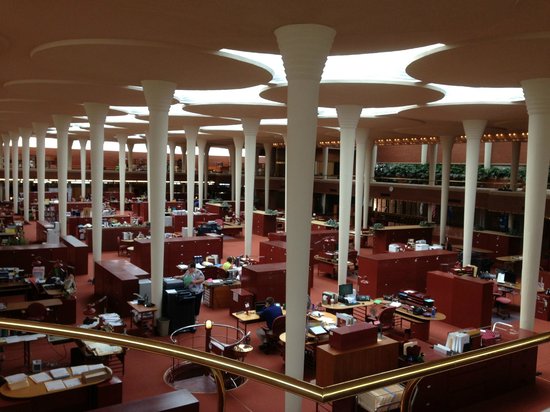
I saw a dozen shots of Frank Lloyd Wright’s Johnson’s Wax Building, juxtaposed with the covers of old Amazing Stories pulps, by an artist named Frank R. Paul; the employees of Johnson’s Wax must have felt as though they were walking into one of Paul’s spray-paint pulp utopias. Wright’s building looked as though it had been designed for people who wore white togas and Lucite sandals.


Interior of Johnson's Wax Building


Here, we see a reference to Amazing Stories, published by Gernsback, and the cover art of Frank R. Paul, an artist closely associated with this magazine's visual style, who trained as an architect himself. Downes says that we might think of these images and designs 'as a kind of alternate America: a 1980 that never happened. An architecture of broken dreams'. The narrator starts to warm up to the project, and he tries to re-imagine the environment around him according to this aesthetic:

I thought myself in Dialta Downes’s America. When I isolated a few of the factory buildings on the ground glass of the Hasselblad, they came across with a kind of sinister totalitarian dignity, like the stadiums Albert Speer built for Hitler. But the rest of it was relentlessly tacky: ephemeral stuff extruded by the collective American subconscious of the Thirties, tending mostly to survive along depressing strips lined with dusty motels, mattress wholesalers, and small used-car lots. I went for the gas stations in a big way.


As the photographer tunes in more and more to this 'shadowy America-that-wasn’t', the images begin to take on real forms, a phenomenon his journalist friend Kihn calls 'semiotic phantoms, bits of deep cultural imagery that have split off and taken on a life of their own'. Driving back to Los Angeles, he reflects on this explanation but it troubles him and, exhausted and agitated, he pulls over the car to sleep. Upon waking, he finds a phantom futuristic city looming before him; this is the ekphrastic element Richard highlighted in his talk:

Then I looked behind me and saw the city. The books on Thirties design were in the trunk; one of them contained sketches of an idealised city that drew on Metropolis and Things to Come, but squared everything, soaring up through an architect’s perfect clouds to zeppelin docks and mad neon spires. That city was a scale model of the one that rose behind me [...] You could hide the Empire State Building in the smallest of those towers. Roads of crystal soared between the spires, crossed and recrossed by smooth silver shapes like beads of running mercury. The air was thick with ships: giant wing-liners, little darting silver things (sometimes one of the quicksilver shapes from the sky bridges rose gracefully into the air and flew up to join the dance), mile-long blimps, hovering dragonfly things that were gyrocopters...

Even more troubling is the appearance of a couple, 'white, blond', the 'children of Dialta Downes’s ’80-that-wasn’t', framed by the illuminated shadow city. The narrator imagines the city populated by these creatures 'orderly and alert, their bright eyes shining with enthusiasm for their floodlit avenues and silver cars', deciding 'it had all the sinister fruitiness of Hitler Youth propaganda'.

The photography for Downes' book ends up being a great success. But, desperate to return to some kind of normality, the story ends with the photographer rushing to the nearest newsstand to buy a paper and read about the petroleum crisis and the nuclear energy hazard:

[Newsstand proprietor] ‘Hell of a world we live in, huh?’ [...] ‘But it could be worse, huh?’ 

‘That’s right,’ I said, ‘or even worse, it could be perfect.’

Overall then, Gibson takes a cynical view of the technophilia and optimism of the 1930s and 1940s, epitomised in the covers of Gernsback's SF magazines. As Bruce Sterling has commented, 'The Gernsback Continuum shows [Gibson] consciously drawing a bead on the shambling figure of the SF tradition'. Nevertheless, his evocative rendering of the 'semiotic phantoms' lurking in American architecture throws a sharp critical and visual lens on one of the country's many futures past.

Thursday, 31 August 2017

Cyberpunk 1990

Oxford English Dictionary – Cyberpunk: A genre of science fiction set in a lawless subculture of an oppressive society dominated by computer technology


The heyday of Cyberpunk was captured in a 1990 documentary by Marianne Trench and Peter von Brandenburg, providing an insight into its guiding ideas and featuring leading lights such as William Gibson, Jaron Lanier, Brenda Laurel and Timothy Leary. As a movement, it was primarily concerned with developments in technology, particularly artificial intelligence and virtual reality (the ‘consensual hallucination’ of a computer-generated world); “information wants to be free”, a phrase echoed by several participants in the documentary, symbolized their vision. Cyberpunk drew on influences from, and in turn influenced, art, fashion, film (Blade Runner was a major visual precursor), and literature (Gibson’s Neuromancer is its key text, while Jeff Noon’s Vurt and Neal Stephenson’s Snow Crash are both highly regarded); it manifested in computer hacking, ‘industrial’ music, rave culture, and video game graphics, all considered in the film. Whilst most commentators see a trend toward liberation, others strike a cautionary note; that the Utopian technology which can empower, may also enslave. Very much a product of its time, the documentary’s imagery and production values illustrate how quickly the cutting-edge can become obsolete. It remains a valuable document of what the future looked like in 1990, at the dawn of the ‘computer age’, though its main protagonists have enjoyed contrasting fortunes over the subsequent 27 years... 


William Gibson – the American novelist is regarded as the Godfather of Cyberpunk, many of its central themes originating in his 1984 novel Neuromancer, the biggest single influence on the sub-genre. Gibson famously created his vision of the future on a manual type-writer, didn’t have an e-mail address until 1996, and has stated that he has “never really been very interested in computers themselves. I don't watch them; I watch how people behave around them.” By the 1990s, as advances in technology brought some of his concepts toward reality, he was in demand as a spokesman, reflected in his extensive contribution to the documentary. Neuromancer (the first book of his ‘Sprawl’ trilogy) portrayed a post-industrial, high-tech society dominated by multi-national corporations – zaibatsus – where national boundaries have been dissolved, and individuals define their identity through consumer products. He coined the term ‘cyberspace’ in his 1982 short story ‘Burning Chrome’, to denote the virtual territory contained within computer networks, before the worldwide phenomenon of the Internet. Another of his early short stories, ‘Johnny Mnemonic’, was filmed in 1995, with a pre-Matrix Keanu Reeves in the title role, as a cyber-courier who carries information in his brain – the acting, simplified plot and already-dated setting brought widespread derision (a fate shared by the same year’s risible techno-movie Hackers), although most critics recognised its distance from Gibson’s original conception.


William Gibson. Photo: Christopher J. Morris/Corbis via Getty Images
The 2000 documentary by film-maker Mark Neale, No Maps for these Territories, provides an introduction to Gibson’s biography and preoccupations, as he makes observations on the ‘mediated world’ we live in, during a road-trip across America. The author remains closely associated with Cyberpunk; though his later work has taken him in different directions, he continues to examine consumerism, corporate influence and globalisation, the evolution of the Internet and social media, believing that “the digital has become the constant; it’s becoming where we all are, all the time.”


Timothy Leary in his 1960s pomp
Timothy Leary – best known for his notorious role in the sixties counter-culture, associated with the use of mind-expanding drugs (which he not only advocated, but experimented with enthusiastically), and coining the phrase ‘tune in, turn on, drop out’. A clinical psychologist, researcher and Harvard academic until his drug-related dismissal in 1963, Leary became a major media figure, later described by then-President Richard Nixon as “the most dangerous man in America”. After multiple periods of imprisonment, and a relatively low public profile during the 1970s, Leary embraced the coming ‘cybernetic’ era – the concept of technological revolution embodied by Cyberpunk in the mid-to-late 1980s – adapting his former phrase to ‘turn on, boot up, jack in’ and declaring “the PC is the new LSD”. He saw the potential of home computing, virtual reality and the web as forces for personal liberation, able to free individuals from state control, and to subvert governmental and other power structures. His involvement with new technology extended to creating video games (including a project to produce a version of Neuromancer), endorsing the Mattel Power Glove – a gaming device “unique for its time, allowing players to use motion to control their games” – and acting as ‘technical consultant’ on Billy Idol’s somewhat opportunistic 1993 album Cyberpunk. Leary died in 1996.

Timothy Leary at the time of Cyberpunk

Jaron Lanier, then (above) & now (below)
Jaron Lanier – although only featuring briefly in the documentary, Lanier has since established himself as a leading figure in emerging technology, addressing its philosophical implications and the shortcomings of the Internet. His credentials are both practical and theoretical, as a computer science pioneer, early adopter of virtual reality and software developer. He has been involved in the field since the early 1980s, first working for Atari and then forming his own company, VPL Research, concentrating on visual programming language and virtual reality applications. Lanier has retained his status as a credible commentator and an independent authority, becoming a successful author and public speaker, outlining potential future developments and their impact on wider society in books such as You Are Not a Gadget (2010) and Who Owns the Future? (2013).


Michael Synergy – an enigmatic figure, clearly enjoying the attention bestowed on him by the documentary makers as a man with “the power to bring down governments”, Synergy has, for whatever reason, not enjoyed such publicity since its release. In fact, he has all but vanished – even from the cyberspaces of the Internet – personal details are scant, and information on his subsequent career hard to come by. 

Michael Synergy – current whereabouts unknown

Monday, 28 April 2014

Interconnections: From William Burroughs to Steely Dan to William Gibson (Part Two)

Two


Burroughs had his own career as a recording artist, releasing a series of spoken-word albums; his first official LP, in 1965, produced at and issued by the English Bookshop in Paris (42, rue de Seine on the Left Bank), was Call Me Burroughs. The Beatles apparently all had copies of the record, as well as art dealer Robert Fraser and members of the Rolling Stones. He also experimented with tape ‘cut-ups’ in much the same way as his writing – the recordings he made with Ian Sommerville in London were eventually released as Break through in Grey Room in 1986. 1990 saw the acclaimed release of Dead City Radio, an album which served as a musical vehicle for Burroughs’ spoken words; the following year, the film version of Naked Lunch, directed by David Cronenberg, helped to consolidate his relevance to a new generation. Throughout his career, he regarded collaboration as an essential part of the creative process; he later worked with artists such as Laurie Anderson, Kurt Cobain, R.E.M., Patti Smith, Tom Waits and also, appropriately, Donald Fagen of Steely Dan. Sonic Youth paid overt homage in a series of albums, and were among those to visit Burroughs at his home in Lawrence, Kansas (in 1993). 

An American writer based in Canada, William Gibson’s 1984 novel Neuromancer popularised the science fiction ‘Cyberpunk’ sub-genre [1], marked by a fascination with technology. Gibson has confessed that “I had to teach myself not to write too much like Burroughs”, though his own work remains highly acclaimed and influential. His novels are also known for their frequent allusions to Steely Dan, a band whose name was itself taken from Naked Lunch. While suggesting the use of the name shouldn’t be taken too literally, Donald Fagen conceded that “we have certainly picked up on some of his world view. I admire Burroughs a lot.” 

Gibson has described Steely Dan’s music as “among the most genuinely subversive oeuvres in late 20th-century pop”. Direct references to their songs in his work include Barrytown (a location), The Gentleman Loser (a bar), Here at the Western World (another bar), and Klaus and the Rooster (characters). Steely Dan, formed in New York, were ostensibly a conventional seventies soft-rock act. They were nonetheless labelled “the perfect musical antiheroes for the Seventies” by Rolling Stone magazine – possibly owing to the sometimes sinister effect of their cryptic, often obscure lyrics hidden within smooth jazz-rock arrangements, suggesting subversive intent; according to Danny Weizmann (in Too Cool), they “pushed the most potent lyric pills since mid-Dyl[an].” 

Gibson is an outwardly conventional figure in appearance (as Burroughs was); he is an innovator in terms of ideas, if not language. The last twenty years particularly have seen him moving beyond traditional sci-fi in a series of novels exploring what happens to humanity in an increasingly technologically-dominated society, tackling the nature of ‘virtual reality’ and the role of the Internet in shaping the modern world, addressing the insidious nature of corporate advertising and branding. Gibson investigates the implications for the very near future, in effect commenting on contemporary life; in this respect he shares an affinity with English author J.G. Ballard, another admirer of Burroughs, who also moved beyond the conventions of science fiction. Gibson’s work has been characterised by critic John Clute as “SF for the new century.” Whilst the Steely Dan references have lessened in recent years, he still titled his 1999 novel All Tomorrow’s Parties, a nod to Lou Reed, the Velvet Underground and their counter-cultural legacy. That book also featured a mysterious character known as the ‘Tao man’, who Gibson has explained as “some sort of avatar connected to the late William Burroughs. An unconscious expression of Burroughsness.”

However, there is always a flip-side to these rich interconnections: Billy Idol paid a dubious homage to Gibson with his 1993 Cyberpunk album, featuring a track entitled ‘Neuromancer’; an enterprise mildly described by Gibson as “very silly.” Also preferably ignored are the subsequent adoption of Deacon Blues (a dire 1980s band appropriating a Steely Dan song title), and The Wild Boys (another Burroughs title and, extending the connection, dismal Duran Duran hit; a group whose own name derived from the 1968 science fiction film Barbarella). In his later years, all manner of unlikely musicians, without any obvious connection to him or signs of influence, began to see a Burroughs photo-opportunity as an ideal means of establishing their own counter-cultural credentials – chief among them Sting and the ubiquitous Bono. While the music of Steely Dan and the novels of William Gibson have a devoted following, they are essentially cult interests. Despite the avant-garde origins and often challenging nature of his work, it is Burroughs who has permeated popular culture, for better or worse.


The influences and the influenced: Call Me Burroughs (Original Cover Design: Tientje Louw, Cover Photo: Harriet Crowther); Neuromancer (Front Cover Illustration by Steve Crisp); Cyberpunk (Cover Art by Mark Frauenfelder)


[1] OED definition: A genre of science fiction set in a lawless subculture of an oppressive society dominated by computer technology; it has been said that “without Naked Lunch there would probably be no cyberpunk” (Richard Kadrey and Larry McCaffery, Storming the Reality Studio: A Casebook of Cyberpunk and Postmodern Fiction, 1991)

Thursday, 3 April 2014

Interconnections: From William Burroughs to Steely Dan to William Gibson (Part One)

Introduction


The novels of William S. Burroughs, notably the notorious Naked Lunch, written in the late 1950s and early 1960s, have exerted a disproportionate influence on counter-cultural artists, authors, film-makers, and musicians over subsequent decades. Among those influenced by Burroughs are the 1970s pop group Steely Dan, who took their name from a rubber appendage in Naked Lunch; it is possible to trace a line through that band to contemporary science fiction author William Gibson in the 1980s and 90s, a writer known for references to Steely Dan lyrics in his work. It is but one instance of the continued relevance of Burroughs in cultural life, a legacy primarily illustrated through the medium of popular music.

One

“It is a book unlike any other. Famous, infamous, derided, and banned but also recognised as a work of genius. For fifty years, it has tantalized, shocked, baffled, and inspired. It simultaneously holds a significant place in postmodern literature while retaining its iconic, underground allure, resisting diverse critical attempts to define and explain it. It is an aberrant concoction, stylistically brilliant and structurally disorientating, obscene and blasphemous and yet satirically cathartic and redemptive.”

[Oliver Harris and Ian MacFadyen, Preface to Naked Lunch @ 50: anniversary essays, 2009]

Burroughs came to prominence in parallel with the Beat Generation [1], which he described as a “sociological movement… a cultural revolution”, and is often cited as Godfather and Mentor of the Beats (though a reluctant pioneer himself, never keen on being allied with any group or cause). His reputation was forged with Naked Lunch, published in 1959, which completes the seminal trilogy of Beat works (after Allen Ginsberg’s Howl and Jack Kerouac’s On the Road). His work has become a byword for the transgressive in modern literature; his status as an iconoclastic figure was recognised in his appearance on the cover of the Beatles’ Sgt Pepper in 1967, together with numerous major cultural figures. He is credited with introducing the terms ‘Blade Runner’ and ‘heavy metal’ to popular culture – in The Soft Machine, the character Uranian Willy is described as “the Heavy Metal Kid” – a reference initially taken up by the band Steppenwolf, which came to be used for an entire musical genre.

Whilst acknowledging that many readers would find it ‘disgusting’, contemporary critic Mary McCarthy declared in her New York Times review that the almost-plotless Naked Lunch “must be the first space novel, the first serious piece of science fiction.” Avant-garde and experimental it may have been, but many readers must have been not only ‘disgusted’, but thoroughly confused, “as Burroughs's alter-ego William Lee and a shifting cast of protagonists drift in and out of heroin-laced visions of scoring drugs, sexual obsession and degradation, bizarre political plots, and even stranger medical experiments.”

Naked Lunch (whose title was suggested by Kerouac) can be seen as a synthesis of Burroughs’ myriad interests: philosophy, science, language, consciousness, mind travel, altered states and pharmacology. Recognised as a radical, subversive artistic statement, the book was subjected to censorship and faced charges of obscenity (it was banned after a trial in Boston in 1962, a verdict overturned four years later); it repulsed mainstream western society – read as a reaction against its values – challenging the use of language as a means of political, sexual and social control. For Burroughs biographer Barry Miles, it remains “a devastating attack on the hypocrisy, greed, racism, addiction to power and mindless suburban consumerism of the postwar American way of life.”

The origins of Burroughs’ pioneering works lie with Brion Gysin, a British-Canadian poet and painter, and his invention of the cut-up technique – using random juxtapositions of text which are literally cut into pieces and re-assembled. This was adopted by Burroughs when the two were living at the Beat Hotel, Paris (9 rue Gît-le-Coeur, in the Latin Quarter) in the 1950s; he acknowledged Gysin as “the first to create cut-ups.” Burroughs had been attempting to edit Naked Lunch for several years, and finally completed it using this technique. Each of the cut-up novels which followed Naked LunchThe Soft Machine, The Ticket That Exploded, Nova Express – proved especially influential; David Bowie has by his own admission made use of the method in his lyric writing. Another musician active in New York in the mid-to-late 1970s, David Byrne of Talking Heads, has described the cut-up technique as a means of “achieving a freedom from the strictures of conventional language and thought”.


Naked Lunch & Soft Machine UK Corgi covers, courtesy of www.beatbookcovers.com

1960s Canterbury-based band The Soft Machine – whose leader, Daevid Allen, had lived at the Beat Hotel – became one of the first Burroughs-inspired names for musical groups, a list which may have begun with the Mugwumps in New York in the early 1960s, and later included Nova Mob and Thin White Rope in the 1980s and 90s. The Velvet Underground are one of several bands to acknowledge the influence of Burroughs, the subject of their 1970 song ‘Lonesome Cowboy Bill’; their songwriter Lou Reed said that “Burroughs alone made us pay attention to the realities of contemporary life and gave us the energy to explore the psyche without a filter.” An early instance of lyrical inspiration drawn from Burroughs can be found in the 1970 film Performance, where Mick Jagger’s ‘Memo from Turner’ includes the line “the man who squats behind the man who works the Soft Machine”.

With his transgressive fiction and anti-authoritarian stance, Burroughs is regarded as a significant influence on punk – during the 1970s he lived close to its major venues in New York’s Bowery district, CBGBs and Max’s Kansas City, where he could often be found, and wrote a column for rock magazine Crawdaddy. Several musicians active in that scene took inspiration from the work of Burroughs – for example, both Iggy Pop (explicitly in his song ‘Gimme Some Skin’) and Patti Smith (in her debut album Horses). In addition, the lyric of Iggy Pop’s ‘Lust for Life’ has its source in the ‘operation rewrite’ section of Burroughs’ novel The Ticket That Exploded – the character of Johnny Yen, strip teases, torture films and “hypnotising chickens” can all be found here. His enduring influence extended to the UK in the same period, where it can also be located in Joy Division’s 1979 song ‘Interzone’ – the imagined setting of Naked Lunch – which also became the title of a respected British science fiction magazine founded in the early 1980s [a publication whose Leeds origins will be explored in a future post].

[1] OED: a movement of young people in the 1950s and early 1960s who rejected conventional society, valuing self-expression and favouring modern jazz. Wikipedia: Central elements of “Beat” culture included rejection of received standards, innovations in style, experimentation with drugs, alternative sexualities, an interest in Eastern religion, a rejection of materialism, and explicit portrayals of the human condition.