Showing posts with label Andrei Tarkovsky. Show all posts

Sunday, 28 August 2022

The Story of Stalker

The 1972 novel Roadside Picnic by the Strugatsky brothers, Arkady (1925-1991) and Boris (1933-2012), is described by Ursula Le Guin as “a ‘first contact’ story with a difference.” The alien ‘visitors’ have been and gone, apparently indifferent to Earth and its inhabitants, leaving behind in the Visitation Zones a range of objects which remain completely mysterious to Man. Some are deadly, others highly useful and technologically valuable (such as ‘eternal batteries’) – but their operating principles are totally impenetrable to science, despite institutes dedicated to their study. Le Guin makes the comparison with Solaris, “in which the human characters are defeated, humbled by their failure to comprehend alien messages or artefacts.”


The plot focuses on one of the six Zones – the location is never specified but resembles North America – and the characters who operate in the scientific institute and black market which have grown up around it. Among the troubling phenomena in the wake of the visit are mutated children, reanimated corpses returning to their former homes and catastrophes which follow emigrants from the Zones. The unpredictable hazards within the Zone itself defy the laws of physics; there have been attempts to seal and guard it, but the value of the mysterious artefacts within attracts intruders, or ‘stalkers’. They risk their lives amid the dangers of ‘burning fluff’, ‘mosquito mange’ and ‘witches’ jelly’ to return and sell their bounty. Red Schuhart is one such stalker, and the main protagonist of the novel, last seen in search of the ‘Golden Ball’ which reputedly has the power to grant wishes.

Arkady Strugatsky was a translator and editor, Boris an astro-physicist and computer mathematician. The brothers began writing together in the late 1950s and were the most popular science fiction authors in the USSR but, as Yvonne Howell relates, this did not stop them falling into “a precarious position as writers neither wholly approved of, nor yet officially black-listed.” Boris Strugatsky later charted the tortuous publishing history of Roadside Picnic, which had originally been written in 1971. After appearing in the journal Avrora in 1972, it took eight years to navigate the labyrinth of Soviet-era literary bureaucracy and the eventual book publication was heavily censored. He gives one instance of an 18-page document submitted by the ‘language editors’ – a list of removals and substitutions, covering such categories as ‘Comments Concerning the Immoral Behaviour of the Heroes’, and ‘Comments About Vulgarisms and Slang Expressions’.


Arkady & Boris Strugatsky


On its English translation in 1977, the novel found admirers including Le Guin abroad. In the Soviet Union, the director Andrei Tarkovsky had been so impressed with the story in its journal form that he almost immediately decided to embark on a film version, his second foray into science fiction after Solaris. The term ‘stalker’ was previously unknown in the Russian language – the brothers borrowed it from Rudyard Kipling’s Stalky & Co and Tarkovsky adopted it for his title. By 1975, he had agreed to work with the Strugatsky brothers on the script, and shooting began in 1977; after initial filming in Tajikistan was interrupted by an earthquake, moved to locations around Tallinn, Estonia.

Arkady Strugatsky recalled the tortuous process of scriptwriting for the film – frustration at the frequent changes demanded and last-minute re-writes. Besides the liberties Tarkovsky was taking with the plot, the script was often discarded completely in favour of improvisation on the set. While the brothers were nominally the scriptwriters, the director was seemingly keen “to move away from the original science fiction concepts and premises of the original story”. A baffled Arkady was advised by Tarkovsky that “Stalker must be quite different… I don’t want that bandit of yours in the screenplay.” Eventually they were compelled to write a completely new script, now ‘a fable’, which continued to be adapted, on the set and in post-production. Like Lem before them with Solaris, the Strugatskys more or less disowned the film, claiming the final script was essentially Tarkovsky’s.


There were further hazards awaiting the film, beyond the usual wrangles with the authorities – after several months, it became apparent that the film stock was defective and useless. Tarkovsky somehow managed to get permission (and money) to re-shoot from scratch and it progressed to a general release in May 1979 without significant cuts. In their study The films of Andrei Tarkovsky, Johnson and Petrie record however that: “Official disapproval was exhibited in the almost complete absence of reviews in major Moscow newspapers and journalists.” Most of the minimal publicity was negative, the director “accused of wasting public funds for films he made ‘for himself and his friends’.” A prize-winner when screened at Cannes in 1980, Stalker was well received in the West with a steadily growing cult reputation. It was the final film that Tarkovsky made in the Soviet Union; he spent the final years of his life in Europe.

The filmed version retains the basic outline of Roadside Picnic – the Zone with its altered laws of physics and incomprehensible dangers (such as ‘the meatgrinder’) – and the concept of stalkers. As he had indicated to the Strugatskys, Tarkovsky made significant changes to the characters, namely Red, who is replaced by the eponymous Stalker as the guide to the Zone. The opening scenes show the Stalker, his daughter evidently altered in some way (as is Red’s daughter Monkey in the book), and begged by his wife not to return to the Zone, emerging into a post-apocalyptic wasteland. Rather than a hard-bitten mercenary prone to violence, compelled to return by financial necessity, his is a more philosophical quest as, avoiding military patrols, he leads his companions into the Zone. This pair, known only as Professor and Writer, have even more obscure motives for entering the Zone, with their goal the enigmatic Room at its heart (an analogue of the ‘Golden Ball’).


By the time Tarkovsky died in Paris on 29 December, 1986, Stalker had taken on darker significance with the Chernobyl disaster of April that year, and the resulting fall-out Zone around the plant. The overgrown wasteland and bleak industrial ruins of the film’s Zone have been seen to anticipate the Soviet tragedy. This theme is made explicit in the video game franchise S.T.A.L.K.E.R. (beginning with Shadow of Chernobyl), as mercenaries brave the irradiated landscape in search of its treasures. Many of the novel’s hazards and artefacts, discarded in the film, are revived in the game – ‘burning fluff’, ‘mosquito mange’, ‘black sprays’ and ‘full empties’. Johnson & Petrie note that: “Among Russian film buffs, Stalker has become a kind of cult figure and film, foreshadowing Chernobyl and the ecological, social and moral collapse of the Soviet Union.”

Among the film’s Estonian locations were two abandoned hydroelectric power stations; downstream along the Jägala River from a chemical plant. Stalker’s sound designer, Vladimir Sharun, recalls it pouring out “poisonous liquids… white foam floating down the river. In fact it was some horrible poison.” Sharun attributes the death of Tarkovsky, his wife Larissa, actors Nikolai Grinko, Aleksandr Kaidanovsky, Anatoly Solonitsyn and others involved in the production to this sinister setting.


Map of Stalker's locations


Stalker inspired Geoff Dyer’s meditation, Zona: A Book about a Film about a Journey to a Room, a detailed examination of the film. Dyer is among the critics to see echoes of the Soviet Gulags in Tarkovsky’s work, finding it “haunted by memories of the camps,” in the vocabulary of the Zone and the Stalker’s shaved head. James Norton’s article ‘Stalking the Stalker’ reaches a similar conclusion, that the Zone “was also the term by which the Gulag was known, as the Russian audience would have recognised.”

The Strugatsky brothers continued to influence Soviet science fiction, with other popular film adaptations of their work including Dead Mountaineer’s Hotel, and Hard to be a God. The director Konstantin Lopuchansky was an assistant to Tarkovsky on Stalker, and the influence of film and director can be seen in the post-apocalyptic landscapes of Letters from a Dead Man (1986) and Visitor to a Museum (1989). Lopuchansky returned to the dystopian sci-fi theme in 2006 with The Ugly Swans, also based on a novel by the Strugatskys. The Ugly Swans revisits many aspects of Roadside Picnic in its setting of a quarantined zone, mutated children, and allusions to the aftermath of alien visitation.


Saturday, 26 February 2022

The Story of Solaris

Solaris is the best-known work of the Polish novelist Stanisław Lem (1921-2006), a philosophical science fiction writer. It has been adapted twice into major feature films and on each occasion met with the author’s disapproval.

Lem’s 1961 book re-evaluates the nature of Contact with a truly alien intelligence, an immeasurable and unknowable entity. It opens with the arrival of a psychologist, Dr Kris Kelvin, at the station on Solaris, a distant planet dominated by its sentient, plasmic ocean. The disordered state of the station is reflected in the mental distress of the beleaguered remaining crew – the ocean apparently sends ‘visitors’ to them, (re-)constructed from their memories. From the initial premise, Kelvin recounts the science of Solaristics, the planet’s discovery, exploration and studies/theories of the ocean’s enigmatic organic structures, before he receives his own ‘visitor’. 


The Yugoslav SF writer, Darko Suvin, a contemporary of Lem’s, credits the Polish author with raising sci-fi “to the dignity of a major literary genre,” praising Solaris as “puzzle, parable and cognition of freedom”. Critics have attempted to unlock the book’s “psychological puzzle” by placing it within a Freudian framework or interpreting it as a parable of madness/schizophrenia. Acknowledging the novel’s complexity, Richard E. Ziegfeld saw in it Lem’s depiction of “the infinite nature of the universe,” contrasted with “the limits of man’s knowledge”.

Both the English and Russian translations of Solaris are problematic – an English version (the first of any of Lem’s work) was not available until 1970, Joanna Kilmartin and Steve Cox basing it on a French translation. The background to the film adaptation is similarly complex and difficult. The very first film was made for Soviet television in 1968, directed by Boris Nuremberg and, though low-budget, regarded as faithful to the novel (more so than the following versions). It was Andrei Tarkovsky’s film, released in 1972, that remains the most celebrated and controversial version of Solaris.

An “uncompromising visionary” working within the Soviet system, Tarkovsky had no love of science fiction, but (correctly) reasoned that working within the genre would grant him greater leeway. He had seen numerous projects blocked outright, and others subject to lengthy delays before release. According to artist and the set designer of Solaris, Mikhail Romadin, in the eyes of the authorities sci-fi “was hardly serious and intended for youngsters”. Tarkovsky’s proposal of “a futuristic thriller set on board a remote space station” was granted official approval by Goskino (USSR State Committee for Cinematography), though an initial draft of the screenplay re-located two-thirds of the film to Earth. After meeting a disapproving Lem in Moscow, and working with writer Friedrich Gorenstein, Tarkovsky settled on another draft, closer to the novel. 

Andrei Tarkovsky on the set of Solaris

However, the final version of Solaris, clocking in at more than two and a half hours at a stately pace, concentrates more on the ‘human’ aspect of the narrative. The film inserts a lengthy prologue on Earth, at Kelvin’s dacha, where the pilot Berton’s report on the phenomena he witnessed in the ocean is delivered. Kelvin’s relationship with his own ‘visitor’ and the response of the other inhabitants of the station to theirs remains central. Even after filming was completed, at a reduced budget, further changes and cuts were requested by the authorities. Ostensibly science fiction, Soviet censors still objected to the religious themes (present in all Tarkovsky’s work) and caused the usual delays in the film’s release; meanwhile Lem, already irritated by the liberties taken with his novel in the screenplay, accused the director of making “Crime and Punishment in space”.


Coming soon after Stanley Kubrick’s celebrated 2001: A Space Odyssey, there was bound to be a perception of Solaris as a Soviet equivalent. Where 2001 used compositions by Johan and Richard Strauss, J.S. Bach provides the main theme for Solaris, with additional soundtrack contributions from the contemporary Soviet electronic music composer Eduard Artemiev (in the first of his three collaborations with Tarkovsky). The production values reflected the respective budgets, with Mikhail Romadin in charge of the slightly kitsch interior design of the Solaris space station at the state studio Mosfilm – cutting-edge certainly in terms of Soviet film at the time, the future has dated rapidly in this instance. However, Tarkovsky clung to his vision of a mysterious, philosophical epic, haughtily dismissing 2001 as “phony... a lifeless schema with only pretensions to truth,” and continuing to bemoan his own film’s sci-fi trappings as “a distraction.” 


After winning the Grand Jury Special Prize at the 1972 Cannes Film Festival (and also the BFI’s ‘Film of the Year’ award), the international reputation of Solaris was secured. Its many admirers see it as a high watermark for the genre in film: “the benchmark against which all sci-fi should be held accountable.” The English writer Trevor Hoyle was “absolutely blown away” by Tarkovsky’s “magical” film. Other critics have found it confusing, overly long, pretentious and – presumably in contrast to 2001 – commented on its “visual poverty” (New York Times). The director himself later came to regard Solaris as the least favourite of his films.

Like 2001, Solaris has been subjected to innumerable academic re-readings and critical interpretations, and remains the director’s most enduring work. Tarkovsky returned once more to science fiction for the similarly fascinating, grandiose and troubled Stalker in 1979. He left the Soviet Union the same year, made two further films during his European exile and died of cancer in Paris, aged only 54, in 1986.


Long after Tarkovsky’s death, a third adaption of Solaris was made, this time in the United States. Steven Soderbergh’s slick and expensive 2002 film version, while cutting more than an hour off the running time, is essentially a Hollywood re-make of the Soviet epic thirty years on rather than an attempt to return to Lem’s text. The author was distinctly unimpressed: “And I thought Tarkovsky’s Solaris was bad.”

In continuing to distance himself from both major versions of the film, as late as a 2002 interview, Lem stated: “As Solaris’ author I shall allow myself to repeat that I only wanted to create a vision of a human encounter with something that certainly exists, in a mighty manner perhaps, but cannot be reduced to human concepts, ideas or images.”


Stanisław Lem

Tuesday, 31 October 2017

Communist Post-Apocalyptic Film

The dogged band of survivors in the aftermath of apocalypse – whether alien attack, environmental disaster, nuclear war, or worldwide pandemic virus – has become a preoccupation of science fiction, especially since World War Two and the dropping of the atomic bomb on Hiroshima and Nagasaki. Developing from H.G. Wells’ visionary The Shape of Things to Come, filmed in 1936 by William Cameron Menzies, the theme has proliferated in the post-War years, becoming a sub-genre in its own right; notable novels and film adaptations range from On the Beach and I Am Legend (filmed as The Omega Man) in the 1950s, through The Day of the Triffids, to the contemporary 28 Days Later and The Road. In the distinctive Eastern European version of the post-apocalyptic film, at its peak between the 1960s to the decline of the Soviet Union in the late 1980s, the last representatives of humanity are typically corrupt, cynical, disillusioned, and dishonest – the nobler qualities having vanished in the struggle for survival. The bleakest examples portray the ragged remnants of mankind, often diseased or mutated, reduced to scavenging among the post-industrial ruins, occasionally emerging from improvised shelters to salvage a few precious relics of civilisation – from libraries, museums, and schools. As they gather in claustrophobic and spartan enclaves waiting for the inevitable end, there is a stark contrast with the initial optimism which followed the October Revolution of 1917. 


In the early years of Soviet rule, the Bolsheviks actively encouraged the population to look forward to the expansion of Communism, spreading a Utopian message both on earth (‘world revolution’) and into the cosmos. The Party enlisted artists to promote their vision in state-sanctioned productions, notably the film Aelita: Queen of Mars (1924), itself preceded by leading Bolshevik Alexander Bogdanov’s 1908 novel Red Star, which effectively transplanted Marxism to Mars. That expansive mood had long since been dissipated; firstly by the dictates of ‘socialist realism’, aggressively promoted under Stalin, which disdained science fiction in favour of heroic portraits of the Soviet workers’ struggle, and later by economic stagnation and social decay, Cold War paranoia and pessimism. The 1966 Czech film The End of August at the Hotel Ozone depicts a group of virtually feral female survivors wandering the desolate countryside, anticipating a bleak, cruel and violent future. 1985’s O-Bi O-Ba (subtitled The End of Civilisation) by Polish writer/director Piotr Szulkin, is set in a particularly grim underground bunker, whose inhabitants endure a hopeless wait for a new Ark. Both represent a widespread disillusionment with the project of international Communism, and express subtle dissent against the central control exerted by Moscow over its satellite nations of the Eastern Bloc.


Above: Poster for Aelita

Right: Poster for Voyage to Mars


Though still closely overseen by the state after the death of Stalin, film-makers, artists and writers were able – often avoiding censorship by using science fiction as a metaphor – to articulate these fears. In 1972, Soviet director Andrei Tarkovsky filmed Solaris, based on Stanislav Lem’s novel, set on a near-deserted, distant space station; a meditation on an aborted mission which paralleled the abandonment of the space programme. With the launch of the Sputnik 1 satellite in 1957 and Yuri Gagarin’s historic orbital flight four years later, there had been a brief rush to glorify the triumphs of the cosmonauts; after the American moon landing of 1969 effectively marked the end of the space race, the focus largely shifted from the conquest of the stars to the struggle for survival on an ailing earth. 


Tarkovsky returned to science fiction themes in 1979’s Stalker, adapted from the novel Roadside Picnic by the brothers Boris and Arkady Strugatsky. Fredric Jameson’s Archaeologies of the Future considers Roadside Picnic in terms of problematic or ‘failed’ Utopias, with professional scavengers, or ‘stalkers’, entering the Zones (sites of alien visitation, now sealed by the authorities) in search of bounty, though they run the risk of encountering inexplicable dangers and death. As it transpired, the filming locations close to the Estonian capital Tallinn proved deadly; an abandoned electrical generating station and the Jägala River, polluted by an upstream chemical works were linked to the early deaths from bronchial cancer of Tarkovsky, his wife Larisa, and actor Anatoly Solonitsyn. The Zone, mysterious centre-piece of book and film, was not only the name later applied to the contaminated area of exclusion around Chernobyl but, as James Norton noted in an article for Vertigo magazine, ‘Stalking the Stalker’, “was also the term by which the Gulag was known, as the Russian audience would have recognised.” 


Location map for Stalker

 The loose trilogy of post-apocalypse nightmares by Tarkovsky’s protégé Konstantin Lopuchansky – Letters from a Dead Man, Visitor to a Museum, and The Ugly Swans (another adaptation of a novel by the Strugatsky brothers) – focus unflinchingly on the decline of the Communist dream. This trio of films, the first two made in the later 1980s, are alike set in landscapes blighted by industrial pollution, radiation fall-out, and toxic waste, resulting in mental illness and physical mutations. These futuristic visions were thinly-veiled echoes of a catastrophic reality; the 2016 documentary City-40, exposing the once-hidden ecological devastation in one of the Soviet Union’s uranium-processing ‘closed cities’, was part of a gradual process revealing the extent of environmental destruction. Just as the locations of Stalker offered a haunting precursor of tragic things to come, the ravaged nuclear fall-out setting of Letters from a Dead Man pre-figured the Chernobyl disaster, which occurred in the same year as the film’s release, 1986. Combined with an escalating arms race between the USA and USSR, which by the 1980s threatened to become a full-blown conflict, world-wide apocalypse no longer seemed a film-maker’s fanciful notion.

Sunday, 26 October 2014

Structures of Soviet Science Fiction (II)

While the art-work of Ilya Kabakov (discussed in Part I) documents the decline of the Soviet Space Age, further evidence of this ongoing process is abundant in modern-day Russia. A visit to the Space Museum in Moscow in the early years of the twenty-first century confirmed the distance between the heroic feats of Gagarin and his fellow cosmic pioneers, mythologised in Soviet propaganda, and the true state of affairs in the post-Communist era. The dingy gallery of space junk had its own charm, with its obsolete hardware and the space-suited dogs Belka and Strelka who fell to earth, alive, complete with their clear spherical helmets. Signs of neglect were evident in this main gallery; though perhaps the dim illumination of the gloomy chamber was for conservation purposes, rather than cost-cutting, the Museum offered little in the way of either customer service or exhibition interpretation. It all seemed very distant from the smiling Cosmonauts gazing skyward, in anticipation of conquering the heavens.

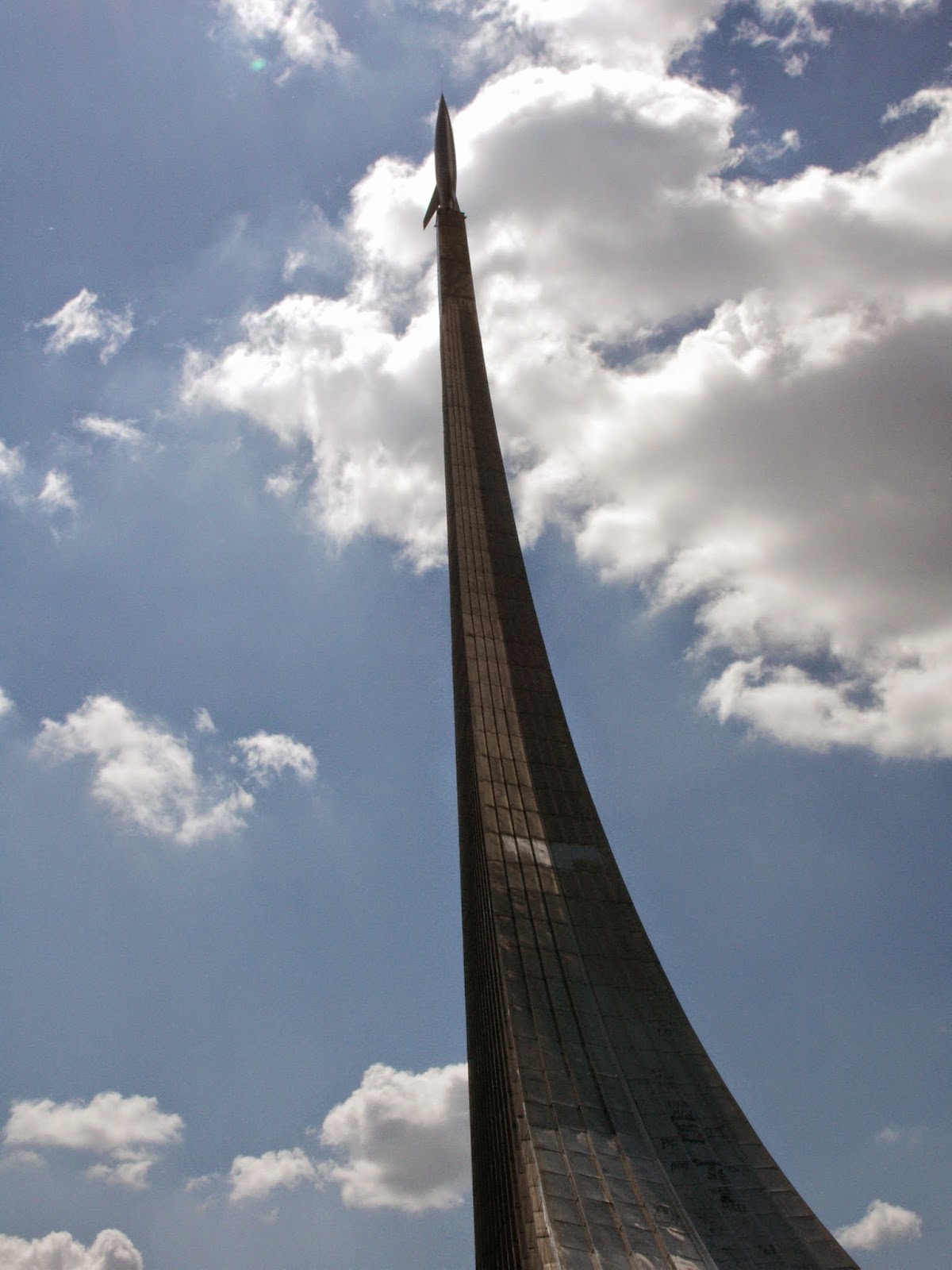
On the paved space above the Museum-bunker stands the imposing metallic Space Monument, thrusting toward the stars; it is surrounded by the Pavilions of the VDNKh – the former All-Union Exhibition of Economic Achievements – a showcase of planned-economy productivity. In the vast interior spaces where once the achievements of the mighty State in all spheres of science and industry were proudly displayed, the void is now filled by market stalls selling competitively-priced consumer goods; as in the Museum, rockets, satellites and even space capsules are mere theme-park sideshows. Thus the vanished Soviet utopian dream, a gleaming, technologically-advanced future, has left behind a faded splendour. The derelict worlds of futuristic entropy portrayed in Andrei Tarkovsky’s 1970s films Solaris and especially Stalker (both based on sf novels by eastern European authors), documents from the years of stagnation before Communism’s terminal collapse, begin to look painfully prophetic. The whole Exhibition complex, evidently still a popular attraction, appeared run-down to western eyes, in a state of decay and dilapidation, slowly becoming overgrown; the subsequent refurbishment of the Space Museum was, in truth, long overdue.


Above: Belka & Strelka in the Space Museum
Right: The Space Monument


Artists Jane and Louise Wilson, sisters from Newcastle-upon-Tyne, are among those to have investigated the relics of the Soviet Space Age, notably with their installation piece, Star City (2000), filmed at the formerly secret Cosmonaut training base outside Moscow, Zvyozdny Gorodok (translated literally as ‘Starry Town’). Once a source of Soviet pride, the facility has only survived into the twenty-first century by embracing space tourism and western capital. The Wilson sisters have also engaged with another, grimmer aspect of the Soviet legacy in their 2012 film The Toxic Camera. Taking as its subject the nuclear reactor explosion at Chernobyl in 1986, and the subsequent deadly toxic fall-out, it utilises contemporary footage taken at the scene by Soviet film-maker Vladimir Shevchenko, who later died due to the radiation he was exposed to there. In the Wilsons’ photographic series, Atomgrad, haunting images of the city of Pripyat, abandoned in the wake of the disaster, evoke the wider damage of state-sponsored environmental pollution and the dystopian high-rise collective housing estates which dominate the urban landscape, from the suburbs of the capital to the towns of the provinces.

The central concept of the novel Roadside Picnic by brothers Arkady and Boris Strugatsky, Soviet science fiction writers, which was filmed as Stalker, is ‘The Zone’; in book and film this is a sealed-off area once visited by extra-terrestrial life, where earth’s physical laws no longer apply and strange things occur. Later the term was also applied to another zone of exclusion – the irradiated region around Chernobyl, marking the limits of human habitation after the disaster. The parallels between the fictional post-apocalyptic ‘Zone’ and the all-too-real one between Belarus and Ukraine are reflected in the growth of ‘anti-tourism’, with increased visitors to the area in recent years. This has also given rise to its further use as a set for a virtual gaming environment, with scenes based on photography taken in the actual physical location. 


Hotel Cosmos

The superficial brilliance of contemporary Moscow, represented as a resurgent, shiny megalopolis of gangsters, oligarchs and pop stars in the blockbuster films Night and Day Watch (2004 and 2006, both based loosely on Sergei Lukyanenko’s novel The Night Watch) suggests another (science-) fictional world, embodied by their use of the strikingly futuristic Hotel Cosmos, itself overlooking the Exhibition grounds and Space Museum, as a pivotal location. Where those films echoed a popular image of the capital’s prosperity, rapid development and regeneration – capturing a narrative that President Putin’s regime is also keen to present to the West – much of post-Communist Russia is broken-down, worn-out, and facing an uncertain future. The past continues to cast a long shadow, even if the revolutionary rhetoric of a technologically-enabled utopia, embedded in the Soviet Union from its inception with its egalitarian society, space-flight complexes and optimistic dreams of conquering the cosmos, now belongs to a vanished world, and its monuments to the glorious future have long since become rusting remnants of that distant era.

Saturday, 12 July 2014

Subversive Urbanism

I came across this blog at a film showing of Andrei Tarkovsky's Stalker. Or rather, I came across the blog's author, Phil Wood. Funnily enough, I'd seen him give a presentation more than a year before at a Leeds Psychogeographers event, otherwise known as urban walking. The title of his Tumblr site, Subversive Urbanism, reflects his interest in this field, and surveys some of the lesser known architectural sites across Europe, Asia, Latin America; as he notes in the introduction, 'most of us actually live in places that you’ve probably never heard of'. The images Phil posts are striking, often haunting and utterly science-fictional, particularly those from former Soviet countries. This example (see below) is a Yugoslav war memorial, an enigmatic concrete structure, upturned to the sky like an alien bloom or an extraterrestrial transmitter.

Stone Flower, a monument to the victims of Jasenovac
Little wonder, then, that I should see him at a Tarkovsky film. Stalker itself is a meditation on inner and outer space, with most of the action taking place in the mysterious Zone, a site fabled to have the power to grant peoples' deepest desires. Phil has visited many of the places where films like this were shot; let's hope his travels through urban space will continue to generate memorable images and insights into architectural and urban endeavours all over the world.