Showing posts with label Yuri Gagarin. Show all posts

Tuesday, 31 October 2017

Communist Post-Apocalyptic Film

The dogged band of survivors in the aftermath of apocalypse – whether alien attack, environmental disaster, nuclear war, or worldwide pandemic virus – has become a preoccupation of science fiction, especially since World War Two and the dropping of the atomic bomb on Hiroshima and Nagasaki. Developing from H.G. Wells’ visionary The Shape of Things to Come, filmed in 1936 by William Cameron Menzies, the theme has proliferated in the post-War years, becoming a sub-genre in its own right; notable novels and film adaptations range from On the Beach and I Am Legend (filmed as The Omega Man) in the 1950s, through The Day of the Triffids, to the contemporary 28 Days Later and The Road. In the distinctive Eastern European version of the post-apocalyptic film, at its peak between the 1960s to the decline of the Soviet Union in the late 1980s, the last representatives of humanity are typically corrupt, cynical, disillusioned, and dishonest – the nobler qualities having vanished in the struggle for survival. The bleakest examples portray the ragged remnants of mankind, often diseased or mutated, reduced to scavenging among the post-industrial ruins, occasionally emerging from improvised shelters to salvage a few precious relics of civilisation – from libraries, museums, and schools. As they gather in claustrophobic and spartan enclaves waiting for the inevitable end, there is a stark contrast with the initial optimism which followed the October Revolution of 1917. 


In the early years of Soviet rule, the Bolsheviks actively encouraged the population to look forward to the expansion of Communism, spreading a Utopian message both on earth (‘world revolution’) and into the cosmos. The Party enlisted artists to promote their vision in state-sanctioned productions, notably the film Aelita: Queen of Mars (1924), itself preceded by leading Bolshevik Alexander Bogdanov’s 1908 novel Red Star, which effectively transplanted Marxism to Mars. That expansive mood had long since been dissipated; firstly by the dictates of ‘socialist realism’, aggressively promoted under Stalin, which disdained science fiction in favour of heroic portraits of the Soviet workers’ struggle, and later by economic stagnation and social decay, Cold War paranoia and pessimism. The 1966 Czech film The End of August at the Hotel Ozone depicts a group of virtually feral female survivors wandering the desolate countryside, anticipating a bleak, cruel and violent future. 1985’s O-Bi O-Ba (subtitled The End of Civilisation) by Polish writer/director Piotr Szulkin, is set in a particularly grim underground bunker, whose inhabitants endure a hopeless wait for a new Ark. Both represent a widespread disillusionment with the project of international Communism, and express subtle dissent against the central control exerted by Moscow over its satellite nations of the Eastern Bloc.


Above: Poster for Aelita

Right: Poster for Voyage to Mars


Though still closely overseen by the state after the death of Stalin, film-makers, artists and writers were able – often avoiding censorship by using science fiction as a metaphor – to articulate these fears. In 1972, Soviet director Andrei Tarkovsky filmed Solaris, based on Stanislav Lem’s novel, set on a near-deserted, distant space station; a meditation on an aborted mission which paralleled the abandonment of the space programme. With the launch of the Sputnik 1 satellite in 1957 and Yuri Gagarin’s historic orbital flight four years later, there had been a brief rush to glorify the triumphs of the cosmonauts; after the American moon landing of 1969 effectively marked the end of the space race, the focus largely shifted from the conquest of the stars to the struggle for survival on an ailing earth. 


Tarkovsky returned to science fiction themes in 1979’s Stalker, adapted from the novel Roadside Picnic by the brothers Boris and Arkady Strugatsky. Fredric Jameson’s Archaeologies of the Future considers Roadside Picnic in terms of problematic or ‘failed’ Utopias, with professional scavengers, or ‘stalkers’, entering the Zones (sites of alien visitation, now sealed by the authorities) in search of bounty, though they run the risk of encountering inexplicable dangers and death. As it transpired, the filming locations close to the Estonian capital Tallinn proved deadly; an abandoned electrical generating station and the Jägala River, polluted by an upstream chemical works were linked to the early deaths from bronchial cancer of Tarkovsky, his wife Larisa, and actor Anatoly Solonitsyn. The Zone, mysterious centre-piece of book and film, was not only the name later applied to the contaminated area of exclusion around Chernobyl but, as James Norton noted in an article for Vertigo magazine, ‘Stalking the Stalker’, “was also the term by which the Gulag was known, as the Russian audience would have recognised.” 


Location map for Stalker

 The loose trilogy of post-apocalypse nightmares by Tarkovsky’s protégé Konstantin Lopuchansky – Letters from a Dead Man, Visitor to a Museum, and The Ugly Swans (another adaptation of a novel by the Strugatsky brothers) – focus unflinchingly on the decline of the Communist dream. This trio of films, the first two made in the later 1980s, are alike set in landscapes blighted by industrial pollution, radiation fall-out, and toxic waste, resulting in mental illness and physical mutations. These futuristic visions were thinly-veiled echoes of a catastrophic reality; the 2016 documentary City-40, exposing the once-hidden ecological devastation in one of the Soviet Union’s uranium-processing ‘closed cities’, was part of a gradual process revealing the extent of environmental destruction. Just as the locations of Stalker offered a haunting precursor of tragic things to come, the ravaged nuclear fall-out setting of Letters from a Dead Man pre-figured the Chernobyl disaster, which occurred in the same year as the film’s release, 1986. Combined with an escalating arms race between the USA and USSR, which by the 1980s threatened to become a full-blown conflict, world-wide apocalypse no longer seemed a film-maker’s fanciful notion.

Sunday, 23 August 2015

Science Fiction-Music Interconnections: Space Age Pop

The Soviet-American Space Race, which began in earnest following the Second World War, intensified during the late 1950s and early 60s, and increasingly captured the world’s imagination. Soviet Cosmonaut Yuri Gagarin’s historic orbital flight of April 1961 preceded the American Apollo 11 moon landing in July 1969, and the sudden proximity of ‘outer space’ posed a series of questions for science fiction. Long before it was defined as a genre, a substantial strand of literature had been concerned with the possibilities of exploring the cosmos, and discovering life on other planets; from Lucian’s True History to H.G. Wells’ First Men in the Moon, through the fantastic journeys which filled the pages of the early science fiction magazines, the lunar voyage had become a staple topic. Now that which had been fantasy was about to become reality, how would its practitioners respond? Whilst authors pondered the ramifications of this re-shaped future, the instant, often ephemeral, world of popular music, seized on the possibilities in myriad ways. 

An eccentric London-based record producer and former RAF radar operator, Joe Meek, utilised the primitive technology of his home studio for the distinctively strange sounds conveyed in ‘Telstar’, an opportunistic celebration of the launch of the communications satellite of the same name in 1962, which relayed the first live transatlantic television feed. The song – bizarre even to modern ears – an instrumental featuring the Clavioline, also spanned the Atlantic, reaching no. 1 in both UK and US pop charts on its release the following year. Meek, a troubled character, never reaped the rewards of his innovation, becoming embroiled in a legal dispute on the origins of ‘Telstar’, eventually settled in his favour in 1967; tragically Meek had killed himself (and his landlady) three weeks earlier. To some extent ‘Telstar’ and its composer suffered from the taint of the novelty record, of which there were a profusion on space themes on both sides of the Atlantic.


Joe Meek in his studio

The sub-genre known as Space Age Pop music in the late 1950s and early 60s was largely an American phenomenon, capitalising on the commercial production of ‘stereo’ records from 1958 onward. These early discs were often advertised as maximising the stereophonic potential of the home hi-fi system (envisioned as taking pride of place in the hi-tech ‘space age bachelor pad’ of its modern male consumer), a rapidly expanding market in the post-War USA. The style and content of the genre itself, as practiced by artists such as Les Baxter, Martin Denny and Esquivel was essentially conservative, often using traditional instrumentation for adaptations of standards interspersed with original compositions and more in the nature of ‘easy listening’, ‘lounge’, or ‘mood’ music, which it is now generally designated as. Clarity of sound was its main selling point, with occasional effects in the mix to display the latest advances in recording technology, serving to demonstrate the overall aural superiority of stereo to mono discs.


 Two sides of Space Age Pop
  

Slightly more adventurous, and operating at a tangent to these artists, were Jean-Jacques Perrey and Gershon Kingsley, credited as being among the “first to create electronic music for the general public,” at a time when it was still either the preserve of the academic avant-garde, or fodder for novelty records. Perrey had been introduced to the Ondioline, one of the instruments that succeeded the Theremin, by its French inventor, Georges Jenny, and was working in the USA as a salesman and demonstrator of that unusual instrument when he met Kingsley, a German-Jewish refugee and self-trained classical musician. Without the advantages of digital technology, the two worked with tape loops and meticulous splicing, each tune taking weeks to produce. This painstaking work was unveiled in the 1966 debut Perrey-Kingsley album, The In Sound from Way Out, which influenced future generations of musicians from the Beastie Boys to Stereolab, containing such inventive space-titled tracks as “Unidentified Flying Object”, “The Little Man From Mars” and “Visa to the Stars.” They later embraced the Moog synthesizer and went on to productive and innovative careers as solo artists.


                           The influential first Perrey-Kingsley album, and a performance at the end of this US TV clip

There was even a curious Soviet equivalent to Perrey-Kingsley and the outer fringes of Space Age Pop in Vyacheslav Mescherin’s Orchestra of Electro-Musical Instruments, active from the late fifties to the eighties, which incorporated theremins and later branched out into self-designed early synthesizers and recorded highly original material. As officially-sanctioned artists, one of the rare popular groups allowed to record on the prestigious state label, Melodiya, Mescherin’s Orchestra had to tread a fine line between their more experimental leanings and the need to remain in favour with the authorities – hence, such ideologically-sound titles as “On the Collective Poultry Farm.” Nonetheless, few acts in West or East have had such impressive sci-fi credentials; a specially-commissioned version of the Socialist anthem ‘Internationale’ was broadcast into outer space from the Sputnik satellite, Gagarin and his fellow cosmonauts were fans, and the Orchestra provided the soundtrack to the 1959 Soviet science fiction film Nebo Zovyot [The Sky Calls]. The latter “tells of the ‘space race’ between two future nations competing to become the first to land a spacecraft on the planet Mars,” and was re-made in the US as Battle Beyond the Sun.


Sunday, 26 October 2014

Structures of Soviet Science Fiction (II)

While the art-work of Ilya Kabakov (discussed in Part I) documents the decline of the Soviet Space Age, further evidence of this ongoing process is abundant in modern-day Russia. A visit to the Space Museum in Moscow in the early years of the twenty-first century confirmed the distance between the heroic feats of Gagarin and his fellow cosmic pioneers, mythologised in Soviet propaganda, and the true state of affairs in the post-Communist era. The dingy gallery of space junk had its own charm, with its obsolete hardware and the space-suited dogs Belka and Strelka who fell to earth, alive, complete with their clear spherical helmets. Signs of neglect were evident in this main gallery; though perhaps the dim illumination of the gloomy chamber was for conservation purposes, rather than cost-cutting, the Museum offered little in the way of either customer service or exhibition interpretation. It all seemed very distant from the smiling Cosmonauts gazing skyward, in anticipation of conquering the heavens.

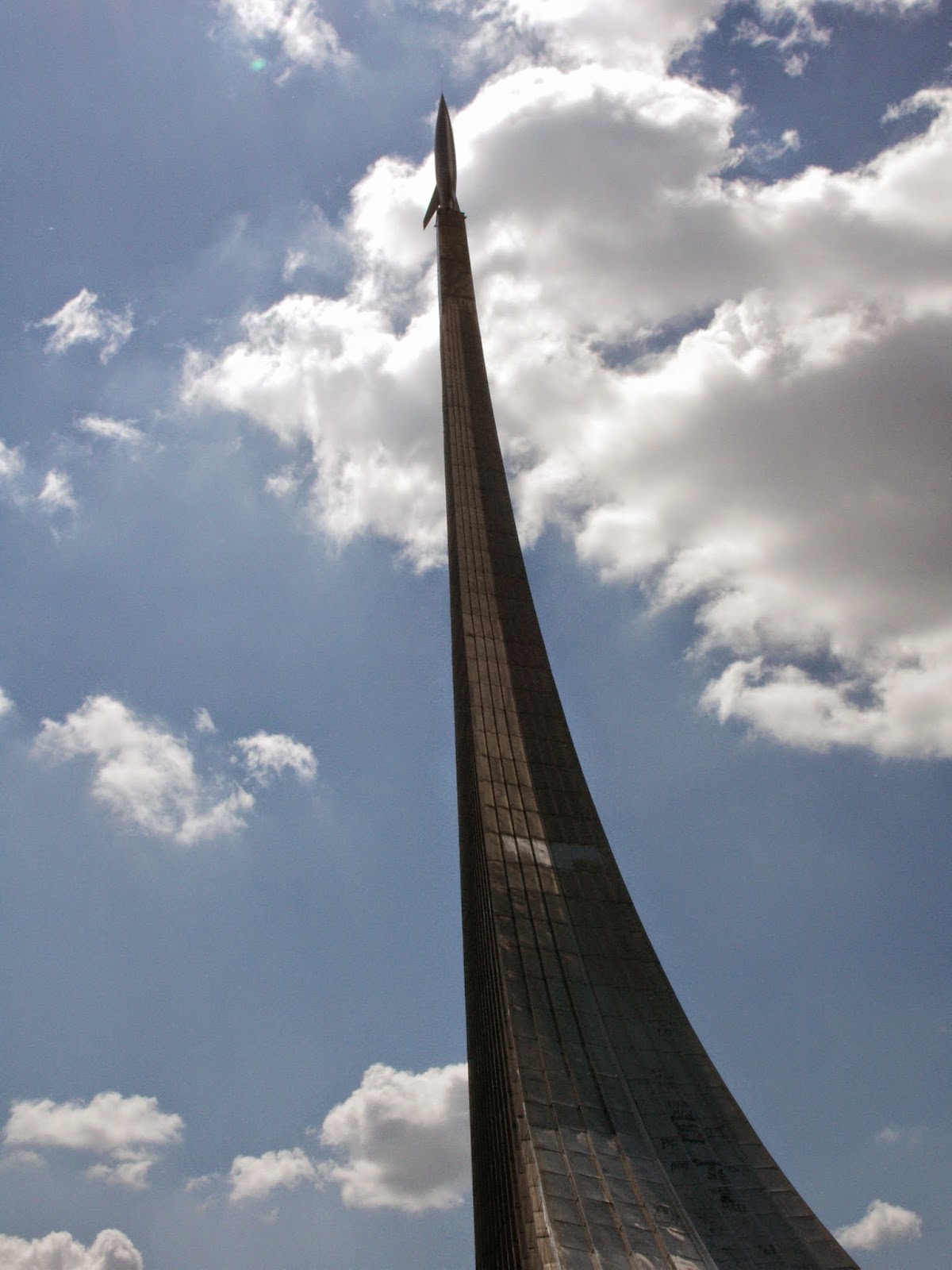
On the paved space above the Museum-bunker stands the imposing metallic Space Monument, thrusting toward the stars; it is surrounded by the Pavilions of the VDNKh – the former All-Union Exhibition of Economic Achievements – a showcase of planned-economy productivity. In the vast interior spaces where once the achievements of the mighty State in all spheres of science and industry were proudly displayed, the void is now filled by market stalls selling competitively-priced consumer goods; as in the Museum, rockets, satellites and even space capsules are mere theme-park sideshows. Thus the vanished Soviet utopian dream, a gleaming, technologically-advanced future, has left behind a faded splendour. The derelict worlds of futuristic entropy portrayed in Andrei Tarkovsky’s 1970s films Solaris and especially Stalker (both based on sf novels by eastern European authors), documents from the years of stagnation before Communism’s terminal collapse, begin to look painfully prophetic. The whole Exhibition complex, evidently still a popular attraction, appeared run-down to western eyes, in a state of decay and dilapidation, slowly becoming overgrown; the subsequent refurbishment of the Space Museum was, in truth, long overdue.


Above: Belka & Strelka in the Space Museum
Right: The Space Monument


Artists Jane and Louise Wilson, sisters from Newcastle-upon-Tyne, are among those to have investigated the relics of the Soviet Space Age, notably with their installation piece, Star City (2000), filmed at the formerly secret Cosmonaut training base outside Moscow, Zvyozdny Gorodok (translated literally as ‘Starry Town’). Once a source of Soviet pride, the facility has only survived into the twenty-first century by embracing space tourism and western capital. The Wilson sisters have also engaged with another, grimmer aspect of the Soviet legacy in their 2012 film The Toxic Camera. Taking as its subject the nuclear reactor explosion at Chernobyl in 1986, and the subsequent deadly toxic fall-out, it utilises contemporary footage taken at the scene by Soviet film-maker Vladimir Shevchenko, who later died due to the radiation he was exposed to there. In the Wilsons’ photographic series, Atomgrad, haunting images of the city of Pripyat, abandoned in the wake of the disaster, evoke the wider damage of state-sponsored environmental pollution and the dystopian high-rise collective housing estates which dominate the urban landscape, from the suburbs of the capital to the towns of the provinces.

The central concept of the novel Roadside Picnic by brothers Arkady and Boris Strugatsky, Soviet science fiction writers, which was filmed as Stalker, is ‘The Zone’; in book and film this is a sealed-off area once visited by extra-terrestrial life, where earth’s physical laws no longer apply and strange things occur. Later the term was also applied to another zone of exclusion – the irradiated region around Chernobyl, marking the limits of human habitation after the disaster. The parallels between the fictional post-apocalyptic ‘Zone’ and the all-too-real one between Belarus and Ukraine are reflected in the growth of ‘anti-tourism’, with increased visitors to the area in recent years. This has also given rise to its further use as a set for a virtual gaming environment, with scenes based on photography taken in the actual physical location. 


Hotel Cosmos

The superficial brilliance of contemporary Moscow, represented as a resurgent, shiny megalopolis of gangsters, oligarchs and pop stars in the blockbuster films Night and Day Watch (2004 and 2006, both based loosely on Sergei Lukyanenko’s novel The Night Watch) suggests another (science-) fictional world, embodied by their use of the strikingly futuristic Hotel Cosmos, itself overlooking the Exhibition grounds and Space Museum, as a pivotal location. Where those films echoed a popular image of the capital’s prosperity, rapid development and regeneration – capturing a narrative that President Putin’s regime is also keen to present to the West – much of post-Communist Russia is broken-down, worn-out, and facing an uncertain future. The past continues to cast a long shadow, even if the revolutionary rhetoric of a technologically-enabled utopia, embedded in the Soviet Union from its inception with its egalitarian society, space-flight complexes and optimistic dreams of conquering the cosmos, now belongs to a vanished world, and its monuments to the glorious future have long since become rusting remnants of that distant era.