Showing posts with label The Twilight Zone. Show all posts

Wednesday, 29 November 2017

Earth-sized Planets Discovered Orbiting Nearby Star

It was around this time last year, when I posted about exoplanets and the possibility of habitable life beyond Earth. Perhaps, then, a year on, is an apt time to revisit this theme and one of my favourite space stories from 2017 – the discovery of exoplanets found orbiting Trappist-1. Trappist-1 is a red dwarf star, located 39 light-years away from Earth in the constellation Aquarius. As such, it is one of our nearest neighbours in the Milky Way.

2015 was the year of the first discovery of Earth-sized planets orbiting Trappist-1 but, early in 2017, astronomers announced the news of additional exoplanets around the star, seven in total. The Guardian first published a story on the discovery in February, with follow-up stories in May and August.

The seven planets are, to date, the largest number of exoplanets found orbiting a neighbouring star, raising hopes that the search for alien life might be within reach using the next generation of astronomical telescopes. Trappist-1 shines with a light 2000 times fainter than our sun, meaning that the planets are more likely to hold liquid water and surface life. Researchers hope to obtain this information within the next decade.

One of the most exciting aspects of the story – alongside the possibility of discovering aliens, or a planet capable of supporting human life – was the incredible orbits of the planets and the prospect of the Trappist-1 star looming large in the sky from the planets’ surface (see illustration below). Because the planets are so much closer to the cool Trappist-1 star, each of their orbits is more compact than those of the planets orbiting our sun – the closest with a very short orbit of one and a half days, the furthest away taking 20 days.

Illustration of the view of Trappist-1 from the fifth planet by Nasa/JPL-Caltech.

These phenomena put me in mind of SF narratives that hinge on inter-world relationships, and the planetary astrophysics underpinning such stories. A famous example is Isaac Asimov’s ‘Nightfall’, a 1941 short story, later adapted into a novel with Robert Silverberg. The action takes place on Lagash, a planet located in a multiple star system with six suns, which keeps it constantly illuminated. The coming of an eclipse is a cause for concern for the planet's scientists, who fear that the general population will be unable to cope with the darkness. However, ultimately, it is the discovery of other stars and planets, which become visible during the eclipse, that sends Lagash's inhabitants into a frenzy.

The double planet (or binary planet) system of Urras and Anarres in Ursula Le Guin’s The Dispossessed is another memorable example, in which the juxtaposition of capitalist Urras and anarchist Anarres functions as a device for Le Guin’s exploration of ‘ambiguous’ utopias. In a variation of this theme, the planet Solaris, in the novel of the same name, orbits a binary star system with one red-coloured and one blue-coloured sun.
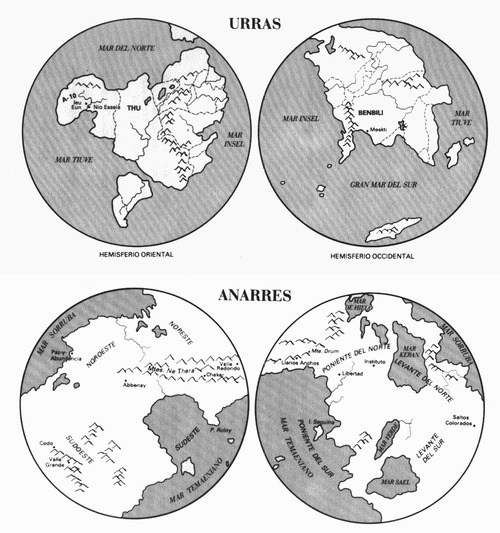
Geographies of the double planet system Urras and Anarres.

Finally, returning to our solar system, the Twilight Zone episode, ‘Midnight Sun’, imagines a scenario in which the Earth's orbit has been disturbed, causing it to move slowly towards the sun. In the end, it transpires that this was only a fever dream experienced by the protagonist Norma, and the Earth is in fact, inexplicably, moving further away from the sun.

SF experimentation with different star systems and planetary configurations adds to the other-worldliness of the stories, even while often offering a critical lens on real world issues. The Trappist-1 discovery begins to shed light on just how distant or close such other worlds may be.

Friday, 27 February 2015

Another Cover Without a Cause

Continuing the theme of hopelessly misjudged science fiction book covers, I recently picked up a copy of Richard Matheson's short story collection, Shock! As the author of I Am Legend, a regular contributor to The Twilight Zone, and the creator of the stories which were filmed as The Incredible Shrinking Man and Duel, Matheson was a multi-faceted and versatile writer, blending elements of science fiction, horror and fantasy to original effect. The 'shock' in his work is generally of a psychological nature. However, when British paperback imprint Sphere came to re-issue his early short story collection of that title, they commissioned cover art (by an artist who, perhaps wisely, remained anonymous) spectacularly lacking in subtlety: an axe splitting a bloody skull...


It transpires that a similar artistic formula was employed for the remaining story collections in the series, which can be viewed on the Vault of Evil blog. Matheson's response is sadly unknown.

Thursday, 11 December 2014

The Twilight Zone and Rod Serling

“You’re travelling through another dimension – a dimension not only of sight and sound but of mind. A journey into a wondrous land whose boundaries are that of imagination. Your next stop: the Twilight Zone!”

Late 1950s/early 1960s American television broadcasting remains associated with the celebration of traditional values and the provision of wholesome family entertainment – nothing too daring or threatening which might offend commercial or Establishment interests. Rod Serling, a successful script-writer for radio and television plays, had become frustrated by over-bearing network control and the demands of sponsors, and was in search of his own project. As creator of The Twilight Zone, which initially ran from 1959 to 1964, he achieved that ambition. Within the constraints of the time – and in appearance, he conformed to the clean-cut image of his era – Serling crafted a truly pioneering series of half-hour stand-alone episodes, ranging freely across science fiction and fantasy themes. Many episodes were written or adapted by Serling himself, but he was also able to utilise the talents of authors Charles Beaumont and Richard Matheson, who constituted an informal writing team, later supplemented by George Clayton Johnson. They were able to draw on a wealth of as yet unfilmed science fiction material – notably short stories – for the scripts; among the well-established authors to make a one-off contribution was Ray Bradbury (‘I sing the body electric’). The show also featured many young actors in the formative stages of their careers who went on to greater fame, including Dennis Hopper, Donald Pleasance, Robert Redford and Burt Reynolds, in addition to both Leonard Nimoy and William Shatner, pre-Star Trek.


By Serling’s own admission, the quality of episodes was variable – some betray the limitations of a demanding shooting schedule, the expectations of a mainstream audience and technical restrictions which are apparent in the effects and often in the sets, but at its best it transcended those constraints. There was considerable ingenuity and originality in episodes such as ‘Five characters in search of an exit’, whose protagonists know neither where, nor who, they are. Not only did this episode echo Luigi Pirandello’s 1921 play, Six characters in search of an author, it also prefigured the plot of the 1997 film Cube. Investigations on the nature of reality were a frequent topic, memorably tackled in ‘A World of Difference’, whose central character finds he is living in a script – or else the script has become his life. ‘Person or persons unknown’ has parallels with Philip K. Dick’s later novel, Flow my tears, the policeman said, in its depiction of an alternate reality where the central character awakes in familiar surroundings, only to find that no-one recognises him. The Twilight Zone reflects Serling’s personal belief in science fiction as a vehicle to explore contemporary issues, with recurring representations of Cold War anxieties and meditations on the widespread fear of imminent nuclear attack and the aftermath of disaster, in episodes such as ‘Time enough at last’ and ‘The shelter’. As an avowed liberal, Serling used other episodes to promote civil rights and attack the lingering anti-Communist paranoia in the wake of Senator McCarthy’s ‘witch-hunt’ and the hearings of the House Committee on Un-American Activities, which led directly to the blacklisting and exile from Hollywood of actors, directors and writers, for their supposed support for the Soviet Union and Communism.

The series’ distinctive title music was initially provided by Bernard Herrmann, a composer who had scored Orson Welles’s acclaimed Citizen Kane as well as being a regular collaborator with director Alfred Hitchcock (North by Northwest, Psycho, Vertigo). Herrmann was already familiar with science fiction themes (The Day the Earth Stood Still, Journey to the Center of the Earth), and later provided soundtracks for several of Ray Harryhausen’s films (including Jason and the Argonauts, The Three Worlds of Gulliver, and The Seventh Voyage of Sinbad). In his article, ‘Music in the Twilight Zone’, James Wierzbicki states that Herrmann’s atmospheric music “played a significant role in literally selling The Twilight Zone to sponsors”; certainly having a composer of such stature would have helped to establish the show’s credentials at the outset. From the second series French avant-garde composer Marius Constant took over theme music duties, and his eerie title became the one most strongly associated with the programme. Much of the show’s incidental music consisted of previously recorded ‘stock cues’ drawn from the CBS library, a far more economical process than commissioning original music throughout; once an initial fee was paid to the composer, subsequent use was royalty-free. Lud Gluskin was in charge of music for all CBS television shows at that period and as such, Wierzbicki notes, “had a substantial influence on music and the role it played in The Twilight Zone”, whilst producer Buck Houghton was responsible for the precise placement of sounds within each episode.


 After the cancellation of The Twilight Zone in 1964, Serling drifted into Hollywood hack-work, producing scripts and screenplays to order, unable to fully recapture his own vision. His name was later associated with Night Gallery, a less successful attempt at a science fiction television series, but with much-reduced creative input from him. By this time, he had become thoroughly frustrated with the limitations of the format, and its ever-present commercial constraints. The major networks still retained significant control over American television in the early 1970s, and the artistic freedom and independence which Serling and others craved remained many years distant. An articulate and highly intelligent man, always prepared to challenge conventions and to innovate, Serling made a conscious decision to “shy away from the year 2500”, being more interested in “what happens Thursday, not in the next century”, aligning him with subsequent visionary writers of the ‘near future’, such as J.G. Ballard and William Gibson. Rod Serling died in 1975, aged only 50, but his legacy lives on – forever synonymous with his name, The Twilight Zone has become ingrained in popular culture, the title itself used as an almost universal shorthand signifying the uncanny or the unknown. He would surely have wanted it this way.