Back in 2012, the University of Iowa Libraries announced its acquisition of the James L. 'Rusty' Hevelin Collection of pulps, fanzines, and science fiction books. Hevelin died at the end of 2011 but he was well known, particularly in US science fiction circles, as an avid SF fan, collector and dealer. His founding of Iowa state's Icon and DemiCon SF conventions made the Univeristy's purchase of the collection a fitting one.
The items in the collection attest to Hevelin's years as a fan, during the evolution of SF fandom, and the announcement in October of plans to digitise 10,000 fanzines was motivated by a growing interest in the history of this movement. Fanzines to be digised include titles such as the The Phantagraph published in the 1930s-1940s in New York and the Leeds-produced Futurian War Digest (covered in previous posts Futures Past: SF History in Leeds, P.2 and P.4, an issue of which can also be seen in the SF montage that forms a background to the blog). These were DIY materials produced for a growing SF community and often distributed by hand. They also provided a chance for aspiring SF writers to publish their stories, some of whom, Ray Bradbury, Robert Heinlein, and Arthur C. Clarke to name a few, would go on to become icons of the genre. The University's Curator of Science Fiction and Popular Culture Collections, Peter Balestrieri, explained, 'some of the earliest works by these writers can be found in Rusty’s
collection of fanzines, along with important writing from all of the
major fans who created this new form of popular culture'.
There are plans to record the progress of the project to digitise the fanzines at the Hevelin Collection Tumblr, where updates will be posted.
Monday, 24 November 2014
Sunday, 16 November 2014
An Appendix to Structures of Soviet Science Fiction: Visitor to a Museum
Following
the previous feature, which touched on the influence of Andrei Tarkovsky’s 1979
film Stalker and its parallels with
the ‘zone of exclusion’ created by the Chernobyl nuclear disaster, the 28th
Leeds International Film Festival has
screened two Soviet films which can be considered in the same light. Both were
written and directed by Konstantin Lopuchansky, who worked as an assistant on Stalker, and both deal with
post-apocalyptic environments. Lopuchansky’s screenplay for the first of these,
Letters from a Dead Man (1986), was
written in collaboration with Soviet authors Vladimir Rybakov and Boris
Strugatsky. The film depicts the aftermath of nuclear meltdown, a golden-tinted
world of ‘perpetual twilight’ where a scholar, holed up in a makeshift shelter,
copes with the devastation around him by writing and reciting letters to his
son, who is presumed dead.
Posters for Letters from a Dead Man
and Visitor to a Museum,
The
second, Visitor to a Museum (1989), has even been interpreted as
a sequel of sorts to Stalker. Its
main character travels through a vividly portrayed nightmarish wasteland
(literally – it appears to be one vast rubbish dump) on a journey to visit the
Museum of the title, which lies submerged under rising flood waters and can
only be reached at low tide. In this blighted landscape, an underclass of
mutated humans, known as Degenerates, are confined to reservations, where they
persist in primitive forms of worship – their sole prayer is “let us out of
here”. The central protagonist is disturbed by their plight and fascinated by
their religious customs, later seemingly being adopted by them as a Messiah
before continuing on his mission as a form of spiritual quest. The latter part
of the film is particularly hallucinatory and harrowing; the ‘hero’ reaches the
Museum, only to find that it is nothing more than a bleak island of ruins amidst
the toxic sea. These evocations of a decayed civilisation, environmental ruin
and social collapse are vividly portrayed throughout – a truly dystopian vision
created at the very end of the era of Soviet Communism.
Sunday, 26 October 2014
Structures of Soviet Science Fiction (II)
While
the art-work of Ilya Kabakov (discussed in Part I) documents the decline of the
Soviet Space Age, further evidence of this ongoing process is abundant in
modern-day Russia. A visit to the Space Museum in Moscow in the
early years of the twenty-first century confirmed the distance between the
heroic feats of Gagarin and his fellow cosmic pioneers, mythologised in Soviet
propaganda, and the true state of affairs in the post-Communist era. The dingy
gallery of space junk had its own charm, with its obsolete hardware and the
space-suited dogs Belka and Strelka
who fell to earth, alive, complete with their clear spherical helmets. Signs of
neglect were evident in this main gallery; though perhaps the dim illumination
of the gloomy chamber was for conservation purposes, rather than cost-cutting,
the Museum offered little in the way of either customer service or exhibition
interpretation. It all seemed very distant from the smiling Cosmonauts gazing
skyward, in anticipation of conquering the heavens.
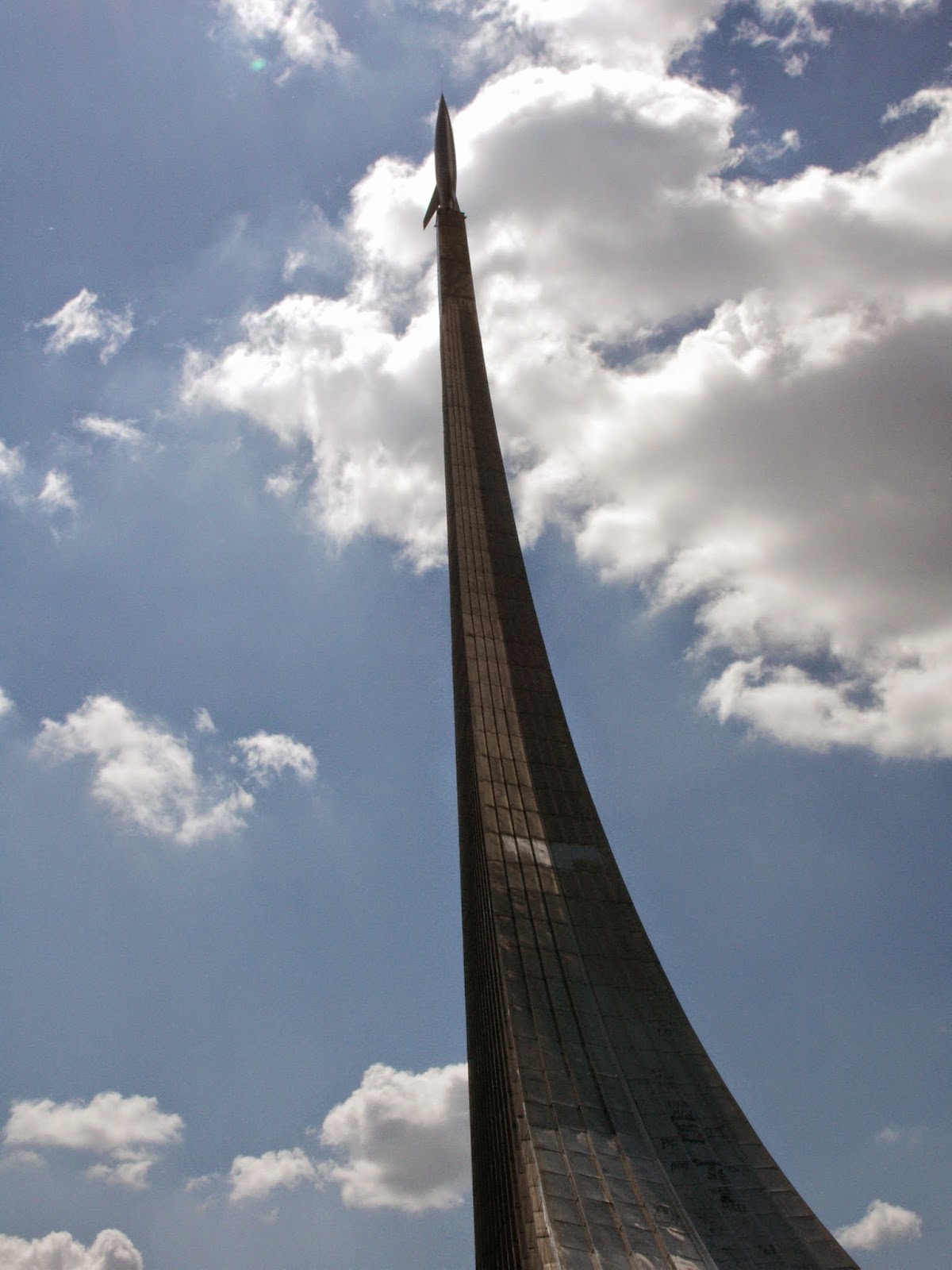
On
the paved space above the Museum-bunker stands the imposing metallic Space
Monument, thrusting toward the stars; it is surrounded by the Pavilions of the
VDNKh – the former All-Union Exhibition of Economic Achievements – a showcase
of planned-economy productivity. In the vast interior spaces where once the
achievements of the mighty State in all spheres of science and industry were
proudly displayed, the void is now filled by market stalls selling
competitively-priced consumer goods; as in the Museum, rockets, satellites and
even space capsules are mere theme-park sideshows. Thus the vanished Soviet
utopian dream, a gleaming, technologically-advanced future, has left behind a faded
splendour. The derelict worlds of futuristic entropy portrayed in Andrei
Tarkovsky’s 1970s films Solaris and
especially Stalker (both based on sf
novels by eastern European authors), documents from the years of stagnation
before Communism’s terminal collapse, begin to look painfully prophetic. The
whole Exhibition complex, evidently still a popular attraction, appeared
run-down to western eyes, in a state of decay and dilapidation, slowly
becoming overgrown; the subsequent refurbishment of the Space Museum was, in truth, long
overdue.
| Above: Belka & Strelka in the Space Museum Right: The Space Monument |
Artists Jane and Louise Wilson, sisters from Newcastle-upon-Tyne, are among those to have investigated the relics of the Soviet Space Age, notably with their installation piece, Star City (2000), filmed at the formerly secret Cosmonaut training base outside Moscow, Zvyozdny Gorodok (translated literally as ‘Starry Town’). Once a source of Soviet pride, the facility has only survived into the twenty-first century by embracing space tourism and western capital. The Wilson sisters have also engaged with another, grimmer aspect of the Soviet legacy in their 2012 film The Toxic Camera. Taking as its subject the nuclear reactor explosion at Chernobyl in 1986, and the subsequent deadly toxic fall-out, it utilises contemporary footage taken at the scene by Soviet film-maker Vladimir Shevchenko, who later died due to the radiation he was exposed to there. In the Wilsons’ photographic series, Atomgrad, haunting images of the city of Pripyat, abandoned in the wake of the disaster, evoke the wider damage of state-sponsored environmental pollution and the dystopian high-rise collective housing estates which dominate the urban landscape, from the suburbs of the capital to the towns of the provinces.
The central concept of the novel Roadside Picnic by brothers Arkady and Boris Strugatsky, Soviet science fiction writers, which was filmed as Stalker, is ‘The Zone’; in book and film this is a sealed-off area once visited by extra-terrestrial life, where earth’s physical laws no longer apply and strange things occur. Later the term was also applied to another zone of exclusion – the irradiated region around Chernobyl, marking the limits of human habitation after the disaster. The parallels between the fictional post-apocalyptic ‘Zone’ and the all-too-real one between Belarus and Ukraine are reflected in the growth of ‘anti-tourism’, with increased visitors to the area in recent years. This has also given rise to its further use as a set for a virtual gaming environment, with scenes based on photography taken in the actual physical location.
![]() |
| Hotel Cosmos |
The superficial
brilliance of contemporary Moscow, represented as a resurgent, shiny
megalopolis of gangsters, oligarchs and pop stars in the blockbuster films Night and Day Watch
(2004 and 2006, both based loosely on Sergei Lukyanenko’s novel The Night
Watch) suggests another (science-) fictional world, embodied by their use
of the strikingly futuristic Hotel Cosmos, itself overlooking the Exhibition
grounds and Space Museum, as a pivotal location. Where those films echoed a
popular image of the capital’s prosperity, rapid development and regeneration –
capturing a narrative that President Putin’s regime is also keen to present to
the West – much of post-Communist Russia is broken-down, worn-out, and facing
an uncertain future. The past continues to cast a long shadow, even if the
revolutionary rhetoric of a technologically-enabled utopia, embedded in the
Soviet Union from its inception with its egalitarian society, space-flight
complexes and optimistic dreams of conquering the cosmos, now belongs to a vanished
world, and its monuments to the glorious future have long since become rusting
remnants of that distant era.
Thursday, 9 October 2014
Leeds Transported into the Next Century: Light Night 2014
![]() |
| The Leeds Civic Hall on Light Night 2014 |
Last week, on the 3 October 2014, the festival celebrated its tenth year, and there was something of a science fictional theme. From the hi-tech Hackspace Cube installation at the City Museum to the re-imagining of Leeds post-zombie invasion in the Trinity Centre, many of the events played with alternative scenarios or reflected on what the city would be like in years to come. None more so than the Theatre of Illumination, a special light performance projected onto Leeds Civic Hall, created by OMNI Pictures. The design used 3D optical illusions and projection mapping, combined with surround sound, to create what was described as 'a futuristic journey through time and space', propelling 'the architecture of Leeds Civic Hall into the next century with the explosive energy of a firework display'.
Having seen the projection myself, the effect was certainly spectacular. The neoclassical architecture of the building, designed by Vincent Harris, was transformed by the light and music, swirling with geometric shapes and a Dr Who-style vortex. The idea seemed to be that The Civic Hall represented the history of Leeds, while the light show evoked possible futures. In that respect, this spectacle put me in mind of a very different but nevertheless Leeds-based fiction:- Leeds Beatified (see my earlier post on the obscure pamphlet from 1900), which features a Wellsian time traveller who journeys to a transformed future Yorkshire. The association with light has echoes in this passage when the traveller finds himself in 1951:
There was no longer the darkness
which shrouded my first departure from Leeds in 1900. Every village and road
was lighted by lamps which by combining electricity and compressed gas gave a
brilliance otherwise unattainable. There were ingenious and artistic devices
for such lamps. Illuminated Owls seemed to be in favour, for though an ill omen
to others, the bird of night had brought prosperity if not wisdom to Leeds.
Likewise, the owls that flank the outside of The Civic Hall are, in 2014, still emblematic of the city. The Light Night performance, then, was not first foray into the future of Leeds, and it is very unlikely to be the last.
Saturday, 27 September 2014
Red Star Gazing and the Inevitability of Full Space Communism
Part Two
Under Stalin, what remained of the Soviet communist dream turned into a nightmare of international proportions. Nevertheless, many people outside of the USSR in the 30s, even anti-Stalinist communists who managed to avoid being murdered by the GPU, went along with Trotsky’s formulation in 1936 that 'socialism has demonstrated its right to victory, not on the pages of Das Kapital, but in an industrial arena comprising a sixth part of the earth’s surface-not in the language of dialectics, but in the language of steel, cement and electricity'. In other words, the productive capacity of the supposedly socialist Soviet Union was sufficient justification for its existence. When this system was belatedly mobilised for the fight against Nazism, those who still dreamed of a communist future were further comforted that there remained something to be said for the USSR’s 'socialism'. Doris Lessing’s The Golden Notebook and Vasily Grossman’s Life and Fate provide novelistic depictions of how believers in very different contexts convinced themselves that the sacrifices required by this system were worthwhile.
The twin shocks of Khrushchev’s 'secret speech' and the bloody suppression of the Hungary uprising in 1956 put paid to such illusions in the West and gave birth to the so-called New Left. This created a space for a questioning of the determinist Marxism that had until then been given a free pass on the left (except in isolated and disparate cases), and which held that technological advance = progress = creating the conditions for socialism. This led to a re-evaluation (particularly among English new-left historians) of such awkwardly un-scientific tendencies as 19th century utopian socialism, 17th century millenarian proto-communism and Luddism. However, while the de-Stalinisation of the left in the West led, in many cases, to a rejection of technological determinism and laid the ground for the rise of CND and the green movement, this historical conjuncture gave technological determinism a new lease of life in the Soviet Union. In an echo of Trotsky’s logic, the Soviet Union would have to justify the horrors of the Stalinist era by delivering on the techno-utopian dream that had seemingly been side-lined along with constructivism and the abandonment of the revolution’s internationalism.
Francis Spufford takes this post-Stalin Soviet panorama as the backdrop of his novelised history book Red Plenty. In it, he has Khrushchev musing on the current situation of the USSR: 'fortunately, the hard part of the task was nearly done. They had almost completed the heavy lifting, they had heaved and shoved and (yes) driven people on with kicks and curses, and they had built the basis for the good life, their very own horn of plenty', and translates him as claiming in 1959 that 'in our day, the dreams mankind cherished for ages, dreams expressed in fairytales which seemed sheer fantasy, are being translated into fantasy by man’s own hands'. Of course, the utopian dreams of the planned economy were rather more prosaic than the electrifying explosion of creativity that might have been heralded by world soviet revolution in 1917-21. Nevertheless, in the context of the space race, they did provide a boost to the Soviet sci-fi imagination, as the the Soviet images featured on io9 and Dark Roasted Blend attest.
While the illustrations here don’t have the eerie parallel universe feel that art and sci-fi had in the Russian Revolution’s heroic period, they still pack a punch, particularly the depiction of the communal living space under the surface of the moon from the journal Tekhnika Molodezhi, whose on-line archive is available here: http://zhurnalko.net/journal-2
Under Stalin, what remained of the Soviet communist dream turned into a nightmare of international proportions. Nevertheless, many people outside of the USSR in the 30s, even anti-Stalinist communists who managed to avoid being murdered by the GPU, went along with Trotsky’s formulation in 1936 that 'socialism has demonstrated its right to victory, not on the pages of Das Kapital, but in an industrial arena comprising a sixth part of the earth’s surface-not in the language of dialectics, but in the language of steel, cement and electricity'. In other words, the productive capacity of the supposedly socialist Soviet Union was sufficient justification for its existence. When this system was belatedly mobilised for the fight against Nazism, those who still dreamed of a communist future were further comforted that there remained something to be said for the USSR’s 'socialism'. Doris Lessing’s The Golden Notebook and Vasily Grossman’s Life and Fate provide novelistic depictions of how believers in very different contexts convinced themselves that the sacrifices required by this system were worthwhile.
The twin shocks of Khrushchev’s 'secret speech' and the bloody suppression of the Hungary uprising in 1956 put paid to such illusions in the West and gave birth to the so-called New Left. This created a space for a questioning of the determinist Marxism that had until then been given a free pass on the left (except in isolated and disparate cases), and which held that technological advance = progress = creating the conditions for socialism. This led to a re-evaluation (particularly among English new-left historians) of such awkwardly un-scientific tendencies as 19th century utopian socialism, 17th century millenarian proto-communism and Luddism. However, while the de-Stalinisation of the left in the West led, in many cases, to a rejection of technological determinism and laid the ground for the rise of CND and the green movement, this historical conjuncture gave technological determinism a new lease of life in the Soviet Union. In an echo of Trotsky’s logic, the Soviet Union would have to justify the horrors of the Stalinist era by delivering on the techno-utopian dream that had seemingly been side-lined along with constructivism and the abandonment of the revolution’s internationalism.
Francis Spufford takes this post-Stalin Soviet panorama as the backdrop of his novelised history book Red Plenty. In it, he has Khrushchev musing on the current situation of the USSR: 'fortunately, the hard part of the task was nearly done. They had almost completed the heavy lifting, they had heaved and shoved and (yes) driven people on with kicks and curses, and they had built the basis for the good life, their very own horn of plenty', and translates him as claiming in 1959 that 'in our day, the dreams mankind cherished for ages, dreams expressed in fairytales which seemed sheer fantasy, are being translated into fantasy by man’s own hands'. Of course, the utopian dreams of the planned economy were rather more prosaic than the electrifying explosion of creativity that might have been heralded by world soviet revolution in 1917-21. Nevertheless, in the context of the space race, they did provide a boost to the Soviet sci-fi imagination, as the the Soviet images featured on io9 and Dark Roasted Blend attest.
![]() |
| From Tekhnika Molodezhi journal |
While the illustrations here don’t have the eerie parallel universe feel that art and sci-fi had in the Russian Revolution’s heroic period, they still pack a punch, particularly the depiction of the communal living space under the surface of the moon from the journal Tekhnika Molodezhi, whose on-line archive is available here: http://zhurnalko.net/journal-2
Sunday, 14 September 2014
How the Future was Imagined 100 Years Ago...
![]() |
| Le Petit Journal, 30 December 1923 |
Published from 1863 to 1944, Le Petit Journal was a middle-brow daily Parisian newspaper that satirised social and political events of the day. The images featured on RT include underwater cities, towering skyscrapers and airborne tram networks. This faith in technology is indicative of a general optimism about the future, in common with other accounts from around the turn of the century.
For instance, in 1902 The Atlantic Monthly published the American economist John Bates Clark's mock retrospective of the coming era, which envisages 'the building of good dwellings, and of parks and playgrounds many stories in height, with their frames of massive steel' and the seas full with 'passenger vessels so vast as to seem like floating cities'. However, as we can see from the examples in Le Petit Journal, twenty years on the First World War has left its mark. Illustrations such as 'Les Tanks Amphibies' from 30 December 1923 (see above) depict sinister modifications to the weapons of destruction that were developed during WWI, and hint at the dark side of technological progress.
Tuesday, 26 August 2014
J.G. Ballard's Invisible Library
| Untitled (White Library) by Wilfredo Prieto at MoNA |
A couple of months ago I published a write-up of the 'Landscapes of Tomorrow: J.G. Ballard in Space and Time' conference, which took place at the University of Leeds on 3 May 2014. In that post, I mentioned the collection of ephemera that Ballard would refer to as 'invisible literatures', including but not limited to scientific journals, technical manuals, pharmaceutical company brochures, think-tank internal documents and PR company position papers - in Ballard's own words: 'part of that universe of published material to which most literate people have scarcely any access but which provides the most potent compost for the imagination'.
For some time, I've been interested in the significance of these texts and their influence on Ballard's writing, which prompted the current Invisible Library project, a collaborative online catalogue. This is a joint effort with Mike Bonsall, whose own site, Digital Ballard, carries the tagline 'Adventures with J.G. Ballard in the Digital Humanities'. Mike's site interprets Ballard's fiction using a variety of digital tools, with fascinating results. Highlights include Another Terminal Beach, an Interactive Fiction based on Ballard's short story, The Concordance, compiled using all the material in Ballard's published novels and High-Rise: The Movie, an animation of the High Rise plot, made using SketchUp.
With Mike's help an open source list has now been created, collected from various sources, to record the reading material Ballard came into contact with and attempt to make the invisible visible.
So far, the list comprises over 600 items. It's an ongoing project, which invites contributions. To find out more, please visit: http://fentonville.co.uk/invisible-library/
Subscribe to:
Posts (Atom)