Sunday, 26 October 2014

Structures of Soviet Science Fiction (II)

While the art-work of Ilya Kabakov (discussed in Part I) documents the decline of the Soviet Space Age, further evidence of this ongoing process is abundant in modern-day Russia. A visit to the Space Museum in Moscow in the early years of the twenty-first century confirmed the distance between the heroic feats of Gagarin and his fellow cosmic pioneers, mythologised in Soviet propaganda, and the true state of affairs in the post-Communist era. The dingy gallery of space junk had its own charm, with its obsolete hardware and the space-suited dogs Belka and Strelka who fell to earth, alive, complete with their clear spherical helmets. Signs of neglect were evident in this main gallery; though perhaps the dim illumination of the gloomy chamber was for conservation purposes, rather than cost-cutting, the Museum offered little in the way of either customer service or exhibition interpretation. It all seemed very distant from the smiling Cosmonauts gazing skyward, in anticipation of conquering the heavens.

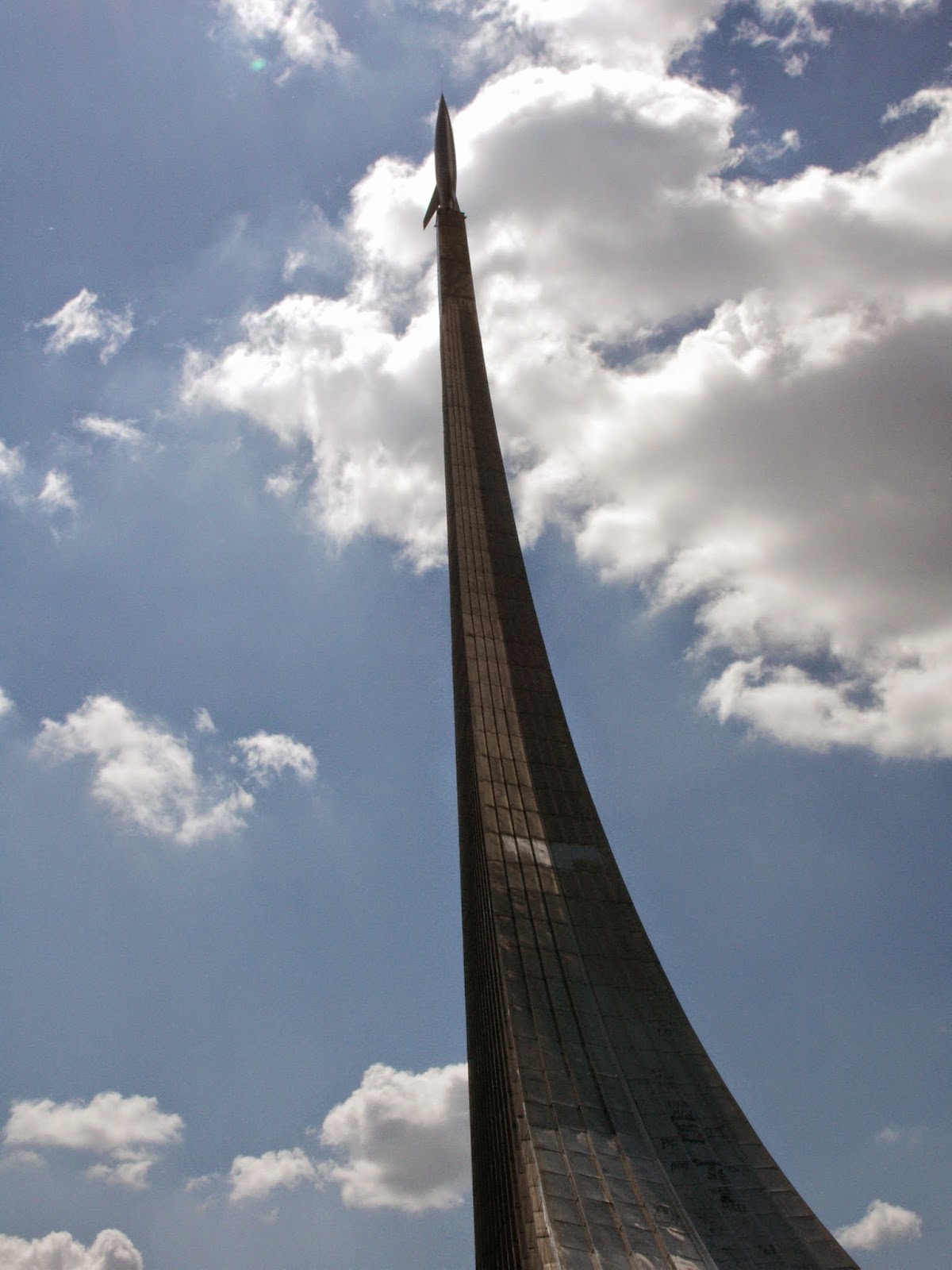
On the paved space above the Museum-bunker stands the imposing metallic Space Monument, thrusting toward the stars; it is surrounded by the Pavilions of the VDNKh – the former All-Union Exhibition of Economic Achievements – a showcase of planned-economy productivity. In the vast interior spaces where once the achievements of the mighty State in all spheres of science and industry were proudly displayed, the void is now filled by market stalls selling competitively-priced consumer goods; as in the Museum, rockets, satellites and even space capsules are mere theme-park sideshows. Thus the vanished Soviet utopian dream, a gleaming, technologically-advanced future, has left behind a faded splendour. The derelict worlds of futuristic entropy portrayed in Andrei Tarkovsky’s 1970s films Solaris and especially Stalker (both based on sf novels by eastern European authors), documents from the years of stagnation before Communism’s terminal collapse, begin to look painfully prophetic. The whole Exhibition complex, evidently still a popular attraction, appeared run-down to western eyes, in a state of decay and dilapidation, slowly becoming overgrown; the subsequent refurbishment of the Space Museum was, in truth, long overdue.


Above: Belka & Strelka in the Space Museum
Right: The Space Monument


Artists Jane and Louise Wilson, sisters from Newcastle-upon-Tyne, are among those to have investigated the relics of the Soviet Space Age, notably with their installation piece, Star City (2000), filmed at the formerly secret Cosmonaut training base outside Moscow, Zvyozdny Gorodok (translated literally as ‘Starry Town’). Once a source of Soviet pride, the facility has only survived into the twenty-first century by embracing space tourism and western capital. The Wilson sisters have also engaged with another, grimmer aspect of the Soviet legacy in their 2012 film The Toxic Camera. Taking as its subject the nuclear reactor explosion at Chernobyl in 1986, and the subsequent deadly toxic fall-out, it utilises contemporary footage taken at the scene by Soviet film-maker Vladimir Shevchenko, who later died due to the radiation he was exposed to there. In the Wilsons’ photographic series, Atomgrad, haunting images of the city of Pripyat, abandoned in the wake of the disaster, evoke the wider damage of state-sponsored environmental pollution and the dystopian high-rise collective housing estates which dominate the urban landscape, from the suburbs of the capital to the towns of the provinces.

The central concept of the novel Roadside Picnic by brothers Arkady and Boris Strugatsky, Soviet science fiction writers, which was filmed as Stalker, is ‘The Zone’; in book and film this is a sealed-off area once visited by extra-terrestrial life, where earth’s physical laws no longer apply and strange things occur. Later the term was also applied to another zone of exclusion – the irradiated region around Chernobyl, marking the limits of human habitation after the disaster. The parallels between the fictional post-apocalyptic ‘Zone’ and the all-too-real one between Belarus and Ukraine are reflected in the growth of ‘anti-tourism’, with increased visitors to the area in recent years. This has also given rise to its further use as a set for a virtual gaming environment, with scenes based on photography taken in the actual physical location. 


Hotel Cosmos

The superficial brilliance of contemporary Moscow, represented as a resurgent, shiny megalopolis of gangsters, oligarchs and pop stars in the blockbuster films Night and Day Watch (2004 and 2006, both based loosely on Sergei Lukyanenko’s novel The Night Watch) suggests another (science-) fictional world, embodied by their use of the strikingly futuristic Hotel Cosmos, itself overlooking the Exhibition grounds and Space Museum, as a pivotal location. Where those films echoed a popular image of the capital’s prosperity, rapid development and regeneration – capturing a narrative that President Putin’s regime is also keen to present to the West – much of post-Communist Russia is broken-down, worn-out, and facing an uncertain future. The past continues to cast a long shadow, even if the revolutionary rhetoric of a technologically-enabled utopia, embedded in the Soviet Union from its inception with its egalitarian society, space-flight complexes and optimistic dreams of conquering the cosmos, now belongs to a vanished world, and its monuments to the glorious future have long since become rusting remnants of that distant era.

Thursday, 9 October 2014

Leeds Transported into the Next Century: Light Night 2014

The Leeds Civic Hall on Light Night 2014
Light Night is a cultural event that takes place in Leeds every October. First launched in 2005 and based on the European model of Nuit Blanche, Light Night sees venues accross the city opening late into the night and inviting the public to experience free performances, installations and other unusual (often light-based) cultural events.

Last week, on the 3 October 2014, the festival celebrated its tenth year, and there was something of a science fictional theme. From the hi-tech Hackspace Cube installation at the City Museum to the re-imagining of Leeds post-zombie invasion in the Trinity Centre, many of the events played with alternative scenarios or reflected on what the city would be like in years to come. None more so than the Theatre of Illumination, a special light performance projected onto Leeds Civic Hall, created by OMNI Pictures. The design used 3D optical illusions and projection mapping, combined with surround sound, to create what was described as 'a futuristic journey through time and space', propelling 'the architecture of Leeds Civic Hall into the next century with the explosive energy of a firework display'.

Having seen the projection myself, the effect was certainly spectacular. The neoclassical architecture of the building, designed by Vincent Harris, was transformed by the light and music, swirling with geometric shapes and a Dr Who-style vortex. The idea seemed to be that The Civic Hall represented the history of Leeds, while the light show evoked possible futures. In that respect, this spectacle put me in mind of a very different but nevertheless Leeds-based fiction:- Leeds Beatified (see my earlier post on the obscure pamphlet from 1900), which features a Wellsian time traveller who journeys to a transformed future Yorkshire. The association with light has echoes in this passage when the traveller finds himself in 1951:

There was no longer the darkness which shrouded my first departure from Leeds in 1900. Every village and road was lighted by lamps which by combining electricity and compressed gas gave a brilliance otherwise unattainable. There were ingenious and artistic devices for such lamps. Illuminated Owls seemed to be in favour, for though an ill omen to others, the bird of night had brought prosperity if not wisdom to Leeds.

Likewise, the owls that flank the outside of The Civic Hall are, in 2014, still emblematic of the city. The Light Night performance, then, was not first foray into the future of Leeds, and it is very unlikely to be the last.

Saturday, 27 September 2014

Red Star Gazing and the Inevitability of Full Space Communism

Part Two

Under Stalin, what remained of the Soviet communist dream turned into a nightmare of international proportions. Nevertheless, many people outside of the USSR in the 30s, even anti-Stalinist communists who managed to avoid being murdered by the GPU, went along with Trotsky’s formulation in 1936 that 'socialism has demonstrated its right to victory, not on the pages of Das Kapital, but in an industrial arena comprising a sixth part of the earth’s surface-not in the language of dialectics, but in the language of steel, cement and electricity'. In other words, the productive capacity of the supposedly socialist Soviet Union was sufficient justification for its existence. When this system was belatedly mobilised for the fight against Nazism, those who still dreamed of a communist future were further comforted that there remained something to be said for the USSR’s 'socialism'. Doris Lessing’s The Golden Notebook and Vasily Grossman’s Life and Fate provide novelistic depictions of how believers in very different contexts convinced themselves that the sacrifices required by this system were worthwhile.

The twin shocks of Khrushchev’s 'secret speech' and the bloody suppression of the Hungary uprising in 1956 put paid to such illusions in the West and gave birth to the so-called New Left. This created a space for a questioning of the determinist Marxism that had until then been given a free pass on the left (except in isolated and disparate cases), and which held that technological advance = progress = creating the conditions for socialism. This led to a re-evaluation (particularly among English new-left historians) of such awkwardly un-scientific tendencies as 19th century utopian socialism, 17th century millenarian proto-communism and Luddism. However, while the de-Stalinisation of the left in the West led, in many cases, to a rejection of technological determinism and laid the ground for the rise of CND and the green movement, this historical conjuncture gave technological determinism a new lease of life in the Soviet Union. In an echo of Trotsky’s logic, the Soviet Union would have to justify the horrors of the Stalinist era by delivering on the techno-utopian dream that had seemingly been side-lined along with constructivism and the abandonment of the revolution’s internationalism.

Francis Spufford takes this post-Stalin Soviet panorama as the backdrop of his novelised history book Red Plenty. In it, he has Khrushchev musing on the current situation of the USSR: 'fortunately, the hard part of the task was nearly done. They had almost completed the heavy lifting, they had heaved and shoved and (yes) driven people on with kicks and curses, and they had built the basis for the good life, their very own horn of plenty', and translates him as claiming in 1959 that 'in our day, the dreams mankind cherished for ages, dreams expressed in fairytales which seemed sheer fantasy, are being translated into fantasy by man’s own hands'. Of course, the utopian dreams of the planned economy were rather more prosaic than the electrifying explosion of creativity that might have been heralded by world soviet revolution in 1917-21. Nevertheless, in the context of the space race, they did provide a boost to the Soviet sci-fi imagination, as the the Soviet images featured on io9 and Dark Roasted Blend attest.

From Tekhnika Molodezhi journal

While the illustrations here don’t have the eerie parallel universe feel that art and sci-fi had in the Russian Revolution’s heroic period, they still pack a punch, particularly the depiction of the communal living space under the surface of the moon from the journal Tekhnika Molodezhi, whose on-line archive is available here: http://zhurnalko.net/journal-2

Sunday, 14 September 2014

How the Future was Imagined 100 Years Ago...

Le Petit Journal, 30 December 1923
The Spanish arm of the RT news network recently featured images from Le Petit Journal, part of the digital collection at the Bibliothèque Nationale de France. These illustrate the most exciting scientific and technological innovations of the future, as imagined by people in the 20s and 30s. Amazing to think that this is now close to 100 years ago!

Published from 1863 to 1944, Le Petit Journal was a middle-brow daily Parisian newspaper that satirised social and political events of the day. The images featured on RT include underwater cities, towering skyscrapers and airborne tram networks. This faith in technology is indicative of a general optimism about the future, in common with other accounts from around the turn of the century.

For instance, in 1902 The Atlantic Monthly published the American economist John Bates Clark's mock retrospective of the coming era, which envisages 'the building of good dwellings, and of parks and playgrounds many stories in height, with their frames of massive steel' and the seas full with 'passenger vessels so vast as to seem like floating cities'. However, as we can see from the examples in Le Petit Journal, twenty years on the First World War has left its mark. Illustrations such as 'Les Tanks Amphibies' from 30 December 1923 (see above) depict sinister modifications to the weapons of destruction that were developed during WWI, and hint at the dark side of technological progress.

Tuesday, 26 August 2014

J.G. Ballard's Invisible Library

Untitled (White Library) by Wilfredo Prieto at MoNA
“... I have always been a voracious reader of what I call invisible literatures” - JG Ballard, The Pleasure of Reading, Antonia Fraser (ed.), 1992.

A couple of months ago I published a write-up of the 'Landscapes of Tomorrow: J.G. Ballard in Space and Time' conference, which took place at the University of Leeds on 3 May 2014. In that post, I mentioned the collection of ephemera that Ballard would refer to as 'invisible literatures', including but not limited to scientific journals, technical manuals, pharmaceutical company brochures, think-tank internal documents and PR company position papers - in Ballard's own words: 'part of that universe of published material to which most literate people have scarcely any access but which provides the most potent compost for the imagination'.

For some time, I've been interested in the significance of these texts and their influence on Ballard's writing, which prompted the current Invisible Library project, a collaborative online catalogue. This is a joint effort with Mike Bonsall, whose own site, Digital Ballard, carries the tagline 'Adventures with J.G. Ballard in the Digital Humanities'. Mike's site interprets Ballard's fiction using a variety of digital tools, with fascinating results. Highlights include Another Terminal Beach, an Interactive Fiction based on Ballard's short story, The Concordance, compiled using all the material in Ballard's published novels and High-Rise: The Movie, an animation of the High Rise plot, made using SketchUp.

With Mike's help an open source list has now been created, collected from various sources, to record the reading material Ballard came into contact with and attempt to make the invisible visible.

So far, the list comprises over 600 items. It's an ongoing project, which invites contributions. To find out more, please visit: http://fentonville.co.uk/invisible-library/

Wednesday, 13 August 2014

Futures Past: SF History in Leeds, P.7 Interzone Today and Tomorrow

Following on from our previous post on the origins of Interzone, Andy Hedgecock, current co-editor, kindly agreed to be interviewed, and to share his thoughts on the past, present, and of course future of the magazine:

How aware are you of the origins of Interzone?

I’m reasonably aware of the magazine’s history, but I make no claim to academic rigour in respect of this. I’m not an obsessive sf historian!

There’s a fine line between being a raconteur or a bore, but I’d like to risk relating my personal history in relation to David Pringle’s Interzone, in particular my initial collision with the magazine in WH Smith in Southampton. It was late 1982, I think, and I was working down there as a researcher for a management consultancy, doing work I found morally dubious and making myself thoroughly miserable. This was a really bad time for me: I didn’t have the insight or sense of direction to change jobs; I wasn’t enamoured with a socio-political landscape in which greed, careerism and self-interest flourished; and the post-punk cultural scene was predictable, unchallenging and trammelled by a fashionable obsession with gloss and surface. It may sound familiar to younger people in 2014.

Anyway, at some stage of my visit to the South Coast I slipped out of the late lamented Polygon Hotel (known locally as the dead parrot for obvious reasons) and treated myself to a copy of this new magazine. I’ve probably projected my own needs and views onto Interzone, but it became a little beacon of hope for me – along with the new Channel 4, the anarchist newspaper Freedom, the radical writers working in Glasgow (including Alasdair Gray and James Kelman) and, of course, Michael Moorcock, whose cultural criticism and fiction stood in opposition to the ghastliness of the early 1980s. And I’m grateful to David Pringle for his role in that.     

I became a regular but non-subscribing reader in the early years. I’ve just been scrabbling about on the top shelf on a very tall bookcase looking for copies from the late 1980s and early 1990s. I nearly broke my neck, but I forgive you as it’s provided some interesting moments of nostalgia. The work that attracted me to early Pringle-era Interzone was Angela Carter, Pamela Zoline, John Sladek, Rachel Pollack, Brian Aldiss, JG Ballard, Barrington Bayley, Keith Roberts, Thomas Disch, M John Harrison and, of course, Michael Moorcock. Many of those writers, as I’m sure you’ll have noticed, were associated with New Worlds and I think I saw Interzone as continuing in the risk-taking tradition of Moorcock’s magazine. Having said that, it also introduced me to writers whose work was new to me – Geoff Ryman, John Crowley, John Shirley, and Kim Newman, Colin Greenland, Greg Egan, Cherry Wilder, William Gibson, Beil Ferguson, John Gribbin, Gary Kilworth and Bruce Sterling. 

As the years passed Interzone became a bit too hard sf for my own tastes, but I kept in touch with it as an occasional reader and still enjoyed much of what I read. In terms of history, I know David Pringle was supported by a group that included John Clute, Colin Greenland (a massively talented writer and critic who I’ve had the pleasure of interviewing for the Andy Cox-era Interzone) and Alan Dorey, a writer and broadcaster who does a cracking music programme called The Musical Box, for Forest FM in Dorset. Well worth catching online.     

Do you see yourself as continuing in the tradition of David Pringle and previous editors?

I can’t answer for Andy Cox of other members of the editorial group but I certainly see a degree of continuity with the David Pringle era. David Pringle took the name from a risk-taking and experimental collection of stories by William Burroughs and it reflects very well the cutting edge and eclectic nature of his magazine. Andy Cox’s roots as a publisher and editor are in the slipstream magazine The Third Alternative, which published sf, fantasy horror and slipstream stories. TTA Press’ successor to The Third Alternative  focuses exclusively on horror, crime stories are published in Crimewave and the sf, fantasy, surreal, weird and otherwise idiosyncratic genre fiction we publish finds its way into Interzone. It’s still eclectic and we still like to take risks. Like David, Andy sets high literary standards for the stories we include. We continue encourage a degree of stylistic experiment and we’re interested in behaviour in extreme situations, diverse psychologies and liminal experiences. Like David Pringle we look for stories that offer new mythologies to enable us to make sense of our experiences and thoughts. If there is a disconnect between the late-Pringle era and the Cox-era it may be that the latter is a little less focused on scientific and technological development, but I wouldn’t like to have to defend that under rigorous academic examination!


The first two editions of Interzone, 1982.

What do you consider your greatest achievement in your time at the magazine?

If I may I’ll choose something from a personal perspective that’s about opportunities I’ve been given. In terms of achievement I’d rather identify something on behalf of the editorial collective.   

There are two things I’m really delighted to have been able to do. One is to have been able to take part in interviews with writers such as Ken McLeod, Michael Moorcock, Terry Pratchett, John Shirley and Susanna Clarke. The other, and the more important, has been to help find really impressive work by new and developing writers, some of whom had gone on to establish formidable reputations. And I think that brings us onto the greatest achievement element.  We’ve passed a number of important milestones: 10 years of the TTA Press ‘flavour’ of Interzone under Andy Cox’s stewardship; we’ve contributed to Interzone being published for more than 30 years; only around a dozen Nebula award-winning stories were published in magazines and one of those is a story we selected, Eugie Foster’s 'Sinner, Baker, Fabulist, Priest; Red Mask, Black Mask, Gentleman, Beast'; we’re the current holder of the British Fantasy Society award for Best Magazine / Periodical; and we’re nominated (again) for a Hugo Award in the Best Semiprozine category. All of which is very encouraging, it’s nice to receive recognition, but I think the thing I’m most proud of is helping Andy Cox set very exacting standards in terms of literary worth, originality and storytelling energy when we select tales for Interzone. We have a good record in terms of Interzone stories being selected for prestigious anthologies, which is far more important than winning awards and celebrating our longevity.  Most of the time Andy and I converge very quickly on what’s promising but not quite right for us, what’s brilliant, what’s bad and what’s simply baffling. It’s a painful process at times – particularly when I get an email-based poke in the ribs for exhibiting spectacularly poor taste. Over the past 10 years we’ve worked with some absolutely brilliant writers – Nina Allan, Neil Williamson, Jason Sanford, Aliette de Bodard, Georgina Bruce, Suzanne Palmer… That list, off the top of my head, reflects something that isn’t our achievement but it is something we should celebrate. Over the past decade we’ve seen an increasing number of stories by women writers in the mag.  

Do you think that science fiction has become more ‘mainstream’ in popular culture over the three decades since Interzone was founded?

I think it’s roughly as mainstream as it was in the early 1980s. There have been some notable entries into genre storytelling by writers very much associated with literary fiction, for example Jane Roger’s The Testament of Jessie Lamb and Cormac McCarthy’s The Road. But hasn’t there always been this traffic across the sf&f vs ‘litfic’ border? Anthony Burgess, Kingsley Amis, Virginia Wolfe, Don Delillo, Richard Brautigan, Vladimir Nabokov, Mark Twain …? I suppose we could point to Haruki Murakami, Will Self and George Saunders as writers who take a hatchet to genre boundaries by mixing sf, fantasy, crime and absurd realism throughout their work. But even that isn’t something that’s developed in the past 30 years.  But all three of those writers draw on the work of Pynchon and Vonnegut, with the same cavalier approach to literary and genre tropes and techniques whose careers took off in the 1960s. 

The concerns of genre and mainstream writers have changed over the years – I’d argue more attention is paid to issues of environmental sustainability, and debt seems to be a more frequently recurring motif. We receive a lot of stories dealing with survival in extremis, the misuse of power and control and shifts of identity.  But these are perennial themes in sf and fantasy. 

I think the literary mainstream and inventive genres revivify each other by trading structures, tools, techniques and obsessions. But I believe that has always been the case.


Interzone 221; artwork by Adam Tredowski

How do you see the future of Interzone and more widely, (science fiction) publishing?

Blimey. Isn’t it interesting how sf editors fall apart and become mumbling wrecks when you ask them about the future? I don’t think we operate in a prophetic way: we celebrate the wondrous and astonishing in storytelling and marvel at the creative way writers and artists invent, remix and repurpose ideas and symbols. If we get hung up on making predictions Interzone might become predictable. It’s not our role to predict the next big thing, just to recognise it when it ambles to the door of TTA Towers.    

There is however one area in which a spot of crystal gazing is essential. Magazine production isn’t cheap and distribution is really, really expensive, particularly if you have an international readership and particularly if there is a lot of fluctuation between currencies. So the online publishing option has its attractions. Having said that, a lot of readers enjoy Interzone as an object (with, we hope, stunning artwork and colour) that drops through their post box every two months. I’m part of the generation for whom the graphic interface version of internet arrived in their thirties and I still prefer to read from paper. I think there will be a need for print publication for the foreseeable future, but the e-version of the mag will become increasingly important. Sustainability and cost will both become increasingly important issues I suspect. The big problem is whether people will pay for online literature – I suspect the shift to e-publishing will exacerbate the crisis relating to paying creative people for cultural output. People seem increasingly reluctant to pay. This is reflected, for example, by the fact that increasing numbers of writers and editors have ‘day jobs’ that subsidise the work they love doing. This is a problem for publishing in general rather than sf publishing. 

In terms of the genre, we may see another swing of the pendulum back to technology and science as a focus for sf; there may be more intense exploration of psychological inner space; we may see more satirical sf. We may plunge into a period of deep pessimism with stories that undermine the notion of progress, or we may experience a wave of high energy optimism focusing on growth, development, possibility and problem solving. I don’t know. The message to our contributors and potential contributors is – as always – surprise us.

Wednesday, 30 July 2014

Futures Past: SF History in Leeds, P.6 The Origins of Interzone

Interzone: “a New Worlds for the 1980s”

The origins of Interzone, one of the UK’s longest-running and best-respected science fiction periodicals, can be traced to Leeds in the 1970s, where several of its founders lived, worked and/or studied. One group of enthusiasts, effectively the Leeds SF Group, met at the Victoria pub in Great George Street on Friday nights, while the Leeds University Union Science Fiction Society (LUUSFS) had been formed in the early 1970s by a group of students, among the most active of whom were John Harvey and Eve Simmons (they later married). John and Eve were also the founding editors of the Society’s fanzine Black Hole. Although ostensibly separate, there was some cross-over of membership between the two. 


Copies of the first issue of Black Hole, March 1974, from Leeds University Library's Special Collections; 'News from Leeds' contains mention of David Masson, Professor Cyril Oakley and Michael Rosenblum, all subjects of previous Futures Past features.

By early 1978, the Leeds SF Group agreed to bid to host the next annual British Easter science fiction convention, or Eastercon, at the Leeds Dragonara Hotel (later the Hilton); the bid was presented at that year’s convention, and won. Having successfully organised this national event in 1979 – known as Yorcon – they also were awarded the 1981 version. As this exceeded expectations, after much debate, they decided to launch a SF magazine with the proceeds of the second convention, Yorcon II. At around the same time that the Leeds group (David Pringle, Alan Dorey, Simon Ounsley, and Graham James) came to this decision, members of a London-based equivalent had independently come up with their own proposal for launching a new science fiction periodical. The four based in Leeds had some discussions with those in London (Malcolm Edwards, John Clute, Colin Greenland, and Roz Kaveney), resulting in the pooling of their resources into a single collective of eight people, all with an equal editorial voice.

The founding group, admirers of the long-running SF magazine New Worlds, chose to take their title from William Burroughs’ (fictional) location for Naked Lunch, and in 1982 Interzone was launched as a quarterly science fiction magazine. It remains a highly-respected cornerstone of British sf, with an illustrious list of published authors including Brian Aldiss, J.G. Ballard, Iain M. Banks, Thomas M. Disch, Greg Egan, Harlan Ellison, William Gibson, M. John Harrison, Gwyneth Jones, Jonathan Lethem, Michael Moorcock, Kim Newman, Rachel Pollack, and Bruce Sterling.

With thanks to Paul Annis for providing an invaluable wealth of background information on the Leeds science fiction scene in the 1970s and early 1980s, which forms the basis of this post.

Alan Dorey has also written a far more comprehensive feature on his own involvement with the Leeds group.