Tuesday, 24 November 2015

Science Fiction-Music Interconnections: 2001 and other Space Oddities

The English author Arthur C. Clarke, one of the delegates to the world’s first science fiction convention, speculated in his short story ‘The Sentinel’ (submitted for a BBC competition in 1948) about the existence of a mysterious pyramid on the Moon. This edifice was apparently to be activated as a transmitter to project signals across the Galaxy in the event of its discovery; the implication being that both Earth and Moon had received ‘visitors’ in the distant past. The story formed the basis of one of the most celebrated science fiction films of the 1960s – released even before Neil Armstrong’s famous first steps on the moon – and, simultaneously, inspired a less celebrated song.

American band the Byrds had already shown an interest in science fiction themes in songs such as ‘Mr Spaceman’ and ‘CTA-102’; their principal songwriter Roger McGuinn was one of the first musicians to invest in the newly-available Moog modular synthesiser, which he purchased at the 1967 Monterey International Pop Festival. McGuinn had previously been known as Jim, but after a flirtation with the Subud spiritual movement, its founder Bapak advised him to change his name on the basis that it would better “vibrate with the universe.” Bapak sent Jim the letter ‘R’ and asked him to send back ten names starting with that letter; as McGuinn relates, “I was into science fiction so I picked Rocket and Retro and React... Roger was the only proper name in the whole bunch of words I chose and the guru thought I was mad.” In 1968, the newly-renamed McGuinn then adapted Clarke’s ‘The Sentinel’ as ‘Space Odyssey’, with co-writer Robert J. Hippard, the lyrics relating how “in nineteen and ninety-six we ventured to the moon... here we saw the pyramid, it looked so very strange”, to the accompaniment of a futuristic sound-scape generated by the Moog synthesiser.


Meanwhile, American Director Stanley Kubrick, having also been inspired by ‘The Sentinel’, was filming a version which eventually bore the title 2001: A Space Odyssey on its release in 1968. Clarke was involved in the screenplay, incorporating elements of several of his other short stories, and re-wrote his original concept into a novelisation to accompany the film; in both, the pyramid had now become an enigmatic monolith. The project even incorporated designs and drawings first used in the Soviet propaganda sci-fi film Nebo Zovyot [The Sky Calls]. While 2001 was widely acclaimed for its ambitious scope, special effects and striking imagery, Kubrick rejected the score commissioned and composed by Alex North in favour of stirring classical music, notably the ‘Blue Danube Waltz’ by Johann Strauss and Richard Strauss’s ‘Also Sprach Zarathustra’.

After the 1969 moon landing, before the Space Age gradually faded from the wider public consciousness, there was another spate of space-themed hit singles (alongside numerous failed attempts to cash in on the space-craze), including the apocalyptic imagery of Zager and Evans’ American number 1 ‘In the Year 2525.’ The most successful, critically and commercially, of these opportunistic efforts was undoubtedly David Bowie’s ‘Space Oddity’. The tale of Major Tom’s doomed excursion to the stars, released only days before the Apollo landing, accompanied by exotic mellotron and stylophone instrumentation, remains perhaps the pinnacle of space-themed popular music, coinciding perfectly with man’s last ‘giant leap.’

Wednesday, 21 October 2015

Futures Past: SF History in Leeds, P.8 Early Films of Leeds

This post was influenced more by technologies than events of futures past, after watching an early film of Leeds bridge and the city centre around the turn of the century. These sorts of films, showing local people and places, were often commissioned by companies in the working class entertainment industry, to be screened in music halls, fairgrounds and public halls - either on their own or as part of a programme of other entertainment.

One such film, Leeds Street Scenes, is featured on the Yorkshire Film Archive’s website. It is made up of portions from three different films: Street Scenes near Bridge (1903); Street Scene in Boar Lane (Leeds) (1898); and Leeds - Views From Moving Tram (1903). The third of these has been identified with the Riley Brothers, a Bradford based manufacturing firm, who also produced some of the lanterns and slides in the Museum of the History of Science, Technology and Medicine's collection (University of Leeds). Optical lanterns were the topic of a former SF Forward post from 2013, in which the magical effects of this early technology were discussed.

Views From Moving Tram is a ‘phantom ride’ film, which begins on Boar Lane, so called because the position of the camera on the front of a moving vehicle meant that the movement appeared to come from an invisible force. Patrick Keiller notes that this type of film doesn't direct the viewer’s attention to any particular part of the scene, in the way that more recent films usually do, and featured Views From Moving Tram in his own moving image project, City of the Future (2007). Compiled from about 60 films made between 1896 and 1903, it has been described as a ‘virtual landscape’ and is arranged both spatially, on a hierarchy of maps, and as a silent narrative, so viewers can switch between the two.

The idea of the city of the future brings me to the SF connection in the film, in the way it sheds light on the development of the modern city, and the use of cinema in capturing the future as it seemed to be unfolding at the turn of the century. From the other end of time, it opens a window onto the past and evokes the perennial SF theme of time travel. Is it a coincidence that The Time Machine and numerous other time travelling stories flourished around this time (see, e.g., Leeds Beatified)? Certainly, there was something about the dawn of the 1900s that must have inspired these imaginative temporal reflections and speculations. Watching Leeds Street Scenes, and its journey through the city, is an immersive experience and draws attention to the sense in which cinema is also a time machine, in its intermingling of forward moving and backward looking momentum.

Still from Leeds Street Scenes, Yorkshire Film Archive

Monday, 28 September 2015

Blake's 7 Fanzines

A long time ago (2012) in a library far, far away, this blog delved into the SF history of the University of Leeds architecture, debunking rumours that buildings such as the Roger Stevens had been used as locations for classic dystopian films like Stanley Kubrick's A Clockwork Orange (1971). Another SF series sometimes associated with the Leeds campus is Blake's 7, although it was in fact Leeds Beckett University where part of the programme was filmed, featuring in the 'Children of Auron' episode from 1980.

Now, following on from last year's announcement about the University of Iowa Libraries' project to digitise 10,000 SF zines, Blake's 7 is back in our orbit with a recent post on the Hevelin Collection's tumblr revealing more about the fanzines and the fan wars connected to the British TV show. The Blake's 7 Wars were a series of disputes in the 1980s between fans and some of the creators and actors over for-profit US conventions, which, fans feared, would restrict and compete with fan-run events.

In keeping with this fanlore was the tone of the zines themselves. The inside cover of the first issue of The Forbidden Zone, seen here, testifies to the themes of resistance and struggle with which the character Blake was identified, reading: 'Forbidden Zone Issue One is dedicated to the liberation of fantasies and resistance to those who would suppress our dreams'. More details of the fan wars and the Hevelin collection can be found here.

Sunday, 23 August 2015

Science Fiction-Music Interconnections: Space Age Pop

The Soviet-American Space Race, which began in earnest following the Second World War, intensified during the late 1950s and early 60s, and increasingly captured the world’s imagination. Soviet Cosmonaut Yuri Gagarin’s historic orbital flight of April 1961 preceded the American Apollo 11 moon landing in July 1969, and the sudden proximity of ‘outer space’ posed a series of questions for science fiction. Long before it was defined as a genre, a substantial strand of literature had been concerned with the possibilities of exploring the cosmos, and discovering life on other planets; from Lucian’s True History to H.G. Wells’ First Men in the Moon, through the fantastic journeys which filled the pages of the early science fiction magazines, the lunar voyage had become a staple topic. Now that which had been fantasy was about to become reality, how would its practitioners respond? Whilst authors pondered the ramifications of this re-shaped future, the instant, often ephemeral, world of popular music, seized on the possibilities in myriad ways. 

An eccentric London-based record producer and former RAF radar operator, Joe Meek, utilised the primitive technology of his home studio for the distinctively strange sounds conveyed in ‘Telstar’, an opportunistic celebration of the launch of the communications satellite of the same name in 1962, which relayed the first live transatlantic television feed. The song – bizarre even to modern ears – an instrumental featuring the Clavioline, also spanned the Atlantic, reaching no. 1 in both UK and US pop charts on its release the following year. Meek, a troubled character, never reaped the rewards of his innovation, becoming embroiled in a legal dispute on the origins of ‘Telstar’, eventually settled in his favour in 1967; tragically Meek had killed himself (and his landlady) three weeks earlier. To some extent ‘Telstar’ and its composer suffered from the taint of the novelty record, of which there were a profusion on space themes on both sides of the Atlantic.


Joe Meek in his studio

The sub-genre known as Space Age Pop music in the late 1950s and early 60s was largely an American phenomenon, capitalising on the commercial production of ‘stereo’ records from 1958 onward. These early discs were often advertised as maximising the stereophonic potential of the home hi-fi system (envisioned as taking pride of place in the hi-tech ‘space age bachelor pad’ of its modern male consumer), a rapidly expanding market in the post-War USA. The style and content of the genre itself, as practiced by artists such as Les Baxter, Martin Denny and Esquivel was essentially conservative, often using traditional instrumentation for adaptations of standards interspersed with original compositions and more in the nature of ‘easy listening’, ‘lounge’, or ‘mood’ music, which it is now generally designated as. Clarity of sound was its main selling point, with occasional effects in the mix to display the latest advances in recording technology, serving to demonstrate the overall aural superiority of stereo to mono discs.


 Two sides of Space Age Pop
  

Slightly more adventurous, and operating at a tangent to these artists, were Jean-Jacques Perrey and Gershon Kingsley, credited as being among the “first to create electronic music for the general public,” at a time when it was still either the preserve of the academic avant-garde, or fodder for novelty records. Perrey had been introduced to the Ondioline, one of the instruments that succeeded the Theremin, by its French inventor, Georges Jenny, and was working in the USA as a salesman and demonstrator of that unusual instrument when he met Kingsley, a German-Jewish refugee and self-trained classical musician. Without the advantages of digital technology, the two worked with tape loops and meticulous splicing, each tune taking weeks to produce. This painstaking work was unveiled in the 1966 debut Perrey-Kingsley album, The In Sound from Way Out, which influenced future generations of musicians from the Beastie Boys to Stereolab, containing such inventive space-titled tracks as “Unidentified Flying Object”, “The Little Man From Mars” and “Visa to the Stars.” They later embraced the Moog synthesizer and went on to productive and innovative careers as solo artists.


                           The influential first Perrey-Kingsley album, and a performance at the end of this US TV clip

There was even a curious Soviet equivalent to Perrey-Kingsley and the outer fringes of Space Age Pop in Vyacheslav Mescherin’s Orchestra of Electro-Musical Instruments, active from the late fifties to the eighties, which incorporated theremins and later branched out into self-designed early synthesizers and recorded highly original material. As officially-sanctioned artists, one of the rare popular groups allowed to record on the prestigious state label, Melodiya, Mescherin’s Orchestra had to tread a fine line between their more experimental leanings and the need to remain in favour with the authorities – hence, such ideologically-sound titles as “On the Collective Poultry Farm.” Nonetheless, few acts in West or East have had such impressive sci-fi credentials; a specially-commissioned version of the Socialist anthem ‘Internationale’ was broadcast into outer space from the Sputnik satellite, Gagarin and his fellow cosmonauts were fans, and the Orchestra provided the soundtrack to the 1959 Soviet science fiction film Nebo Zovyot [The Sky Calls]. The latter “tells of the ‘space race’ between two future nations competing to become the first to land a spacecraft on the planet Mars,” and was re-made in the US as Battle Beyond the Sun.


Thursday, 23 July 2015

SF Vietnam War Petition

I recently read this interesting article about SF and the Vietnam War on the writer Nat Tilander’s website. After purchasing a box of old SF magazines, he describes finding the following two-page advertisement in a 1968 issue of Galaxy Science Fiction; on the right, a list of SF writers who opposed the war in Vietnam, on the left a list of those who supported it:

 
In total, 154 writers made public their position on the war, a controversial move, and one that would seem somewhat at odds with the usually subtle narrative tactics of SF. Of course, though, their views were also reflected in their stories. Figures such as Poul Anderson had written scathing parodies of the Vietnam opposition movement, for example, the ‘World Militants for Peace’ group in The Star Fox (1965) and Robert Heinlein, author of Starship Troopers (1959) and Glory Road (1963), also supported US military intervention. Meanwhile, writers like Ursula K. Le Guin explored questions of colonisation and resistance, notably in The Word for World is Forest (1972), which made her anti-war stance clear. Isaac Asimov would later recall the signing of the petition:

When a statement was handed around at a science fiction convention urging immediate withdrawal from Vietnam, I signed it at once. That statement with a number of names of science fiction personalities attached, was published in a science fiction magazine. But there are conservatives among us, too, and prominent on that list is Poul Anderson. When he heard of the dove statement, he prepared a hawk statement in which signers urged the government to remain in Vietnam until its aims were achieved. The competing statement was also published.

Consciously or not, Galaxy Science Fiction was echoing The Left Review which, during the Spanish Civil War over thirty years before, had famously asked ‘the writers and poets of England, Scotland, Ireland and Wales’ to ‘Take Sides on the Spanish War’. The responses of the correspondents, the vast majority of whom declared their support for the democratically elected Republican Government in its fight against the mutinous Nationalist generals, were subsequently published in pamphlet form. Notable supporters of the Republican cause included W. H. Auden, Sylvia Pankhurst, Aldous Huxley, Ford Madox Ford and Samuel Beckett, who replied simply ‘¡Up the Republic!’ T. S. Eliot, Ezra Pound and H. G. Wells all came under the heading of ‘Neutral?’, which may have been overly generous in Pound’s case. The most notable pro-Francoist featured was Evelyn Waugh.

George Orwell’s unpublished response, beginning ‘will you please stop sending me this bloody rubbish’, was nasty and homophobic, but suggestive at the same time of his rather more complicated perspective on the war, garnered from his experiences of Spain’s revolution and counter-revolution, recounted in Homage to Catalonia (1938). The decision of The Left Review to ask their respondents to explain their reasoning allowed some anti-fascists, such as C.L.R. James and Ethil Mannin, to offer more qualified support. Orwell, convalescing with a bullet hole in his neck, was less inclined to be reasonable. Since Galaxy Science Fiction only published the lists of names, it is unknown whether any SF writers expressed similar misgivings but Le Guin’s thoughts on Vietnam are elaborated in her introduction to The Word for World is Forest, available here.

Co-authored with Danny.

Wednesday, 10 June 2015

Engineering Fiction: Literature and Science in Interwar Britain

‘Engineering Fiction: Literature and Science in Interwar Britain’ is the title of a talk that was given by Dr Charlotte Sleigh (University of Kent) on 20 March 2015, as part of the University of Oxford’s Literature and Science Research Seminar Series (available to watch here and below). Her topic chimes with several previous SF Forward posts, including Futures Past, Part 2 and Part 4.

In the video, Sleigh describes the development of SF fandom between 1930 and 1950, covering the founding of fanzines such as Novae Terrae in 1936 (later to become New Worlds), the world’s first SF convention in Leeds and the founding of the London Branch of the Science Fiction Association with the involvement of writers such as Arthur C. Clarke.

 
Her particular area of interest is in the culture of the fans themselves, with an emphasis on the circulation of stories and reviews in their fanzines. Described unfavourably by C.S. Lewis as the fiction of engineers, Sleigh modifies this title for her talk (also the subject of a forthcoming book), to explore how the SF fan’s identity was created and performed on the page. She explains that many of these fans shared a fascination with science and engineering (although few worked professionally in scientific fields) but their identification with science was bolstered through writing. As Clarke himself once wrote in an early essay for Novae Terrae, ‘science-fiction authors have actually influenced future development to no small extent, and when space is eventually crossed […] science-fiction will have played an enormous part in the final accomplishment’. Sleigh’s theory is that by participating in the writing cultures of fanzines, fans believed they were participating in the work of science.

She ends with a reading of Star Begotten by H.G. Wells, which along with Sugar in the Air by E.C. Large and Star-Maker by Olaf Stapledon, was one of the most exciting books for SF fans in 1936-7. The story, she suggests, mirrors the way in which SF fans constructed themselves as a social group; the idea of martian rays altering human evolution is both a reflection and a fictional cause of why they felt like outsiders but also superior to those around them.

Thanks to Dominic Berry for drawing my attention to this talk.

Tuesday, 12 May 2015

Science Fiction-Music Interconnections: Theremin

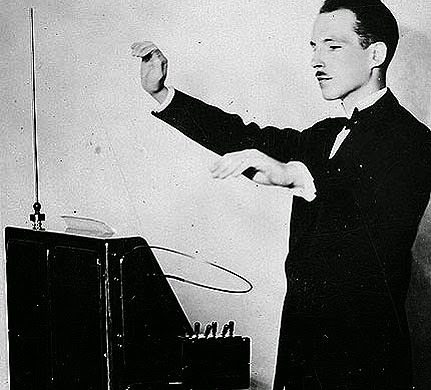
Though preceded by the Telharmonium and closely followed by such intriguing devices as the Ondes Martenot, Clavioline, Ondioline, the Theremin was perhaps the pre-eminent musical invention of the early twentieth century, one which continues to connote other states of mind and other worlds. A true product of the burgeoning Electronic Age, with the striking sight of the performer raising their hands to produce 'music from the ether', over succeeding decades the instrument's unique tones proved perfect for film-makers seeking to convey suspense, unease and, for science fiction purposes, alien beings and the mysteries of outer space.

Lev Sergeyevich Termen [Léon Theremin] was born in St Petersburg in 1896, and from an early age it was apparent that he had a natural gift for a variety of disciplines, from astronomy and physics to music. As a student at what was by then Petrograd Uniersity, he began to conduct experiments with high-frequency currents, magnetic fields and oscillators; though interrupted by the First World War, his research continued at the city's Physico-Technical Institute, where he eventually assembled an instrument, initially called the 'etherphone', which came to the attention of the very highest authorities in the fledgling Soviet state. Lenin himself became an enthusiastic advocate of the instrument, after it was demonstrated to him personally by Theremin in 1922; the head of the USSR, who famously stated that "Communism is Soviet power plus the electrification of the whole country", saw potential in linking this radical electrical invention to the wider revolutionary project. The inventor was accordingly dispatched on tour to advertise his innovation to the masses, enjoying free passage on the railways (themselves an emblem of the Soviet Union's growing technological power). On his return, he was able to capitalise on his prestige with further experiments, including producing the country's first fully-functioning television apparatus. In 1927, "a foreign extension of his agitprop barnstorming" was agreed, this time throughout Western Europe, and Theremin travelled to Berlin with a quartet of musicians from the Moscow Philharmonic Orchestra - and the blessing of the Soviet Intelligence Services.

Theremin performing on the Theremin, c. 1928

Enthusiastically received in Germany and France, where many etherphone recitals were sold out, by the time he reached London Theremin and his 'magic' device were something of a sensation. He gave demonstrations at the Albert Hall and performed before Arnold Bennett and George Bernard Shaw, before finally sailing for New York at the very end of 1927. Along the way, the instrument’s name became interchangeable with that of its creator. The further he travelled, the further its status altered, from its Soviet origins as the ultimate democratic musical object, to a novelty ('no expertise necessary!', as its early American promoters boasted), and then an exclusive plaything of the rich. Theremin gave concerts with virtuoso Clara Rockmore at Carnegie Hall, and even after the Wall Street Crash of 1929 still harboured visions of achieving mass appeal – an RCA advertisement suggested ‘a Theremin in every home’, a bold ambition which sadly never came to fruition – the instrument’s main appeal was for electronics hobbyists. The most notable of these was Hugo Gernsback, an entrepreneur-publisher of popular science magazines such as Modern Electrics. Credited with the creation of the term ‘science fiction’ and popularising it through his ground-breaking genre magazines (beginning with the hugely influential Amazing Stories), Gernsback himself dabbled in inventing electronic instruments, including the ‘Pianorad’. Continuing Theremin’s lineage, Robert Moog, creator of the first modular synthesizer which bore his name, the Theremin of its day, purchased the ‘build-it-yourself’ instructions from one of Gernsback’s publications.

Poster advertising the first Theremin demonstration in the USA; New York, 1928

Though in his New York heyday, Theremin continued to entertain visiting dignitaries and enjoyed the patronage of various high society benefactors, the commercial success he had anticipated showed little sign of materialising, despite his diversifying into alarm systems and other electronic innovations. The Theremin had been adopted in the early 1920s by Soviet film composers, amongst them Shostakovich, (and in 1934 made an appropriate appearance in the score for the propaganda film Komsomol – The Patron of Electrification), and Hollywood was not long in embracing the instrument, reviving its popular fortunes. Connoting strangeness in every sense, its ethereal sounds soon became synonymous with not only disturbed states of mind – pioneeringly used by Alfred Hitchcock in Spellbound (1945) – but also other worlds; as such, it was ideal to be applied to science fiction film soundtracks: Rocketship X-M (1950), The Thing (From Another World) and The Day the Earth Stood Still (both 1951) are among the earliest examples. The subsequent ubiquity of the Theremin in the genre meant that by the time of Tim Burton's 1996 sci-fi homage, Mars Attacks, its inclusion by composer Danny Elfman was regarded as playful parody.

Footage of Theremin in later years, accompanied by his daughter Natalia

Whilst the instrument that bore his name became ever more established in the popular culture of the West, the events of his own life, shrouded in mystery and containing fantastic elements, have been exhaustively recorded by biographer Albert Glinsky in Theremin: Ether Music and Espionage and re-imagined in the 2014 prize-winning novel Us Conductors by Sean Michaels. After his return to the Soviet Union on the eve of the Second World War (whether voluntarily or not is still the subject of speculation, as the ever-vigilant Soviet Intelligence Services are likely to have kept a close eye on him throughout his Western adventures), Theremin’s technical genius was applied to the service of the state during the Cold War – namely, inventing devices for intercepting ‘enemy’ communications and spying – and he worked in seclusion over the following decades. On the fall of the Soviet Union, he re-emerged in the West, even making a triumphant return to New York in his dotage, an improbable event captured for posterity in a documentary released in 1993, the year of his death, Theremin: An Electronic Odyssey; an apt title for a man whose lifetime spanned two centuries, both World Wars and the entire Soviet era, and whose musical and scientific legacy remains relevant today.