Showing posts with label Hugo Gernsback. Show all posts

Wednesday, 17 June 2020

The Gernsback Continuum

I posted about the Transcultural Fantastic seminar series at the University of Leeds last year and, a few weeks ago, the latest in this series of events took place as an online talk, 'The Ekphrastic Fantastic' by Dr Richard Brown. The talk explored the ekphrastic - understood as a verbal evocation of the visual - in contemporary writing, drawing from selected works by J.G. Ballard, China Miéville and Ali Smith.

There were some also fascinating SF connections made in relation to the William Gibson short story The Gernsback Continuum, which I'd never come across before. Hugo Gernsback, the writer, inventer and SF magazine publisher, has featured more than once on this blog, so the title of the story immediately piqued my curiosity. The story is told in the first person, from the perspective of a US photographer, who's commissioned by a British 'trendy trade paperback publisher' to photograph examples of futuristic American city architecture of the Thirties and Forties. It transpires that this book project - working title The Airstream Futuropolis: The Tomorrow That Never Was - is the brainchild of fashionable pop art historian Dialta Downes. The narrator's mild contempt for the idea is evident in his initial encounter with Downes:

There’s a British obsession with the more baroque elements of American pop culture [...] In Dialta Downes this manifested itself in a mania for a uniquely American form of architecture that most Americans are scarcely aware of. At first I wasn’t sure what she was talking about, but gradually it began to dawn on me [...] She was talking about those odds and ends of ‘futuristic’ Thirties and Forties architecture you pass daily in American cities without noticing: the movie marquees ribbed to radiate some mysterious energy, the dime stores faced with fluted aluminium, the chrome-tube chairs gathering dust in the lobbies of transient hotels. She saw these things as segments of a dreamworld, abandoned in the uncaring present; she wanted me to photograph them for her.


The connection to Gernsback becomes clearer when the photographer is shown a collection of Downes' favourite examples of this architectural style, what she calls 'American Streamlined Moderne':

I saw a dozen shots of Frank Lloyd Wright’s Johnson’s Wax Building, juxtaposed with the covers of old Amazing Stories pulps, by an artist named Frank R. Paul; the employees of Johnson’s Wax must have felt as though they were walking into one of Paul’s spray-paint pulp utopias. Wright’s building looked as though it had been designed for people who wore white togas and Lucite sandals.
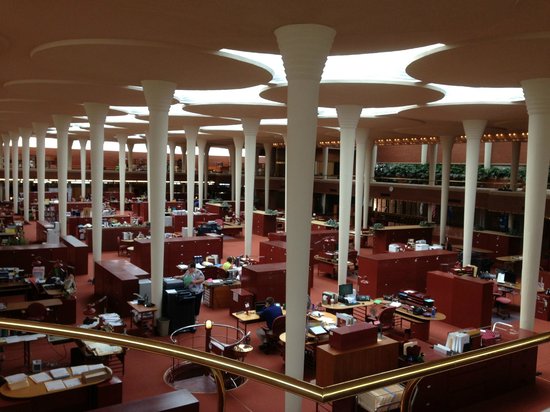

Interior of Johnson's Wax Building


Here, we see a reference to Amazing Stories, published by Gernsback, and the cover art of Frank R. Paul, an artist closely associated with this magazine's visual style, who trained as an architect himself. Downes says that we might think of these images and designs 'as a kind of alternate America: a 1980 that never happened. An architecture of broken dreams'. The narrator starts to warm up to the project, and he tries to re-imagine the environment around him according to this aesthetic:

I thought myself in Dialta Downes’s America. When I isolated a few of the factory buildings on the ground glass of the Hasselblad, they came across with a kind of sinister totalitarian dignity, like the stadiums Albert Speer built for Hitler. But the rest of it was relentlessly tacky: ephemeral stuff extruded by the collective American subconscious of the Thirties, tending mostly to survive along depressing strips lined with dusty motels, mattress wholesalers, and small used-car lots. I went for the gas stations in a big way.


As the photographer tunes in more and more to this 'shadowy America-that-wasn’t', the images begin to take on real forms, a phenomenon his journalist friend Kihn calls 'semiotic phantoms, bits of deep cultural imagery that have split off and taken on a life of their own'. Driving back to Los Angeles, he reflects on this explanation but it troubles him and, exhausted and agitated, he pulls over the car to sleep. Upon waking, he finds a phantom futuristic city looming before him; this is the ekphrastic element Richard highlighted in his talk:

Then I looked behind me and saw the city. The books on Thirties design were in the trunk; one of them contained sketches of an idealised city that drew on Metropolis and Things to Come, but squared everything, soaring up through an architect’s perfect clouds to zeppelin docks and mad neon spires. That city was a scale model of the one that rose behind me [...] You could hide the Empire State Building in the smallest of those towers. Roads of crystal soared between the spires, crossed and recrossed by smooth silver shapes like beads of running mercury. The air was thick with ships: giant wing-liners, little darting silver things (sometimes one of the quicksilver shapes from the sky bridges rose gracefully into the air and flew up to join the dance), mile-long blimps, hovering dragonfly things that were gyrocopters...

Even more troubling is the appearance of a couple, 'white, blond', the 'children of Dialta Downes’s ’80-that-wasn’t', framed by the illuminated shadow city. The narrator imagines the city populated by these creatures 'orderly and alert, their bright eyes shining with enthusiasm for their floodlit avenues and silver cars', deciding 'it had all the sinister fruitiness of Hitler Youth propaganda'.

The photography for Downes' book ends up being a great success. But, desperate to return to some kind of normality, the story ends with the photographer rushing to the nearest newsstand to buy a paper and read about the petroleum crisis and the nuclear energy hazard:

[Newsstand proprietor] ‘Hell of a world we live in, huh?’ [...] ‘But it could be worse, huh?’ 

‘That’s right,’ I said, ‘or even worse, it could be perfect.’

Overall then, Gibson takes a cynical view of the technophilia and optimism of the 1930s and 1940s, epitomised in the covers of Gernsback's SF magazines. As Bruce Sterling has commented, 'The Gernsback Continuum shows [Gibson] consciously drawing a bead on the shambling figure of the SF tradition'. Nevertheless, his evocative rendering of the 'semiotic phantoms' lurking in American architecture throws a sharp critical and visual lens on one of the country's many futures past.

Monday, 31 December 2018

Hugo Gernsback and the Electrical Experimenter Archive

Born in Luxembourg, Hugo Gernsbacher emigrated to New York at the age of 20, in 1904. In the USA, he soon displayed an entrepreneurial spirit, changing his surname to Gernsback and setting up the Electro Importing Co. to sell the latest specialist electronic devices from Europe. Always interested in developments in science and technology, he founded the magazine Modern Electrics in 1908 as a mail-order catalogue, with technical articles and instructions for home electronics enthusiasts. He also registered patents for such exotic items as the Isolator, a sensory-deprivation helmet intended to increase concentration and focus, despite looking more suitable for deep-sea diving.


Electrical Experimenter, which ran between May 1913 and July 1920, was the successor to Modern Electrics, where Gernsback had serialised his own novel Ralph-124C 41+ between 1911 and 1912. Although, like its predecessor, it concentrated on technical science for amateur hobbyists – particularly in the field of radio, or ‘wireless’ – its scope was expanded to include some early science fiction, among them his own stories. Alongside these were articles by Nikolai Tesla, who also published segments of his autobiography in the magazine during 1919. In a 1916 editorial, Gernsback argued that a “real electrical experimenter, worthy of the name” must have imagination and a vision for the future.

The monthly editions of Electrical Experimenter in 1918 largely focused on technology in warfare, with the First World War still raging in Europe. From January’s ‘Electro-Magnetic Depth-Bombs’ through the ‘Gyro-Electric Destroyer’ to ‘The Automatic Soldier’, Gernsback showed his pragmatic knack of seizing the moment. Although the August issue harked back to a more innocent era of transport speculation, presenting the ‘Aerial Mono-Flyer of the Future’, the year concluded with tanks and barbed wire. The magazine continued to run extensive advertisements for all things electrical, including Gernsback’s own Electro Importing Co., which was still in business. The archives of Electrical Experimenter can be found in several digital repositories; the bulk of them are at American Radio History and the Internet Archive.


Though his magazines were both successful and influential, Gernsback was notorious for his sharp business practices, taking advantage of struggling writers. One of these was H.P. Lovecraft, who referred to him as ‘Hugo the Rat’. He went on to found Amazing Stories in 1926, accepted as the first major science fiction magazine (although Gernsback’s preferred term was ‘scientifiction’, which he initially used). He was declared bankrupt in 1929, losing control of his publishing empire, but recovered to launch Wonder Stories and other popular magazines; he founded over 50 different titles during his lifetime. Gernsback was involved in early radio and television broadcasts, and anticipated the rise of mass media and air travel as early as the 1920s. He continued to envision the future, invent and register patents, until his death in 1967. The prestigious Hugo Awards, inaugurated in 1953 at the World Science Fiction Convention, are named after him in recognition of his contribution to the genre, as is a crater on the Moon.

Tuesday, 12 May 2015

Science Fiction-Music Interconnections: Theremin

Though preceded by the Telharmonium and closely followed by such intriguing devices as the Ondes Martenot, Clavioline, Ondioline, the Theremin was perhaps the pre-eminent musical invention of the early twentieth century, one which continues to connote other states of mind and other worlds. A true product of the burgeoning Electronic Age, with the striking sight of the performer raising their hands to produce 'music from the ether', over succeeding decades the instrument's unique tones proved perfect for film-makers seeking to convey suspense, unease and, for science fiction purposes, alien beings and the mysteries of outer space.

Lev Sergeyevich Termen [Léon Theremin] was born in St Petersburg in 1896, and from an early age it was apparent that he had a natural gift for a variety of disciplines, from astronomy and physics to music. As a student at what was by then Petrograd Uniersity, he began to conduct experiments with high-frequency currents, magnetic fields and oscillators; though interrupted by the First World War, his research continued at the city's Physico-Technical Institute, where he eventually assembled an instrument, initially called the 'etherphone', which came to the attention of the very highest authorities in the fledgling Soviet state. Lenin himself became an enthusiastic advocate of the instrument, after it was demonstrated to him personally by Theremin in 1922; the head of the USSR, who famously stated that "Communism is Soviet power plus the electrification of the whole country", saw potential in linking this radical electrical invention to the wider revolutionary project. The inventor was accordingly dispatched on tour to advertise his innovation to the masses, enjoying free passage on the railways (themselves an emblem of the Soviet Union's growing technological power). On his return, he was able to capitalise on his prestige with further experiments, including producing the country's first fully-functioning television apparatus. In 1927, "a foreign extension of his agitprop barnstorming" was agreed, this time throughout Western Europe, and Theremin travelled to Berlin with a quartet of musicians from the Moscow Philharmonic Orchestra - and the blessing of the Soviet Intelligence Services.

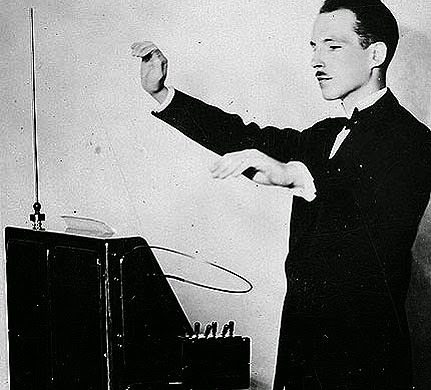
Theremin performing on the Theremin, c. 1928

Enthusiastically received in Germany and France, where many etherphone recitals were sold out, by the time he reached London Theremin and his 'magic' device were something of a sensation. He gave demonstrations at the Albert Hall and performed before Arnold Bennett and George Bernard Shaw, before finally sailing for New York at the very end of 1927. Along the way, the instrument’s name became interchangeable with that of its creator. The further he travelled, the further its status altered, from its Soviet origins as the ultimate democratic musical object, to a novelty ('no expertise necessary!', as its early American promoters boasted), and then an exclusive plaything of the rich. Theremin gave concerts with virtuoso Clara Rockmore at Carnegie Hall, and even after the Wall Street Crash of 1929 still harboured visions of achieving mass appeal – an RCA advertisement suggested ‘a Theremin in every home’, a bold ambition which sadly never came to fruition – the instrument’s main appeal was for electronics hobbyists. The most notable of these was Hugo Gernsback, an entrepreneur-publisher of popular science magazines such as Modern Electrics. Credited with the creation of the term ‘science fiction’ and popularising it through his ground-breaking genre magazines (beginning with the hugely influential Amazing Stories), Gernsback himself dabbled in inventing electronic instruments, including the ‘Pianorad’. Continuing Theremin’s lineage, Robert Moog, creator of the first modular synthesizer which bore his name, the Theremin of its day, purchased the ‘build-it-yourself’ instructions from one of Gernsback’s publications.

Poster advertising the first Theremin demonstration in the USA; New York, 1928

Though in his New York heyday, Theremin continued to entertain visiting dignitaries and enjoyed the patronage of various high society benefactors, the commercial success he had anticipated showed little sign of materialising, despite his diversifying into alarm systems and other electronic innovations. The Theremin had been adopted in the early 1920s by Soviet film composers, amongst them Shostakovich, (and in 1934 made an appropriate appearance in the score for the propaganda film Komsomol – The Patron of Electrification), and Hollywood was not long in embracing the instrument, reviving its popular fortunes. Connoting strangeness in every sense, its ethereal sounds soon became synonymous with not only disturbed states of mind – pioneeringly used by Alfred Hitchcock in Spellbound (1945) – but also other worlds; as such, it was ideal to be applied to science fiction film soundtracks: Rocketship X-M (1950), The Thing (From Another World) and The Day the Earth Stood Still (both 1951) are among the earliest examples. The subsequent ubiquity of the Theremin in the genre meant that by the time of Tim Burton's 1996 sci-fi homage, Mars Attacks, its inclusion by composer Danny Elfman was regarded as playful parody.

Footage of Theremin in later years, accompanied by his daughter Natalia

Whilst the instrument that bore his name became ever more established in the popular culture of the West, the events of his own life, shrouded in mystery and containing fantastic elements, have been exhaustively recorded by biographer Albert Glinsky in Theremin: Ether Music and Espionage and re-imagined in the 2014 prize-winning novel Us Conductors by Sean Michaels. After his return to the Soviet Union on the eve of the Second World War (whether voluntarily or not is still the subject of speculation, as the ever-vigilant Soviet Intelligence Services are likely to have kept a close eye on him throughout his Western adventures), Theremin’s technical genius was applied to the service of the state during the Cold War – namely, inventing devices for intercepting ‘enemy’ communications and spying – and he worked in seclusion over the following decades. On the fall of the Soviet Union, he re-emerged in the West, even making a triumphant return to New York in his dotage, an improbable event captured for posterity in a documentary released in 1993, the year of his death, Theremin: An Electronic Odyssey; an apt title for a man whose lifetime spanned two centuries, both World Wars and the entire Soviet era, and whose musical and scientific legacy remains relevant today.

Wednesday, 11 February 2015

Science Fiction Theatre: Postcard From Barcelona

The subject of this month’s post was selected based on a temporary move to Spain, and the ‘Postcard from Barcelona’ reference proved impossible to resist! The title is borrowed from episode 30 of the 1950s-60s American science fiction television series, Science Fiction Theatre, a forerunner to programmes like the Twilight Zone, also featured here in a recent post.

Hosted by the film actor and former war correspondent Truman Bradley, each episode would begin with a simple science experiment, related in some way to the theme of the show. The shadow of war loomed large in experiments that would demonstrate the power of electron beams or the destruction of model cities, but this was usually tempered by optimism about the potential scientific advances to be made. For example, the intro to Postcard from Barcelona focuses on the construction of solar powered space stations; Bradley comments, ‘solar power can give man a powerful weapon with which to destroy himself or it can give us scientific opportunities for discoveries that will benefit the world’.

The topic of the episode extrapolates from the idea that these space stations already exist and were built by aliens to collect scientific data about Earth. The mysterious postcards from Barcelona (perhaps a suitably exotic and alien location for 1950s America) are received by the scientist Dr Keller, found dead at the beginning of the story, who is described as ‘the greatest scientist of the age’. It transpires that both Keller’s ‘sub-quantum theory of the universe’ and the compound elements for a numerical wonder drug were posted to the doctor exactly a year before he announced them to the world. The episode ends with a final postcard, sent in the code language of cybernetics, from the life forms to whom Keller owes his discoveries. The mantle then passes to his daughter and two former colleagues to keep the secret of the alien space station orbiting Earth.

While the scientific content in the series was minimal by today’s standards, real-world technologies and scientific problems were often the point of departure for the stories. The wider popularisation of science in this period was influenced by the craze for hobbyist magazines, which would usually also publish SF (described then as scientific fiction). Titles such as Modern Electrics, Electrical Experimenter and Amazing Stories, published by Hugo Gernsback in the 1930s, were later followed by a proliferation of anthologies and cheap paperback novels during the post-WWII publishing boom. The ascendency of television in the 1950s explains the emergence of a series like Science Fiction Theatre as part of this trend.

It's not surprising, then, that in the re-imagining of 1950s America in Back to the Future, Science Fiction Theatre features as George McFly’s favourite TV programme...


Friday, 17 May 2013

SF Small Ads: One Giant Leap for Amateur Radio

The year is 1925, one year prior to the launch of Hugo Gernsback's first issue of Amazing Stories. This was the magazine that, along with Gernsback, would later be credited for the invention of scientifiction- science fiction but not as we know it... It is for his contribution to SF that Gernsback is now remembered, the Worldcon Hugo Awards are named in his honour. But, as a former electrical engineer, his first interest was actually amateur radio. 1925 was the year he launched WRNY, an AM radio station that operated in New York and ran until 1934.

Throughout the first half of the 20th century amateur radio was a widespread hobby. In 1912 Gernsback said that he estimated 400,000 people in the U.S. were transmitting or picking up radio signals, and it was presumably audience demand that led to the establishment of WRNY. The first broadcast was on 12 June, 1925 and was covered by The New York Times. The programme included an address from the radio pioneer Lee de Forest and two hours of live musical entertainment. In those early days the idea was that anyone could build their own radio and start picking up frequencies and there were so many stations, it wasn't unusual for them to share the same frequency at different times during the day.

The prevalence of small ads. in contemporary magazines and other Gernsback publications, including Amazing Stories and Wonder Stories, testifies to the popularity of amateur radio. However, Gernsback was also a notorious self-promoter and often used his publications to cross-market one another; some titles would carry the radio station’s call letters on the cover and his company, Experimenter Publishing, produced several specialised publications for radio. In the adverts, amateur radio enthusiasts were called fans and frequently petitioned to buy the latest manuals, which covered such mind-boggling topics as 'radiotics' and 'broadcastatics'.

Still, amateur radio wasn't the only pursuit vying for the attention of the discerning reader- magic sets, night classes, exercise programmes and thinly veiled appeals to enlist for the Navy were among the other adverts. These build up a detailed, if slightly off-putting, picture of the contemporary SF enthusiast: male, possibly lonely and lacking in confidence, with an interest in all things technical and/or magical. Even during this early phase, the stage was being set for the familiar geek-sterotypes, although the later professionalisation of radio would lead to the emergence of an even more unsavoury character... the DJ.

Through his publishing actvities, Gernsback had a significant influence on the growth of early broadcasting. So, while perhaps a more modest achievement than Father of SF, his shortlived ascendancy over the airwaves is nevertheless an interesting footnote in SF's history.