Showing posts with label future. Show all posts

Wednesday, 16 June 2021

Day in the Life of a Tech Hub Librarian

I was going through some old files the other day, when I came across a speculative writing exercise I did for the Dream of a Low Carbon Future project back in 2014. The brief was to use the model of the future envisaged by the project (based on people, societies, and the human and physical environment) and write a 'day in the life' of someone from 2150. Reading it back now, some of these ideas already seem out of date (!) but anyway this is what I came up with... 

The Tech Hub Librarian

Let me describe for you the conditions of my life in 2150AD. I live a fairly solitary existence. I’m not exactly a social pariah but my position in my community is a precarious one. Now at 60 years of age, with no close family, it hardly seems to matter much, although loneliness sets in from time to time. I should be grateful, at least I’m never cold; a side-effect of living in the hub is the abundance of surplus heat generated in powering the knowledge servers. My job title ‘librarian’ is somewhat deceptive. The general understanding of such a role was for many years closely associated with books and written papers, and it was those things that initially drew me to the profession. I was always attached to the romantic idea of preserving material culture - caring for the books and artefacts accumulated over centuries and so treasured by 20th and 21st century societies - that old-fashioned notion of the ‘authentic’. The reality, of course, is vastly different. The hubs constitute a digital cultural record, made up of 0s and 1s. It’s not much to look at; rows and rows of servers punctuated by the odd terminal. There’s a popular myth that these hubs still hold and protect the original treasures. In fact, most of them were sold off long ago into private collections; no one really noticed, what with all the flooding and famine. And goodness knows what happened to them after that! 

Long-held prejudices persist, however, the old ‘knowledge is power’ stereotype... Naturally, it gives us librarians a bad reputation. We’re treated with general suspicion, subject to occasional threats and one extremist group is out to prove we’re a sect of information overlords, who control the inner workings of society. Par for the course, I suppose. Perhaps once there was some grounding for this conspiracy theory. Back in the 21st century, huge server warehouses (probably resembling the hubs of today) used to guide the investment of trillions of assets all over the world, prolonging the boom years and delaying the inevitable financial collapse of world economies by almost 100 years. Sinister stuff. Now, the economy is relatively transparent, although the Citizen’s Income allocation gets more farcical every year. Yes, gone are the ‘knowledge societies’ of the 21st century. A popular, widely held view is that culture is dormant and we’ve returned to the Dark Ages. Odd time to be a librarian, eh? 

It’s all nonsense though! The concept of high culture may be dead but a different kind of cultural value has taken centre stage: know-how, as opposed to Knowledge with a capital ‘K’. There’s still an appetite for heritage in my community but more in the form of family history, which has always been popular. That’s what the majority of the hub’s visitors come for. In the 21st century, there were companies that compiled huge databases of information, digitized from written records: birth, death and marriage certificates, newspapers etc. The floods wiped most of them out but there are still records, saved from the Amazon servers, of individuals’ purchasing history. An odd kind of family history if you ask me but people seem to be fascinated to learn that on the 23 May 2050 great great grandad bought a new birdfeeder. They obviously find all that consumerism rather quaint.

Wednesday, 17 June 2020

The Gernsback Continuum

I posted about the Transcultural Fantastic seminar series at the University of Leeds last year and, a few weeks ago, the latest in this series of events took place as an online talk, 'The Ekphrastic Fantastic' by Dr Richard Brown. The talk explored the ekphrastic - understood as a verbal evocation of the visual - in contemporary writing, drawing from selected works by J.G. Ballard, China Miéville and Ali Smith.

There were some also fascinating SF connections made in relation to the William Gibson short story The Gernsback Continuum, which I'd never come across before. Hugo Gernsback, the writer, inventer and SF magazine publisher, has featured more than once on this blog, so the title of the story immediately piqued my curiosity. The story is told in the first person, from the perspective of a US photographer, who's commissioned by a British 'trendy trade paperback publisher' to photograph examples of futuristic American city architecture of the Thirties and Forties. It transpires that this book project - working title The Airstream Futuropolis: The Tomorrow That Never Was - is the brainchild of fashionable pop art historian Dialta Downes. The narrator's mild contempt for the idea is evident in his initial encounter with Downes:

There’s a British obsession with the more baroque elements of American pop culture [...] In Dialta Downes this manifested itself in a mania for a uniquely American form of architecture that most Americans are scarcely aware of. At first I wasn’t sure what she was talking about, but gradually it began to dawn on me [...] She was talking about those odds and ends of ‘futuristic’ Thirties and Forties architecture you pass daily in American cities without noticing: the movie marquees ribbed to radiate some mysterious energy, the dime stores faced with fluted aluminium, the chrome-tube chairs gathering dust in the lobbies of transient hotels. She saw these things as segments of a dreamworld, abandoned in the uncaring present; she wanted me to photograph them for her.


The connection to Gernsback becomes clearer when the photographer is shown a collection of Downes' favourite examples of this architectural style, what she calls 'American Streamlined Moderne':

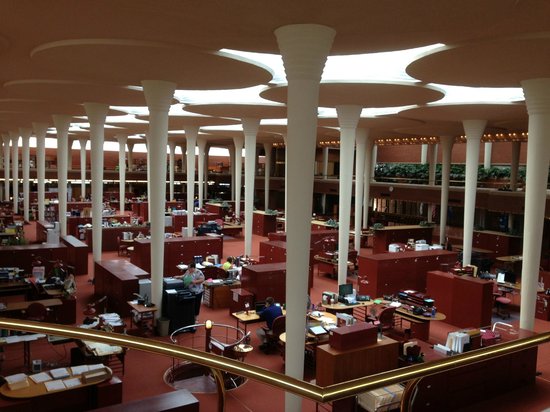
I saw a dozen shots of Frank Lloyd Wright’s Johnson’s Wax Building, juxtaposed with the covers of old Amazing Stories pulps, by an artist named Frank R. Paul; the employees of Johnson’s Wax must have felt as though they were walking into one of Paul’s spray-paint pulp utopias. Wright’s building looked as though it had been designed for people who wore white togas and Lucite sandals.


Interior of Johnson's Wax Building


Here, we see a reference to Amazing Stories, published by Gernsback, and the cover art of Frank R. Paul, an artist closely associated with this magazine's visual style, who trained as an architect himself. Downes says that we might think of these images and designs 'as a kind of alternate America: a 1980 that never happened. An architecture of broken dreams'. The narrator starts to warm up to the project, and he tries to re-imagine the environment around him according to this aesthetic:

I thought myself in Dialta Downes’s America. When I isolated a few of the factory buildings on the ground glass of the Hasselblad, they came across with a kind of sinister totalitarian dignity, like the stadiums Albert Speer built for Hitler. But the rest of it was relentlessly tacky: ephemeral stuff extruded by the collective American subconscious of the Thirties, tending mostly to survive along depressing strips lined with dusty motels, mattress wholesalers, and small used-car lots. I went for the gas stations in a big way.


As the photographer tunes in more and more to this 'shadowy America-that-wasn’t', the images begin to take on real forms, a phenomenon his journalist friend Kihn calls 'semiotic phantoms, bits of deep cultural imagery that have split off and taken on a life of their own'. Driving back to Los Angeles, he reflects on this explanation but it troubles him and, exhausted and agitated, he pulls over the car to sleep. Upon waking, he finds a phantom futuristic city looming before him; this is the ekphrastic element Richard highlighted in his talk:

Then I looked behind me and saw the city. The books on Thirties design were in the trunk; one of them contained sketches of an idealised city that drew on Metropolis and Things to Come, but squared everything, soaring up through an architect’s perfect clouds to zeppelin docks and mad neon spires. That city was a scale model of the one that rose behind me [...] You could hide the Empire State Building in the smallest of those towers. Roads of crystal soared between the spires, crossed and recrossed by smooth silver shapes like beads of running mercury. The air was thick with ships: giant wing-liners, little darting silver things (sometimes one of the quicksilver shapes from the sky bridges rose gracefully into the air and flew up to join the dance), mile-long blimps, hovering dragonfly things that were gyrocopters...

Even more troubling is the appearance of a couple, 'white, blond', the 'children of Dialta Downes’s ’80-that-wasn’t', framed by the illuminated shadow city. The narrator imagines the city populated by these creatures 'orderly and alert, their bright eyes shining with enthusiasm for their floodlit avenues and silver cars', deciding 'it had all the sinister fruitiness of Hitler Youth propaganda'.

The photography for Downes' book ends up being a great success. But, desperate to return to some kind of normality, the story ends with the photographer rushing to the nearest newsstand to buy a paper and read about the petroleum crisis and the nuclear energy hazard:

[Newsstand proprietor] ‘Hell of a world we live in, huh?’ [...] ‘But it could be worse, huh?’ 

‘That’s right,’ I said, ‘or even worse, it could be perfect.’

Overall then, Gibson takes a cynical view of the technophilia and optimism of the 1930s and 1940s, epitomised in the covers of Gernsback's SF magazines. As Bruce Sterling has commented, 'The Gernsback Continuum shows [Gibson] consciously drawing a bead on the shambling figure of the SF tradition'. Nevertheless, his evocative rendering of the 'semiotic phantoms' lurking in American architecture throws a sharp critical and visual lens on one of the country's many futures past.

Saturday, 29 July 2017

Esperanto and SF: A Potted History

Esperanto was invented as an international secondary language by Ludwig Zamenhof, who published his first book on Esperanto in 1887. He believed that a common mode of communication between people would eliminate the problems and misunderstandings of translation and ultimately lead to a more harmonious world system.

Zamenhof was not the first to come up with the idea of an international language. Like many others, he was motivated by the utopian impulse to create a better world, a universal vision that could, through language, overcome the divisions created by humankind. Esperanto is, however, perhaps one of the most famous – or infamous – of such languages, partly because of its widespread uptake and partly because it has been the subject of various parodies and criticisms. For example, it is believed that Esperanto provided the inspiration for Newspeak in George Orwell’s dystopian novel Nineteen Eighty-Four, in which the introduction of a simplified universal language operates as a form of social control to restrict thought.

This leads me on to the topic of this month’s post: Esperanto and SF. While Orwell was sceptical about the implications of a language like Esperanto, many other SF writers have been fascinated by the positive reconfiguration of the world it might bring about, or the kinds of societies that might be amenable to a shared secondary language.

Philip José Farmer's Riverworld novels are perhaps among the most famous works to make use of Esperanto – in the second volume it is the language of the peaceful religion of the Church of the Second Chance. Likewise, the stories of lesser known writers such as Mack Reynolds explore issues of universal basic income and universal religion and language. In his 1974 novel Looking Backward From the Year 2000, a re-writing of Edward Bellamy’s 1888 work, the protagonist finds himself in a future where the revolution in communications and transportation has led to the large-scale adoption of Esperanto as an interlingua.

Morojo with Ackerman in costume in 1939
SF fanzines also have their notable Esperantists. Myrtle Douglas, known by her Esperanto name ‘Morojo’, was a fanzine editor from Los Angeles, who was active between the years 1939 and 1958. From 1939 until 1947, Morojo co-edited the fanzine Voice of the Imagi-Nation with the SF writer, Forrest J Ackerman, who she met at an Esperanto gathering. With Ackerman, she also attended the first World Science Fiction Convention (1939), for which they wore matching futuristic costumes (see image). From 1941 until 1958, Morojo published the zine Guteto, which promoted Esperanto among science fiction fans. After her death, Ackerman wrote of her, ‘she was an expert Esperantist’ and ‘a real science fiction fan’.

These examples reflect the overlap between the imaginary communities explored in the works of SF writers and the radical aspirations for Esperanto as a means of achieving societal transformation. Such experiments in invented language have been sporadic and, at best, only partially successful. However, like language, SF works to both represent and translate cultures, echoing the hopes and fears of the societies from which it is produced.

More information about the inclusion of Esperanto in literary works can be found in the online book The Esperanto Book by Don Harlow.

Wednesday, 29 March 2017

The 'Linear City': Imagining Newcastle's Future in 1965

Histories of city planning can give fascinating insights into the built environment of different localities at particular moments in time. Even more tantalising are those plans and developments that never came to pass, the lost cities of the future that are buried in archives and planning departments. There is a science fictional element to these speculative architectural documents, some of which have been the focus of research projects. Recent examples include My Future York at the University of Leeds and Managing Change in Future Cities at Newcastle University.

A particularly striking idea, drawn from the second project, is the 'Linear City' of 1965 - a visual concept that appeared in the Northern Architect in July 1965. This was the subject of a recent news article, in which project leader Professor Mark Tewdwr-Jones explained that 'the idea was to treat the region as a series of distinct areas - the city, the countryside, the seaside, the lakeside, the hill town - to reflect the different features and asset of the places but all within one region and all connected together by a new fast speedy transport system'. In the image below you can see a visual representation of the monorail system the designers envisaged, which could have been lifted straight off the page of a SF novel.

Linear City Image from Northern Architect (1965) 

Monorail passengers gaze down at the traffic far below and look out over the futuristic city skyline in the next image:

Linear City Image from Northern Architect (1965) 
These design ideas testify to the hopefulness of 1960s Newcastle and capture the spirit of a time that looked forward to improved living conditions and quality of life for the densely populated city. Alternative futures like this one, brought to light by the Future Cities project, also encourage thinking about alternatives in the context of contemporary urban development, meaning that the city of the future is constantly being renewed and reinvented for the present.

Thanks to Bethany Rex for the link and for drawing my attention to this topic.

Wednesday, 29 June 2016

500th Anniversary of More's Utopia - Connected Communities Festival

I've written on the blog before about Utopia and the early printed and Kelsmcott Press editions of Thomas More's work in the Brotherton Library's Special Collections. The name Utopia refers to the island counter-world to which the characters of the story travel, and can be read as both the good place (eutopia) and no place (outopia). While More's island reflected the expanding geographical knowledge of sixteenth century Europe, during the eighteenth century the spatial utopia gradually gave way to a temporal model and utopian narratives became aligned with the idea of a better or alternative future.

Originally published in Latin in 1516, this year sees the 500th anniversary of Utopia, and a number of projects and special events to celebrate the occasion. Among these was the Arts and Humanities Research Council's Connected Communities Festival 2016; this year’s Festival theme was Community Futures and Utopia. I've been involved with the Festival as part of the project team for My Future York. Inspired by work with York Libraries and Archives and the York Past and Present Facebook group, the project explores the potential of utopian thinking for heritage in York and focuses on how these debates can be harnessed in important ways for local democracy. It encompasses a range of temporal perspectives; from thinking about housing plans that didn’t happen to inviting ideas for the future development of the city.

Utopia logo

More's island of utopia

The Festival was in partnership with The Somerset House Trust’s 'Utopia 2016: a year of Imagination and Possibility'. The designs for the 'Utopia 2016' season (see flag above) were created by Jeremy Deller and Fraser Muggeridge studio. They are inspired by Thomas More’s 22-letter Utopian alphabet, which appears in early editions of Utopia with the Latin translation underneath. You can download a copy of the Utopia alphabet here.

To read more about heritage utopias and the My Future York project, visit http://myfutureyork.org/futures-utopias/

Thursday, 25 February 2016

Museums of the Future

Museums make fairly frequent appearances in SF novels, as discussed in the 2012 post, 'The Museum in Science Fiction'. Often, the encounter with the museum in SF is a metaphor for the past (former societies, wars, lost civilisations etc.) and a counterpoint to the future or parallel world of the story. This association is perhaps related to the management of time such institutions are implicated in. Debates in the museum profession are revealing of a similar impulse but from the perspective of the future as well as the past. However, beyond the perennial concern about the future of museums, there seems to have been an intensification of future-gazing type surveys and opinion pieces during the last few years, in a distinctly science fictional vein. The influence of scientific and technological developments, particularly involving the Internet, is clearly part of the reason for this trend. Therefore, I thought I'd do a quick round-up of commentaries on what the 'future museum' might look like.

One of the most interesting things I noticed was that the word 'platform' came up a number of times. This term is increasingly associated with digital media platforms but used in different ways here in relation to museums. For example, in a Tate blog post, Chris Dercon (Director, Tate Modern, London) draws attention to the ever expanding space of the museum, both physical and virtual, writing that 'it is becoming a unique platform for human encounters'. Several contributors to a Museum ID piece also make the connection between the museum and social technologies; Peter Gorgels, (Internet Manager, Rijksmuseum) says: 'Modern museum visitors want to follow their own interests and form their own opinions. The museum of the future will therefore function more as a "meaning platform" where users are inspired to chart their own course and to become, as it were, designers and artists themselves. The digital domain has a logical role to play in this development'.

Others emphasised the social over the technological aspects of the platform model; Clare Brown (Program Head, Master of Arts in Exhibition Design, Corcoran School of the Arts and Design at the George Washington University) commented that exhibit designers are becoming inspired to 'consider exhibitions as nimble platforms for information exchange and social engagement' and Andrew McClellan echoes these thoughts in the Frieze article, 'What is the future of the museum?' He also points out, 'museums can be palliative as well as acting as platforms for global dialogue, and will thrive to the extent they successfully manage their dual identities as zones of engagement and escape'. Finally, in response to the Guardian's question, What should our museums look like in 2020?, Robert Hewison stressed the need for museums to be flexible, suggesting, 'they are meeting places for people and ideas. Their future depends on remaining a dynamic part of the public realm'.

It's difficult to tell how far these ideas constitute prophecies about the museum of the future. Nevertheless, it's a useful insight into the history of the present and the way in which digital technologies are having a growing impact on how people conceptualise their interactions with culture and each other. And if museums in the future do end up becoming increasingly digital, let's just hope the oft-predicted digital dark age doesn't catch up with them...


Thanks to Bethany Rex for the links and for drawing my attention to this topic.

Wednesday, 22 January 2014

The Guardian's Art from Mars

Photo: NASA/JPL-Caltech/Texas A&M/Cornell

This beautiful feature from the Guardian represents the best pictures sent back from NASA rovers Spirit and Opportunity, over a decade spent photographing Mars.

From dazzling dunes to vast craters to space blueberries, these amazing shots are full of imaginative possibilities and offer a glimpse of life on the Red Planet.

Tuesday, 12 November 2013

More's Utopia: Historically Bound

A tradition of utopian writing, in which an ideal state or ‘other worlds’ are portrayed in order to cast a light on contemporary society, runs through English and European literature. The idea of utopia can be traced back to around 380 BC and Plato’s Republic, in which he outlines what he sees as the ideal society and its political system, and discusses the concept of ‘real’ and ‘imagined’ worlds. The word recurs in a modern context in Sir Thomas More’s 1516 work Utopia, where he too sets out a vision of an ideal society. The meaning of utopia - literally ‘no place’ - indicates that the perfect state may be an unattainable goal, and it is often depicted via satire and parody. There are two notable editions of More's Utopia in the Brotherton Library's Special Collections; the first is a 1893 edition, printed by William Morris at the Kelmscott Press in a limited edition of 300 (see image), the second is an early edition, published in 1518 by the famous printer and publisher Johann Froben.

Utopia by Thomas More (Kelsmcott Press)
This second copy of Utopia forms part of the Howard de Walden Collection. The Roundhay Hall catalogue shows that by 1926, Lord Brotherton had purchased 117 volumes from the library of Thomas Evelyn Scott-Ellis VIII, Baron Howard de Walden (1880-1946) for his own collection, which he later bequeathed to the Library. While the works themselves were published between 1471 and 1889 (although most date from the 16th and 17th centuries), many of the collection were bound early in the 20th century with Rivière bindings. These sought to recreate binding styles that were contemporary with the period of the printed work, in-keeping with the fashion at the time. The firm of Rivière, active in London between 1840 and 1939, was famous for the quality of their workmanship, and their work was prized by collectors. However, although the subject requires further research, it has come to light that the techniques used were not always accurate so that in some cases the binding reveals more about the binders' knowledge of historic binding than about the binding styles themselves.

Perhaps, then, the ideal of the perfect binding, much like the ideal of the perfect society envisaged by More's Utopia, remains elusive and ultimately unrealisable. The mixing of memory and desire, quoted famously in T.S. Eliot's The Waste Land (see also the Memory-Technology-Utopia post on this blog), reflects that impulse to delve into the past in the hope of creating something perfect for the future, even if a sense of history becomes distorted the effort.

This post adapts text from the booklet Visions of the Future: The Art of Science Fiction by Paul Whittle and Liz Stainforth.

Thursday, 17 October 2013

The Fugitive Futurist

The Fugitive Futurist is a silent short from 1924, made available by the BFI via Youtube. Cast in the same mould as H.G. Wells' time-traveller, the fugitive of the title reveals to us the secret of his prophetic visions by way of a magic camera.

Opening a window onto the future, these visions include Trafalgar Square submerged in water, the fashionable 1920s Strand boarded up and littered with 'To Let' signs, an airship platform on top of Westminster and high speed trains whizzing across Tower Bridge.


While the camera's inventor turns out to be an escapee from the local asylum, the film's French director Gaston Quiribet may have been onto something with his images of high speed rail lines and famous landmarks flooded by rising sea levels. As BFI curator Simon McCallum wonders, 'could this be a prophetic glimpse of our great capital's fate?'

To find out more about the BFI National Archive visit http://www.bfi.org.uk/archive-collections 

Thursday, 8 August 2013

Memory-Technology-Utopia

Or, Can We Salvage the Future?

[The following is an excerpt from a longer piece of writing, which forms part of my PhD research]

‘Why are there no utopias today?’ is Judith Shklar’s opening gambit in her essay, ‘The Political Theory of Utopia: From Melancholy to Nostalgia’,  a question that assumes the utopian project to be a thing of the past, a historical artefact. This view forms part of a broader narrative of utopia, dominant since the late 1960s, which attributes its disappearance to the decline of modernist narratives of collective progress and improvement. So, where did these utopian visions go? Were they banished to the convenient ‘no place’ of the word’s Greek origins? Was the unfashionable and deterministic idea of progress responsible for their fall from grace? And what, if anything, stood in their (no)place? One version of events is that by the 1970s, the unifying drive of utopia was no longer up to the task of reconciling the competing claims of minority groups in a world with increasingly global perspectives.  As the utopian project waned, the concept of collective memory began to emerge in academic discourse, with all its evocative, recuperative and inclusive potential. Offering a means of coming to terms with the events of the past in order to move forward, memory seemed like an antidote to the perceived authoritarian strain in historical narratives. The past, then, having achieved a healthy distance from the present, was once again close and familiar, no longer a foreign country, but the vehicle for societies’ shared inheritance.  This temporal manoeuvre is well documented, whereby the past, through a discourse of social remembering, is shaped and interpreted according to the present situation.  However, there is something in the latest incarnation which, under the banner of memory, speaks of a particular anxiety about the future. The renewed impetus to remember, memorialise and pass on a legacy, particularly in the sphere of culture, is underpinned by the fear that a failure to do so will perpetuate the already pervasive spectre of cultural amnesia.   Consequently, stories, sites and monuments of the past were never so popular, as much for what they represent as for what they are. But the question of what they represent now is critical; do they memorialise the glories of the past or hold the promise of the future? Is there something faintly utopian about the new and oft cited memory boom?

I want to explore this possibility further and to argue for a theory of utopia that goes beyond its status as an artefact of the modernist era. So rather than asking, as Skhlar does, ‘why are there no utopias today?’, I will not foreclose the question of utopia because it seems to me to be intimately linked to the contemporary concern with memory, borne out of a desire for the future. There is, of course, a well-established precedent for locating the utopian impulse within the realms of memory, for example, in the figure Walter Benjamin's angel of history,  or in the mixing of ‘memory and desire’  in T.S. Eliot’s opening to The Waste Land. Theodor Adorno gave a succinct expression of this relationship in Aesthetic Theory, writing ‘ever since Plato’s doctrine of anamnesis, the not-yet-existing has been dreamed of in remembrance’.  Here, memory appears as the anchor for utopia, opening up the space from which it emerges. The anchoring function of memory is significant in an age where temporal boundaries are being increasingly challenged, effecting a sense of displacement that has been noted by several cultural theorists. For instance, Zygmunt Bauman comments that, ‘due to the ‘pendulum-like’ trajectory of historical sequences a close proximity of forward and backward or ‘utopia’ and ‘nostalgia’ pregnant with confusion is virtually inevitable’.  In this regard, utopia is peculiarly relevant to my study, where the museum, that shrine to the past, is explored in its relation to digital technologies, the current symbol of the future par excellence. Furthermore, my focus is on memory, specifically the discourse of collective memory, and its uptake in discussions about preserving cultural heritage digitally. The question of digital technology is not insignificant, since it potentially re-defines the transmission of culture as the flow of information. Nor is memory a politically benign concept in the projects, press and policies that have the digitisation of cultural heritage as their goal. The central proposition is that a loss of memory is what is at stake in a failure to digitise. Yet there is an irony in making claims, in the name of memory, for a technology which, arguably, changes the nature of how we experience time. As Andreas Huyssen, claims ‘the very organization of this high-tech world threatens to make categories like past and future, experience and expectation, memory and anticipation themselves obsolete’.  The study of memorial forms also entails the study of the history of communication technologies; Paul Ricoeur’s observation that ‘what is peculiar to a history of memory is the history of the modes of its transmission’  highlights the extent to which they are inter-related. Developing this thought, Patrick Hutton adapts Walter J. Ong’s theory of media communications to broadly distinguish four modes of mnemonic representation. He links ‘orality with the reiteration of living memory; manuscript literacy with the recovery of lost wisdom; print literacy with the reconstruction of a distinct past; and media literacy with the deconstruction of the forms with which past images are composed’.  In its latest phase, the opportunities for a more reflexive engagement with memory are both obstructed and enabled by technology. While the capacity to access and interact with heritage collections are greatly increased by their presence online, the process of digitisation potentially disrupts the conventional sequence of past, present and future events, since cultural memory (that sense of the past defined through human actions or social phenomena), is not applicable to the digital archive, which has a time-based element internal to the workings of technical media.  The attendant concern is that in an environment of instant messaging and real-time updates, temporal categories will be swallowed up by an all-pervasive present. 


However, rather than allowing that this situation precludes the emergence of utopian visions, I want to examine how the utopian project is manifested in the wake of temporal crisis. Contra Huyssen who concludes that ‘there can be no utopia in cyberspace, because there is no there there from which a utopia could emerge’,  I will suggest that there is a viable account of memory, technology and utopia beyond the narrative of ‘techno-utopianism’ critiqued by many contemporary commentators.