Wednesday, 29 November 2017

Earth-sized Planets Discovered Orbiting Nearby Star

It was around this time last year, when I posted about exoplanets and the possibility of habitable life beyond Earth. Perhaps, then, a year on, is an apt time to revisit this theme and one of my favourite space stories from 2017 – the discovery of exoplanets found orbiting Trappist-1. Trappist-1 is a red dwarf star, located 39 light-years away from Earth in the constellation Aquarius. As such, it is one of our nearest neighbours in the Milky Way.

2015 was the year of the first discovery of Earth-sized planets orbiting Trappist-1 but, early in 2017, astronomers announced the news of additional exoplanets around the star, seven in total. The Guardian first published a story on the discovery in February, with follow-up stories in May and August.

The seven planets are, to date, the largest number of exoplanets found orbiting a neighbouring star, raising hopes that the search for alien life might be within reach using the next generation of astronomical telescopes. Trappist-1 shines with a light 2000 times fainter than our sun, meaning that the planets are more likely to hold liquid water and surface life. Researchers hope to obtain this information within the next decade.

One of the most exciting aspects of the story – alongside the possibility of discovering aliens, or a planet capable of supporting human life – was the incredible orbits of the planets and the prospect of the Trappist-1 star looming large in the sky from the planets’ surface (see illustration below). Because the planets are so much closer to the cool Trappist-1 star, each of their orbits is more compact than those of the planets orbiting our sun – the closest with a very short orbit of one and a half days, the furthest away taking 20 days.

Illustration of the view of Trappist-1 from the fifth planet by Nasa/JPL-Caltech.

These phenomena put me in mind of SF narratives that hinge on inter-world relationships, and the planetary astrophysics underpinning such stories. A famous example is Isaac Asimov’s ‘Nightfall’, a 1941 short story, later adapted into a novel with Robert Silverberg. The action takes place on Lagash, a planet located in a multiple star system with six suns, which keeps it constantly illuminated. The coming of an eclipse is a cause for concern for the planet's scientists, who fear that the general population will be unable to cope with the darkness. However, ultimately, it is the discovery of other stars and planets, which become visible during the eclipse, that sends Lagash's inhabitants into a frenzy.

The double planet (or binary planet) system of Urras and Anarres in Ursula Le Guin’s The Dispossessed is another memorable example, in which the juxtaposition of capitalist Urras and anarchist Anarres functions as a device for Le Guin’s exploration of ‘ambiguous’ utopias. In a variation of this theme, the planet Solaris, in the novel of the same name, orbits a binary star system with one red-coloured and one blue-coloured sun.
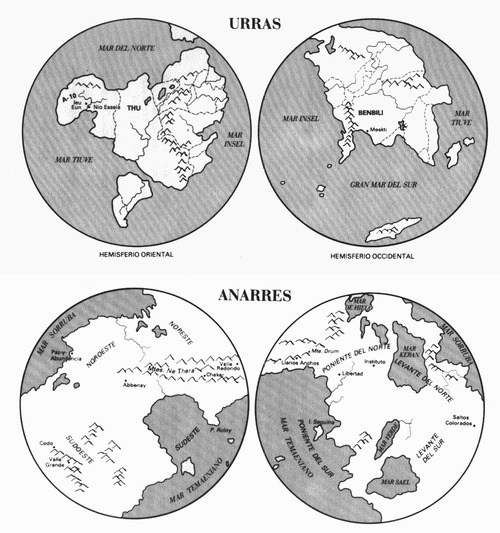
Geographies of the double planet system Urras and Anarres.

Finally, returning to our solar system, the Twilight Zone episode, ‘Midnight Sun’, imagines a scenario in which the Earth's orbit has been disturbed, causing it to move slowly towards the sun. In the end, it transpires that this was only a fever dream experienced by the protagonist Norma, and the Earth is in fact, inexplicably, moving further away from the sun.

SF experimentation with different star systems and planetary configurations adds to the other-worldliness of the stories, even while often offering a critical lens on real world issues. The Trappist-1 discovery begins to shed light on just how distant or close such other worlds may be.

Tuesday, 31 October 2017

Communist Post-Apocalyptic Film

The dogged band of survivors in the aftermath of apocalypse – whether alien attack, environmental disaster, nuclear war, or worldwide pandemic virus – has become a preoccupation of science fiction, especially since World War Two and the dropping of the atomic bomb on Hiroshima and Nagasaki. Developing from H.G. Wells’ visionary The Shape of Things to Come, filmed in 1936 by William Cameron Menzies, the theme has proliferated in the post-War years, becoming a sub-genre in its own right; notable novels and film adaptations range from On the Beach and I Am Legend (filmed as The Omega Man) in the 1950s, through The Day of the Triffids, to the contemporary 28 Days Later and The Road. In the distinctive Eastern European version of the post-apocalyptic film, at its peak between the 1960s to the decline of the Soviet Union in the late 1980s, the last representatives of humanity are typically corrupt, cynical, disillusioned, and dishonest – the nobler qualities having vanished in the struggle for survival. The bleakest examples portray the ragged remnants of mankind, often diseased or mutated, reduced to scavenging among the post-industrial ruins, occasionally emerging from improvised shelters to salvage a few precious relics of civilisation – from libraries, museums, and schools. As they gather in claustrophobic and spartan enclaves waiting for the inevitable end, there is a stark contrast with the initial optimism which followed the October Revolution of 1917. 


In the early years of Soviet rule, the Bolsheviks actively encouraged the population to look forward to the expansion of Communism, spreading a Utopian message both on earth (‘world revolution’) and into the cosmos. The Party enlisted artists to promote their vision in state-sanctioned productions, notably the film Aelita: Queen of Mars (1924), itself preceded by leading Bolshevik Alexander Bogdanov’s 1908 novel Red Star, which effectively transplanted Marxism to Mars. That expansive mood had long since been dissipated; firstly by the dictates of ‘socialist realism’, aggressively promoted under Stalin, which disdained science fiction in favour of heroic portraits of the Soviet workers’ struggle, and later by economic stagnation and social decay, Cold War paranoia and pessimism. The 1966 Czech film The End of August at the Hotel Ozone depicts a group of virtually feral female survivors wandering the desolate countryside, anticipating a bleak, cruel and violent future. 1985’s O-Bi O-Ba (subtitled The End of Civilisation) by Polish writer/director Piotr Szulkin, is set in a particularly grim underground bunker, whose inhabitants endure a hopeless wait for a new Ark. Both represent a widespread disillusionment with the project of international Communism, and express subtle dissent against the central control exerted by Moscow over its satellite nations of the Eastern Bloc.


Above: Poster for Aelita

Right: Poster for Voyage to Mars


Though still closely overseen by the state after the death of Stalin, film-makers, artists and writers were able – often avoiding censorship by using science fiction as a metaphor – to articulate these fears. In 1972, Soviet director Andrei Tarkovsky filmed Solaris, based on Stanislav Lem’s novel, set on a near-deserted, distant space station; a meditation on an aborted mission which paralleled the abandonment of the space programme. With the launch of the Sputnik 1 satellite in 1957 and Yuri Gagarin’s historic orbital flight four years later, there had been a brief rush to glorify the triumphs of the cosmonauts; after the American moon landing of 1969 effectively marked the end of the space race, the focus largely shifted from the conquest of the stars to the struggle for survival on an ailing earth. 


Tarkovsky returned to science fiction themes in 1979’s Stalker, adapted from the novel Roadside Picnic by the brothers Boris and Arkady Strugatsky. Fredric Jameson’s Archaeologies of the Future considers Roadside Picnic in terms of problematic or ‘failed’ Utopias, with professional scavengers, or ‘stalkers’, entering the Zones (sites of alien visitation, now sealed by the authorities) in search of bounty, though they run the risk of encountering inexplicable dangers and death. As it transpired, the filming locations close to the Estonian capital Tallinn proved deadly; an abandoned electrical generating station and the Jägala River, polluted by an upstream chemical works were linked to the early deaths from bronchial cancer of Tarkovsky, his wife Larisa, and actor Anatoly Solonitsyn. The Zone, mysterious centre-piece of book and film, was not only the name later applied to the contaminated area of exclusion around Chernobyl but, as James Norton noted in an article for Vertigo magazine, ‘Stalking the Stalker’, “was also the term by which the Gulag was known, as the Russian audience would have recognised.” 


Location map for Stalker

 The loose trilogy of post-apocalypse nightmares by Tarkovsky’s protégé Konstantin Lopuchansky – Letters from a Dead Man, Visitor to a Museum, and The Ugly Swans (another adaptation of a novel by the Strugatsky brothers) – focus unflinchingly on the decline of the Communist dream. This trio of films, the first two made in the later 1980s, are alike set in landscapes blighted by industrial pollution, radiation fall-out, and toxic waste, resulting in mental illness and physical mutations. These futuristic visions were thinly-veiled echoes of a catastrophic reality; the 2016 documentary City-40, exposing the once-hidden ecological devastation in one of the Soviet Union’s uranium-processing ‘closed cities’, was part of a gradual process revealing the extent of environmental destruction. Just as the locations of Stalker offered a haunting precursor of tragic things to come, the ravaged nuclear fall-out setting of Letters from a Dead Man pre-figured the Chernobyl disaster, which occurred in the same year as the film’s release, 1986. Combined with an escalating arms race between the USA and USSR, which by the 1980s threatened to become a full-blown conflict, world-wide apocalypse no longer seemed a film-maker’s fanciful notion.

Friday, 29 September 2017

African SF

A few months ago I met a researcher, based at SOAS University of London, who works on African SF and ecocriticism. Knowing little about these topics myself, I asked her to recommend some readings to me.

Going through the links and articles she sent me, I’ve been struck by how wide-ranging the field is. Like many forms of SF, some writers are reluctant to be identified with the genre. For example, one of the most prominent AfroSF writers Nnedi Okorafor has described her work as closer to ‘organic fantasy’: ‘What I’ve realized I’m writing is something organic. This type of fantasy grows out of its own soil’. Okorafor suggests several possible reasons for the fantastical elements in her fiction: ‘The first is my complex African experience, which on many levels has been a series of cultural mixes and clashes between being American and being Nigerian. The second being my personal world view. The world is a magical place to me’.

The cover of Okorafor's 2007 novel The Shadow Speaker.

These insights connect to another important theme in AfroSF; that of estrangement as a dimension of black African experience. Citing Greg Tate, the literary theorist Kodwo Eshun writes:

The form itself, the conventions of the narrative in terms of the way it deals with subjectivity, focuses on someone who is at odds with the apparatus of power in society and whose profound experience is one of cultural dislocation, alienation and estrangement. Most science fiction tales dramatically deal with how the individual is going to contend with these alienating, dislocating societies and circumstances and that pretty much sums up the mass experiences of black people in the postslavery twentieth century.
Eshun recasts SF in light of Afrodiasporic history and argues that this powerfully articulates experiences of dislocation, alienation and estrangement, all of which are longstanding tropes within the genre.
Environmental disaster and post-apocalyptic scenarios are also familiar terrain for AfroSF; Okorafor’s ‘Moom!’, Efe Okogu’s ‘Proposition 23’, Nick Wood’s ‘Azania’, Mia Anderne’s ‘Brandy City’ and Martin Stokes’s ‘Claws and Savages’ are exemplary here, and Matthew Omelsky proposes that they constitute a subgenre of ‘postcrisis fiction’ in their own right.

After reading about these stories and writers, I’m really interested to discover more of their work and the ways in which their science fictions apprehend the different possibilities and limitations of the present.

For an introduction to African SF, read Mark Bould's piece for this special issue of Paradoxa journal.

Thanks to Michelle Clarke for drawing my attention to this topic.

Thursday, 31 August 2017

Cyberpunk 1990

Oxford English Dictionary – Cyberpunk: A genre of science fiction set in a lawless subculture of an oppressive society dominated by computer technology


The heyday of Cyberpunk was captured in a 1990 documentary by Marianne Trench and Peter von Brandenburg, providing an insight into its guiding ideas and featuring leading lights such as William Gibson, Jaron Lanier, Brenda Laurel and Timothy Leary. As a movement, it was primarily concerned with developments in technology, particularly artificial intelligence and virtual reality (the ‘consensual hallucination’ of a computer-generated world); “information wants to be free”, a phrase echoed by several participants in the documentary, symbolized their vision. Cyberpunk drew on influences from, and in turn influenced, art, fashion, film (Blade Runner was a major visual precursor), and literature (Gibson’s Neuromancer is its key text, while Jeff Noon’s Vurt and Neal Stephenson’s Snow Crash are both highly regarded); it manifested in computer hacking, ‘industrial’ music, rave culture, and video game graphics, all considered in the film. Whilst most commentators see a trend toward liberation, others strike a cautionary note; that the Utopian technology which can empower, may also enslave. Very much a product of its time, the documentary’s imagery and production values illustrate how quickly the cutting-edge can become obsolete. It remains a valuable document of what the future looked like in 1990, at the dawn of the ‘computer age’, though its main protagonists have enjoyed contrasting fortunes over the subsequent 27 years... 


William Gibson – the American novelist is regarded as the Godfather of Cyberpunk, many of its central themes originating in his 1984 novel Neuromancer, the biggest single influence on the sub-genre. Gibson famously created his vision of the future on a manual type-writer, didn’t have an e-mail address until 1996, and has stated that he has “never really been very interested in computers themselves. I don't watch them; I watch how people behave around them.” By the 1990s, as advances in technology brought some of his concepts toward reality, he was in demand as a spokesman, reflected in his extensive contribution to the documentary. Neuromancer (the first book of his ‘Sprawl’ trilogy) portrayed a post-industrial, high-tech society dominated by multi-national corporations – zaibatsus – where national boundaries have been dissolved, and individuals define their identity through consumer products. He coined the term ‘cyberspace’ in his 1982 short story ‘Burning Chrome’, to denote the virtual territory contained within computer networks, before the worldwide phenomenon of the Internet. Another of his early short stories, ‘Johnny Mnemonic’, was filmed in 1995, with a pre-Matrix Keanu Reeves in the title role, as a cyber-courier who carries information in his brain – the acting, simplified plot and already-dated setting brought widespread derision (a fate shared by the same year’s risible techno-movie Hackers), although most critics recognised its distance from Gibson’s original conception.


William Gibson. Photo: Christopher J. Morris/Corbis via Getty Images
The 2000 documentary by film-maker Mark Neale, No Maps for these Territories, provides an introduction to Gibson’s biography and preoccupations, as he makes observations on the ‘mediated world’ we live in, during a road-trip across America. The author remains closely associated with Cyberpunk; though his later work has taken him in different directions, he continues to examine consumerism, corporate influence and globalisation, the evolution of the Internet and social media, believing that “the digital has become the constant; it’s becoming where we all are, all the time.”


Timothy Leary in his 1960s pomp
Timothy Leary – best known for his notorious role in the sixties counter-culture, associated with the use of mind-expanding drugs (which he not only advocated, but experimented with enthusiastically), and coining the phrase ‘tune in, turn on, drop out’. A clinical psychologist, researcher and Harvard academic until his drug-related dismissal in 1963, Leary became a major media figure, later described by then-President Richard Nixon as “the most dangerous man in America”. After multiple periods of imprisonment, and a relatively low public profile during the 1970s, Leary embraced the coming ‘cybernetic’ era – the concept of technological revolution embodied by Cyberpunk in the mid-to-late 1980s – adapting his former phrase to ‘turn on, boot up, jack in’ and declaring “the PC is the new LSD”. He saw the potential of home computing, virtual reality and the web as forces for personal liberation, able to free individuals from state control, and to subvert governmental and other power structures. His involvement with new technology extended to creating video games (including a project to produce a version of Neuromancer), endorsing the Mattel Power Glove – a gaming device “unique for its time, allowing players to use motion to control their games” – and acting as ‘technical consultant’ on Billy Idol’s somewhat opportunistic 1993 album Cyberpunk. Leary died in 1996.

Timothy Leary at the time of Cyberpunk

Jaron Lanier, then (above) & now (below)
Jaron Lanier – although only featuring briefly in the documentary, Lanier has since established himself as a leading figure in emerging technology, addressing its philosophical implications and the shortcomings of the Internet. His credentials are both practical and theoretical, as a computer science pioneer, early adopter of virtual reality and software developer. He has been involved in the field since the early 1980s, first working for Atari and then forming his own company, VPL Research, concentrating on visual programming language and virtual reality applications. Lanier has retained his status as a credible commentator and an independent authority, becoming a successful author and public speaker, outlining potential future developments and their impact on wider society in books such as You Are Not a Gadget (2010) and Who Owns the Future? (2013).


Michael Synergy – an enigmatic figure, clearly enjoying the attention bestowed on him by the documentary makers as a man with “the power to bring down governments”, Synergy has, for whatever reason, not enjoyed such publicity since its release. In fact, he has all but vanished – even from the cyberspaces of the Internet – personal details are scant, and information on his subsequent career hard to come by. 

Michael Synergy – current whereabouts unknown

Saturday, 29 July 2017

Esperanto and SF: A Potted History

Esperanto was invented as an international secondary language by Ludwig Zamenhof, who published his first book on Esperanto in 1887. He believed that a common mode of communication between people would eliminate the problems and misunderstandings of translation and ultimately lead to a more harmonious world system.

Zamenhof was not the first to come up with the idea of an international language. Like many others, he was motivated by the utopian impulse to create a better world, a universal vision that could, through language, overcome the divisions created by humankind. Esperanto is, however, perhaps one of the most famous – or infamous – of such languages, partly because of its widespread uptake and partly because it has been the subject of various parodies and criticisms. For example, it is believed that Esperanto provided the inspiration for Newspeak in George Orwell’s dystopian novel Nineteen Eighty-Four, in which the introduction of a simplified universal language operates as a form of social control to restrict thought.

This leads me on to the topic of this month’s post: Esperanto and SF. While Orwell was sceptical about the implications of a language like Esperanto, many other SF writers have been fascinated by the positive reconfiguration of the world it might bring about, or the kinds of societies that might be amenable to a shared secondary language.

Philip José Farmer's Riverworld novels are perhaps among the most famous works to make use of Esperanto – in the second volume it is the language of the peaceful religion of the Church of the Second Chance. Likewise, the stories of lesser known writers such as Mack Reynolds explore issues of universal basic income and universal religion and language. In his 1974 novel Looking Backward From the Year 2000, a re-writing of Edward Bellamy’s 1888 work, the protagonist finds himself in a future where the revolution in communications and transportation has led to the large-scale adoption of Esperanto as an interlingua.

Morojo with Ackerman in costume in 1939
SF fanzines also have their notable Esperantists. Myrtle Douglas, known by her Esperanto name ‘Morojo’, was a fanzine editor from Los Angeles, who was active between the years 1939 and 1958. From 1939 until 1947, Morojo co-edited the fanzine Voice of the Imagi-Nation with the SF writer, Forrest J Ackerman, who she met at an Esperanto gathering. With Ackerman, she also attended the first World Science Fiction Convention (1939), for which they wore matching futuristic costumes (see image). From 1941 until 1958, Morojo published the zine Guteto, which promoted Esperanto among science fiction fans. After her death, Ackerman wrote of her, ‘she was an expert Esperantist’ and ‘a real science fiction fan’.

These examples reflect the overlap between the imaginary communities explored in the works of SF writers and the radical aspirations for Esperanto as a means of achieving societal transformation. Such experiments in invented language have been sporadic and, at best, only partially successful. However, like language, SF works to both represent and translate cultures, echoing the hopes and fears of the societies from which it is produced.

More information about the inclusion of Esperanto in literary works can be found in the online book The Esperanto Book by Don Harlow.

Friday, 30 June 2017

Trevor Hoyle – An Introduction

Trevor Hoyle is a versatile English author, having published over 20 books ranging across genres, from mainstream novels, memoir, spy and suspense thrillers to acclaimed science fiction and drama, encompassing ecological disaster and football hooliganism along the way. Based outside the metropolitan cultural centres in unfashionable Rochdale, where he was born, grew up, and still follows the local football team as a season ticket holder at Spotland, he has (according to the SF Encyclopaedia) “most unusually, been able to apply an erudite surrealism to works directed towards a mass market.”

Trevor Hoyle (photo by Glyn Hughes)
Hoyle’s early training as an actor is reflected in his success as a dramatist and script-writer for television and radio, including the plays GIGO [Garbage In Garbage Out], inspired by his interest in quantum mechanics, which won a Radio Times Drama Award, and Randle’s Scandals: The Life and Liver of Frank Randle, about the subversive Lancashire comedian. He attributes the development of a distinctive method and literary style to the experience he gained working as an advertising copywriter in Manchester, which he describes as “the best training on the job a fiction writer can get.” Hoyle self-published his first book, The Relatively Constant Copywriter, in 1972, after it was rejected by 18 publishers; several of their responses are reproduced inside the book, concluding that whilst “interesting” and “well written”, “it is an uncommercial novel.”
 

After becoming a full-time author, Hoyle had a stint writing and presenting Granada TV’s weekly arts show What’s On, before the publication of Rule of Night in 1975, an unflinching look at social deprivation and urban violence from the perspective of a memorable anti-hero in teenage football hooligan Kenny Seddon. Rule of Night was a significant breakthrough for Hoyle, garnering critical praise both at the time and on its 2003 re-issue, with many reviewers noting echoes of A Clockwork Orange in this “powerfully authentic account of working-class life and gang violence.” His subsequent Q series of novels, incorporating parallel world theories and alternate realities, cemented his reputation as an innovative science fiction writer and led to his involvement in the BBC’s prime-time series Blake’s 7, writing scripts and producing novelizations of various episodes.


Hoyle has established himself as a highly productive author, producing successful ‘commercial’ work alongside more experimental fiction, notably 1979’s The Man Who Travelled On Motorways, “a multi-layered exploration of fantasy and reality, recollection and illusion, sex and terror and the dynamic nature of the collective unconscious”, and 1984’s Vail, described by the author as “a dystopian vision of Britain as a police state.” The ability to combine elements of different genres is amply evidenced by his epic novel of global complicity in climate change, The Last Gasp: first published in 1983 and revised in 1990, it was re-issued in 2016, having been extensively re-written to bring its themes up to date. With a strong cast of characters, a plot spanning decades and continents which interweaves corporate greed and ecological disaster with military and political interference in the environment, its cinematic qualities have been recognised by Hollywood studios taking a movie option on the book. Hoyle explains that “dystopian futures are much more interesting and filled with dramatic potential than utopian ones, which to a novelist is a definite attraction”. In many ways, The Last Gasp is not so much speculative science fiction as sober prediction, based on evidence and identifiable trends in world climate; as Andy Hedgecock put it, “Hoyle seems less like a prophet and more like a chronicler of imminent chaos.”


A two-part interview with Trevor Hoyle followed in 2018.

Sunday, 30 April 2017

A Clockwork Orange in popular music and culture

Music forms a key component of A Clockwork Orange, both as novel and film. Anthony Burgess was a classical music enthusiast (and a prolific composer), who disdained youth culture and the popular music of the later sixties, as being “based on so little knowledge of tradition” that “it often elevates ignorance into a virtue.” When not terrorising citizens, the central character Alex praises “lovely Mozart, the Jupiter” and proudly boasts “J. S. Bach I had, the Brandenburg Concerto just for middle and lower strings”; he and his fellow teenage hoodlums cause mayhem to the strains of Beethoven. This is contrasted with an intense dislike of pop music, which Burgess regarded as an ephemeral, juvenile art form; he conveys his low regard for the genre via the artists invented for the book – Stash Kroh, The Mixers, Johnny Zhivago, Ike Yard – and “their pathetic pop-discs”.

Despite the author’s vehemently expressed contempt, popular culture enthusiastically embraced the imagery and themes of A Clockwork Orange – especially once Stanley Kubrick turned it into a notorious film in 1972. The distinctive language of the book, which had earlier captivated Rolling Stones manager Andrew Loog Oldham, found favour with David Bowie at the height of his popularity. He used the term ‘droogie’ in ‘Suffragette City’, a song from his 1972 Ziggy Stardust album, while opening concerts with Beethoven’s Ninth Symphony, as used in the film’s soundtrack. Bowie was also among the first to appropriate the look of Kubrick’s version, which inspired his stage costumes of the era. Later in the 1970s, the Korova record label took its name from the novel’s ‘milk-plus mesto’ bar; names taken directly from A Clockwork Orange include those of Sheffield-based bands Heaven 17 (the film has The Heaven Seventeen at number 4 in the charts with ‘Inside’) and, later, Moloko – one of the words Burgess transliterated from Russian, where it means milk. He also referenced the Soviet state record label, Melodia, through Alex, as a record shop: “the disc-bootick I favoured... a real horrorshow mesto and skorry, most times, at getting the new recordings.”


The official soundtrack gave another twist to Burgess’s vision – Kubrick gave it the same prominence and single-minded attention to detail as he had the film’s overall design. He was contacted by electronic music pioneer Walter (later Wendy) Carlos, who he then commissioned to interpret the score on Moog synthesiser. For the main theme, ‘March from A Clockwork Orange’, Carlos and collaborator/producer Rachel Elkind used the choral movement of Beethoven’s Ninth Symphony, with the vocal part featuring the first known recording of a vocoder. This appeared alongside other electronic re-workings of Beethoven, Elgar and Rossini, which built on the success of Carlos’s earlier ground-breaking experiment in applying modern technology to classical standards, 1968’s celebrated album Switched-on Bach. The original songs on the soundtrack included ‘Timesteps,’ described by Carlos as an “autonomous composition with an uncanny affinity for Clockwork” and which is “still considered one of the landmarks of electronic music.” Not entirely satisfied with the official album which accompanied the film, as it excluded much of what they had recorded, Carlos and Elkind shortly released their own score for A Clockwork Orange, which “brought together all the music that Wendy suggested, arranged and / or composed for this remarkable film.”

Wendy Carlos in her New York studio


Alex and his marauding droogs have since been portrayed as dangerous and even glamorous anti-heroes; a lengthy list of the most unlikely artists have adopted the film’s visual references for their performances and videos, from U2 to Kylie Minogue, Blur to Guns ‘n’ Roses. No doubt Burgess, who protested that “youth is so conformist, so little concerned with maverick values, so proud of being rather than making, so bloody sure that it and it alone knows”, would be exasperated by the reduction of his novel’s complex themes to a crude shorthand for non-conformity. The ongoing appropriation of A Clockwork Orange – both book and film continue to generate homage and parody in pop culture – demonstrates that there is still no better way to sell products than with a whiff of youthful rebellion, however inauthentic.


The Simpsons, among other representations of A Clockwork Orange